The Pain of Paying in Behavioral Economics: Payment Emotions, Consumer Choice, and Responsible Marketing
- 11 hours ago
- 23 min read
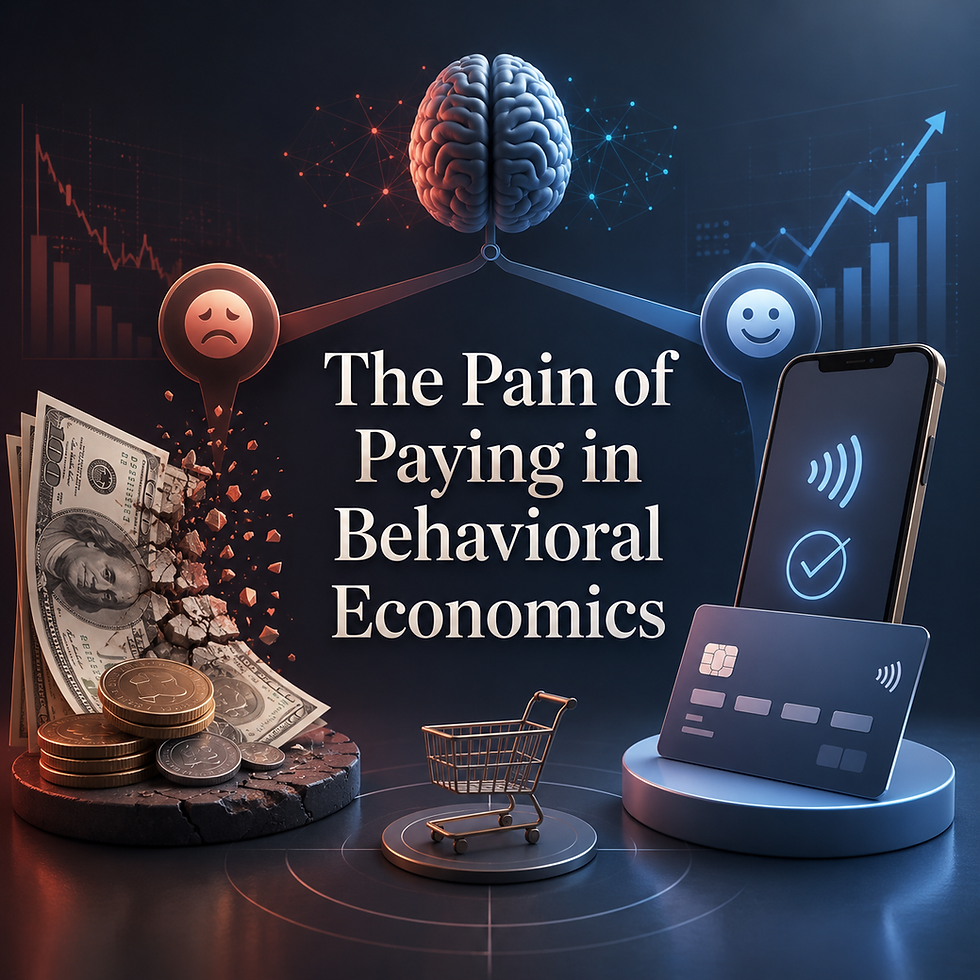
The “pain of paying” is an important concept in behavioral economics and consumer psychology. It explains why payment is not only a rational exchange of money for goods or services, but also an emotional experience. Consumers often feel a psychological cost when they pay, especially when the payment is visible, immediate, and easy to understand. Cash payments may feel more painful because the consumer physically gives away money. Digital payments, credit cards, mobile wallets, subscriptions, and one-click purchases can feel less painful because the payment becomes more abstract. This difference can influence buying behavior, spending control, impulse purchases, and customer satisfaction.
For marketing students, the pain of paying is a valuable concept because it connects pricing, payment design, consumer emotions, ethics, and long-term trust. Reducing payment friction can increase sales and improve customer convenience, but it can also create risks when customers spend more than they planned or buy things they do not need. Responsible marketing should therefore balance commercial goals with consumer well-being. This article discusses the pain of paying through behavioral economics, psychological accounting, payment transparency, and modern digital commerce. It also connects the topic with broader social theories, including Bourdieu’s view of habitus and capital, world-systems theory, and institutional isomorphism. These theories help explain why payment behavior is not only individual, but also shaped by culture, social class, technology, institutions, and global market systems.
Using a conceptual qualitative method based on academic literature, the article analyzes how payment methods affect consumer behavior and how marketers can apply this knowledge responsibly. The findings show that payment pain is strongest when payment is concrete, immediate, and visible, and weaker when payment is delayed, hidden, fragmented, or automatic. The article concludes that ethical marketing education should teach students to understand payment psychology without using it to exploit customers. The goal should be to reduce unnecessary barriers while protecting consumer autonomy, financial health, and informed decision-making.
Keywords: pain of paying, behavioral economics, consumer psychology, digital payments, responsible marketing, Bourdieu, world-systems theory, institutional isomorphism
1. Introduction
Marketing is often described as the study of markets, customers, value, communication, and exchange. In simple terms, marketing helps organizations understand what people need, how they make choices, and how products or services can be offered in a meaningful way. However, consumer choice is not always fully rational. People do not always compare all prices, calculate all benefits, and choose only the option that gives the highest economic value. Instead, consumers are influenced by habits, emotions, social pressure, cultural meaning, convenience, trust, and the way a purchase is presented.
One important idea that shows this clearly is the “pain of paying.” This concept refers to the negative feeling or psychological discomfort that people may experience when they spend money. Paying is not only a financial act. It can also be an emotional moment. A person may want a product, but at the same time feel hesitation when giving up money. This hesitation is part of the payment experience. It may appear as guilt, regret, anxiety, loss, uncertainty, or simple discomfort.
The pain of paying is closely linked to behavioral economics. Behavioral economics studies how real people make decisions, not how perfectly rational people are expected to make decisions in traditional economic models. It combines economics with psychology. It accepts that consumers often use shortcuts, emotions, habits, and social signals when making choices. In this view, the act of payment matters because the form of payment can change how the consumer feels about the purchase.
For example, paying with cash may feel more painful than paying with a card. When a consumer pays with cash, they see the notes leaving their hand. The loss is physical and immediate. The consumer can directly feel that their available money has decreased. By contrast, paying with a card, phone, or online wallet may feel easier. The consumer taps a device, enters a code, or clicks a button. The money is still spent, but the payment feels less visible. The loss is more abstract. Because of this, people may spend more easily when the payment method reduces the emotional weight of payment.
This issue has become more important in modern commerce. Many purchases now happen online or through mobile applications. Customers can buy products with one click, subscribe to services automatically, pay later, divide payments into smaller parts, or use digital wallets without seeing physical money. These systems offer real benefits. They save time, support convenience, reduce transaction barriers, and help businesses serve customers more efficiently. However, they also raise important ethical questions. If payment becomes too easy, customers may lose awareness of how much they are spending. They may make purchases quickly, impulsively, or without careful reflection.
Marketing students should understand this concept carefully. From a business perspective, reducing friction in the purchase process can increase sales. A smooth payment process can improve customer experience and reduce abandoned shopping carts. It can help organizations compete in digital markets. But responsible marketing cannot be limited to short-term sales. It must also consider consumer welfare, trust, fairness, and long-term relationships. A marketer who understands behavioral economics should not use psychological knowledge only to push customers into unnecessary spending. Instead, the marketer should design purchase systems that are clear, fair, and respectful.
This article examines the pain of paying as a behavioral economics concept and as a practical issue in marketing. It explains why payment methods influence emotions, why cash often feels more painful than digital payment, and why reduced payment friction can increase consumption. It also discusses the ethical responsibilities of marketers. The article is written in simple, human-readable English but follows the structure of an academic journal article. It includes a theoretical framework, method, analysis, findings, conclusion, and references.
The article also uses broader social theories where appropriate. Bourdieu’s concepts of habitus, economic capital, cultural capital, and symbolic capital help explain why payment behavior is shaped by social background and lifestyle. World-systems theory helps place digital payment systems within global economic structures, showing how payment technologies spread through unequal global markets. Institutional isomorphism helps explain why many companies adopt similar payment designs, subscription models, and digital checkout systems because they copy successful competitors, follow professional norms, or respond to market pressure.
The central argument of this article is that the pain of paying is not a small detail in consumer behavior. It is a meaningful part of how people experience markets. Payment methods do not only transfer money; they shape attention, emotion, memory, and responsibility. For this reason, marketing education should treat payment design as both a commercial tool and an ethical responsibility.
2. Background and Theoretical Framework
2.1 Behavioral Economics and Consumer Decision-Making
Traditional economic theory often assumes that consumers are rational decision-makers. In this model, people are expected to compare prices and benefits logically, then select the option that gives them the greatest utility. This view is useful in many ways, but it does not fully describe real consumer behavior. In daily life, people make many decisions quickly and under limited information. They may be tired, distracted, emotionally influenced, or affected by social expectations.
Behavioral economics developed partly as a response to this gap. Scholars such as Daniel Kahneman, Amos Tversky, Richard Thaler, and others showed that human decision-making is shaped by biases, mental shortcuts, emotions, and context. Consumers may fear losses more than they value gains. They may separate money into mental accounts. They may be influenced by framing, default options, social proof, and present bias. This means that the same price can feel different depending on how it is presented, when it is paid, and what payment method is used.
The pain of paying fits well within behavioral economics because it shows that price is not only a number. A price can be experienced emotionally. A customer may think a product is worth the money but still feel discomfort at the moment of payment. Another customer may spend more easily if the payment process hides or softens this discomfort. Therefore, payment is not a neutral technical step. It can influence the whole purchase decision.
2.2 The Meaning of the Pain of Paying
The pain of paying refers to the psychological discomfort connected with spending money. It is a form of emotional cost. When consumers buy something, they receive a benefit, but they also experience a loss because they give up money. The feeling of this loss depends on how visible, immediate, and concrete the payment is.
Cash payment often creates a strong pain of paying because the consumer directly sees the money leaving their possession. The payment is separate, visible, and easy to understand. If a person gives a shopkeeper a banknote, they can see exactly what has been lost. This visible loss may cause the consumer to think more carefully before buying.
Digital payment can reduce the pain of paying because it separates the purchase from the feeling of money loss. When a person pays by card or mobile wallet, the action is fast and symbolic. The customer may not feel the same direct loss. The amount may appear later in a bank statement or app notification, but the emotional moment has already passed. The purchase can therefore feel easier.
Credit cards and “buy now, pay later” systems may reduce payment pain even more because payment is delayed. The consumer receives the product now but pays later. This weakens the connection between consumption and cost. Subscriptions can also reduce payment pain because payments become automatic and routine. The customer may stop noticing each payment, especially if the amount is small or repeated monthly.
This does not mean that digital payment is bad. Digital payment can be useful, safe, efficient, and inclusive. It can help people access services, reduce the need to carry cash, and support online commerce. The ethical issue is not the existence of digital payment. The issue is whether payment design supports informed choice or encourages careless spending.
2.3 Mental Accounting
Mental accounting is a concept strongly connected to the pain of paying. It explains how people mentally organize money into different categories. For example, a person may treat salary money, gift money, savings, and credit differently, even though all money has the same economic value. A consumer may be careful with money from a monthly budget but more willing to spend a gift card or bonus.
Payment methods influence mental accounting. Cash may feel like “real money” because it is physically present. A credit card may feel like future money. A gift card may feel like free money, even though it has value. Loyalty points may feel even less painful because they are not experienced as direct cash. This can affect spending decisions.
For marketers, mental accounting is important because customers do not only ask, “Can I afford this?” They may also ask, consciously or unconsciously, “Which mental account does this payment come from?” A holiday purchase, educational course, luxury item, business tool, or family gift may all be evaluated differently. The same amount of money can feel acceptable in one category and too expensive in another.
Responsible marketing should not manipulate mental accounting in harmful ways. For example, presenting debt as easy or harmless can encourage poor financial decisions. But mental accounting can also be used positively. A platform may help customers track spending, separate budgets, or understand the long-term value of a purchase. The ethical difference depends on whether the design supports or weakens consumer control.
2.4 Payment Transparency and Friction
Payment transparency means how clearly the consumer sees and understands the cost of a purchase. A transparent payment system shows the price clearly, explains additional fees, and makes the payment moment visible. Low transparency can hide costs, delay awareness, or make payments feel smaller than they are.
Payment friction refers to the effort required to complete a purchase. High friction means the consumer must take more steps, think more, or face more reminders of cost. Low friction means the consumer can buy quickly and easily. Marketers often try to reduce friction because complicated payment processes can make customers abandon purchases. This is especially important in online commerce.
However, friction is not always negative. Some friction can protect consumers by creating time for reflection. For example, a clear confirmation page, a visible total price, or a reminder before a recurring subscription renews can help customers make better decisions. A purchase process that is too fast may increase impulsive buying.
The key question is not whether friction should be high or low. The key question is what kind of friction is useful. Bad friction creates confusion, stress, and unnecessary difficulty. Good friction supports attention, understanding, and responsible choice. Ethical marketing should remove bad friction but keep or create good friction when needed.
2.5 Bourdieu: Habitus, Capital, and Payment Behavior
Pierre Bourdieu’s social theory can help explain why payment behavior differs across social groups. Bourdieu argued that people develop a habitus, which means a set of deeply learned habits, tastes, expectations, and ways of acting. Habitus is shaped by family, education, class position, culture, and social experience. People often believe they are making individual choices, but those choices are influenced by social background.
In payment behavior, habitus may shape how people feel about cash, credit, debt, luxury, savings, and financial risk. Some consumers may grow up with strong warnings against debt and may feel high payment pain when using credit. Others may see credit as normal and practical. Some may view cash as a symbol of control, while others may view digital payment as modern and efficient.
Bourdieu’s idea of capital is also useful. Economic capital refers to money and financial resources. Cultural capital refers to knowledge, education, and skills. Social capital refers to networks and relationships. Symbolic capital refers to status and recognition. Payment behavior is connected to all of these. A consumer with high economic capital may feel less payment pain for ordinary purchases, but may still feel symbolic pressure to buy certain brands. A consumer with high cultural capital may understand financial products better and avoid harmful credit. A consumer seeking symbolic capital may spend more on goods that communicate status.
This means that the pain of paying is not the same for everyone. It is influenced by income, education, family history, social meaning, and cultural expectations. Marketing students should therefore avoid assuming that all customers experience payment in the same way. A fair marketing approach must recognize different consumer positions and vulnerabilities.
2.6 World-Systems Theory and Global Payment Markets
World-systems theory, associated with Immanuel Wallerstein, studies how the global economy is structured between core, semi-peripheral, and peripheral regions. Core regions often control advanced industries, finance, technology, and global standards. Peripheral regions often supply labor, raw materials, or dependent markets. Semi-peripheral regions stand between these positions.
This theory can help explain the global spread of digital payment systems. Many payment technologies, financial platforms, and e-commerce models are developed by powerful firms in advanced economies. These systems then spread into global markets. Consumers in different regions may adopt the same payment habits, subscription models, mobile wallets, and digital credit systems, but their economic situations may be very different.
For example, a payment system designed for wealthy markets may be introduced into countries where consumer protection is weaker or financial literacy is uneven. Easy digital credit may appear convenient, but it can increase debt risk for vulnerable consumers. At the same time, digital payment can support financial inclusion by helping people participate in online commerce and access services. The effect depends on regulation, education, income stability, and institutional trust.
World-systems theory reminds marketing students that payment design is not only a technical issue. It is part of global capitalism. Payment systems connect consumers to banks, platforms, data systems, advertisers, and international firms. This creates opportunities but also responsibilities. Ethical marketing should consider how global payment systems affect different societies, not only how they increase conversion rates.
2.7 Institutional Isomorphism and Similar Payment Designs
Institutional isomorphism is a concept from organizational theory, especially associated with Paul DiMaggio and Walter Powell. It explains why organizations in the same field often become similar over time. They may copy each other because of competition, professional standards, regulation, or uncertainty. There are usually three forms: coercive, mimetic, and normative isomorphism.
Coercive isomorphism happens when organizations change because of laws, regulations, or powerful stakeholders. In payment design, this may include compliance with banking rules, data protection laws, or consumer protection requirements. Mimetic isomorphism happens when organizations copy successful competitors, especially under uncertainty. If one large platform increases sales through one-click buying or subscription models, many others may follow. Normative isomorphism happens when professional groups, consultants, business schools, and industry experts promote similar best practices.
This theory helps explain why many digital checkout systems look similar. Customers often see saved cards, automatic renewal, free trials, limited-time offers, installment options, and simplified payment flows across many platforms. These practices spread because companies learn from each other and because professional marketing knowledge circulates globally.
Institutional isomorphism is not always negative. It can spread good practices, such as secure payment, clear refund rules, and transparent checkout design. But it can also spread questionable practices if the market rewards short-term conversion more than consumer welfare. Marketing education must therefore teach students not only to follow industry trends, but also to evaluate them critically.
3. Method
This article uses a conceptual qualitative method based on academic literature in behavioral economics, consumer psychology, marketing ethics, sociology, and organizational theory. It does not present a new survey or experiment. Instead, it reviews and connects existing ideas to build a clear explanation of the pain of paying and its importance for marketing students.
The method follows four main steps.
First, the article identifies the key concept: the pain of paying. This concept is examined through behavioral economics and consumer psychology. Special attention is given to how different payment methods influence consumer emotions and spending behavior.
Second, the article connects the concept with related theories, including mental accounting, loss aversion, payment transparency, and purchase friction. These ideas help explain why payment is not only a rational calculation.
Third, the article applies broader social theories. Bourdieu’s theory is used to understand how payment behavior is shaped by class, habitus, capital, and cultural meaning. World-systems theory is used to place payment technologies within global economic structures. Institutional isomorphism is used to explain why firms adopt similar payment practices and checkout designs.
Fourth, the article develops practical and ethical implications for marketing education. The aim is not only to explain how payment pain can be reduced, but also to discuss when and how it should be reduced responsibly.
The article is interpretive rather than statistical. This means that it seeks to understand meaning, relationships, and implications. This method is suitable because the pain of paying is both psychological and social. It includes emotions, payment technologies, cultural habits, institutional practices, and ethical choices.
The main limitation of this method is that it does not measure consumer behavior directly. It does not provide new numerical data. However, it provides a structured academic discussion that can support teaching, future research, and responsible marketing practice.
4. Analysis
4.1 Payment as an Emotional Moment
The act of payment is often treated as the final step in a transaction. A customer chooses a product, checks the price, and pays. From a technical view, payment completes the exchange. But from a behavioral view, payment is much more than a technical step. It is a moment of emotional evaluation.
At the moment of payment, the consumer becomes aware of loss. They must give up money. This can create discomfort because money represents many possible future uses. Spending money on one item means not spending it on something else. Even when the purchase is useful, the consumer may still feel the sacrifice.
This is why the same price can feel different in different contexts. Paying $50 in cash for a small product may feel expensive because the money visibly leaves the consumer’s hand. Paying the same $50 by card may feel less painful because the action is quick and abstract. Paying through a monthly subscription may feel even smaller because the amount is divided and repeated automatically.
Payment pain is therefore connected to attention. When the consumer pays attention to the money leaving them, the pain is stronger. When attention is moved away from the payment, the pain is weaker. Modern payment systems often reduce attention by making payment fast, invisible, delayed, or automatic.
4.2 Cash, Cards, and Digital Payments
Cash is concrete. It has a physical form. The consumer can count it, hold it, and see it disappear. This makes cash powerful as a budgeting tool. People who use cash may be more aware of spending limits because the money supply is visible. When the wallet becomes empty, the limit is clear.
Cards are different. A card does not visibly decrease after payment. The same card remains in the consumer’s hand. The consumer may receive a receipt, notification, or monthly statement, but the payment itself feels less physical. This can reduce the emotional signal of spending.
Digital wallets and mobile payments can make payment even more abstract. The customer may simply tap a phone or approve a transaction with a fingerprint. The action feels smooth and modern. The emotional distance between buying and paying becomes greater. This can increase convenience, but it can also weaken spending awareness.
Online shopping adds another layer. Consumers may browse products, save payment details, receive recommendations, and complete purchases without entering card information again. The payment process may become almost invisible. In such cases, the consumer may focus more on the product benefit and less on the financial cost.
This does not mean consumers become irrational in a simple way. Many consumers still know they are spending money. But the emotional strength of the payment is reduced. The lower emotional cost can increase purchase likelihood, especially for small, repeated, or impulse purchases.
4.3 Credit, Delayed Payment, and “Buy Now, Pay Later”
Credit changes the timing of payment. The consumer receives the benefit now but pays later. This weakens the connection between consumption and cost. Because the painful part is delayed, the purchase can feel easier at the moment of decision.
Credit can be useful and legitimate. It allows consumers to manage cash flow, handle emergencies, invest in education, or buy important goods. However, it can also increase risk when consumers underestimate future payment pressure. The pleasure of consumption happens immediately, while the pain of payment arrives later.
“Buy now, pay later” systems increase this issue. They often divide the total price into smaller payments. A product that costs $400 may be presented as four payments of $100. This can make the purchase feel more affordable, even though the total cost remains the same. When used responsibly, installment payment can help customers manage budgets. When used carelessly, it can encourage overconsumption.
Marketing students should understand the difference between affordability and perceived affordability. Affordability means the customer can reasonably pay without financial harm. Perceived affordability means the payment feels manageable because of how it is framed. Ethical marketing should not confuse the two.
4.4 Subscriptions and Automatic Payments
Subscription models are common in digital services, education platforms, media, software, fitness, and many other industries. They can benefit customers by providing continuous access, predictable pricing, and convenience. They can also benefit companies by creating stable revenue.
However, subscriptions reduce the pain of paying because payments become automatic. The customer does not make a new active decision each month. Once the subscription is set, the payment continues unless the customer cancels. This can be useful when the service is valuable. But it can be problematic when customers forget, lose interest, or find cancellation difficult.
A responsible subscription model should make terms clear, send useful reminders, and allow easy cancellation. These practices may reduce short-term revenue from forgotten subscriptions, but they build trust. Long-term customer relationships depend on fairness, not only on automatic billing.
The pain of paying can be reduced in subscriptions, but consumer awareness should not be removed. Ethical design should allow the customer to remain informed and in control.
4.5 Pricing Presentation and Framing
The way a price is presented can change how painful it feels. A large annual price may feel more painful than a smaller monthly price, even if the annual cost is similar. A price shown before taxes and fees may feel lower at first, but customers may feel frustration later when the total increases. A discount can reduce payment pain because the customer feels they are avoiding a loss or gaining value.
Marketers use framing to help customers understand value. This is not automatically unethical. For example, showing the monthly cost of a long-term educational program can help students plan their budgets. Showing cost per day can help customers compare value. However, framing becomes problematic when it hides the real total cost or makes customers underestimate their commitment.
A fair pricing presentation should be clear, complete, and easy to understand. Customers should know what they are paying, when they are paying, and what they receive in return. Reducing payment pain should not mean reducing price awareness.
4.6 The Role of Trust
Trust changes the pain of paying. When consumers trust a brand, institution, or seller, they may feel less anxiety during payment. They believe the product will deliver value and that the organization will behave fairly. Trust reduces uncertainty.
This is especially important in online commerce, where customers may not meet the seller face to face. A clear payment page, secure process, transparent refund policy, and professional communication can reduce fear. In this case, reducing payment pain is positive because it removes unnecessary anxiety.
However, trust can also be misused. If a trusted organization uses hidden fees, difficult cancellation, or manipulative urgency, the damage can be serious. Customers may feel betrayed. Responsible marketing should treat trust as a relationship, not as a resource to exploit.
4.7 Social Class, Habitus, and Payment Sensitivity
Bourdieu’s theory helps explain why consumers do not all feel the same level of payment pain. People with different life histories develop different attitudes toward money. A person raised in financial insecurity may feel strong pain even for necessary purchases. A person raised with financial stability may feel less anxiety when spending. A person with business education may see certain payments as investments, while another may see them as risky expenses.
Habitus also shapes what people consider normal. In some families or communities, cash budgeting may be common. In others, credit card use may be normal. In some professional groups, paying for premium services may be seen as a sign of efficiency or status. In others, it may be seen as wasteful.
Symbolic capital also matters. Some purchases are connected to status, identity, and recognition. A consumer may accept payment pain if the product increases social image. Luxury brands, professional education, technology products, and lifestyle services often carry symbolic meaning. The customer is not only buying function; they are also buying identity.
Marketing students should therefore understand that payment pain is socially shaped. A simple “low price” strategy does not affect all customers in the same way. Different groups interpret value differently. Ethical marketing requires sensitivity to these differences.
4.8 Global Digital Payment Systems
Digital payment is part of a larger global transformation. Payment platforms, financial technology, mobile wallets, and e-commerce systems are spreading across countries. This creates new possibilities for trade, education, entrepreneurship, and access. Small businesses can reach international customers. Students can pay for online learning. Families can transfer money quickly. These are positive developments.
At the same time, world-systems theory reminds us that global markets are unequal. Payment technologies are often designed by powerful firms and financial institutions. Their models may spread into countries with different income levels, legal systems, and consumer protections. A payment design that seems convenient in one context may create risk in another.
For example, easy credit may support consumption in wealthy societies but create debt pressure in lower-income communities. Subscription systems may work well where consumers have stable income and strong cancellation rights, but they may be harmful where consumer protection is weaker. Digital payment can include people in the market, but it can also expose them to new forms of financial pressure.
Marketing education should therefore include global awareness. Students should ask: Who benefits from this payment design? Who carries the risk? Does the customer understand the commitment? Are vulnerable groups protected? These questions are essential in responsible global marketing.
4.9 Institutional Pressure and Copying in Marketing Practice
Many companies adopt similar payment designs because they operate in similar markets and learn from each other. If a competitor increases sales by reducing checkout steps, others may follow. If subscriptions become popular, firms in many industries may introduce subscription options. If installment payments increase conversion, many platforms may add them.
Institutional isomorphism explains this similarity. Organizations often copy practices that appear successful. Professional consultants, business schools, software providers, and payment companies also promote similar models. Over time, these models become normal.
This creates a challenge. A practice may become common before its long-term social effects are fully understood. For example, automatic renewal, free trials requiring card details, and one-click purchases may become standard because they improve business performance. But if they also increase forgotten payments, overspending, or consumer regret, marketers must evaluate them critically.
Marketing students should not assume that a common practice is automatically ethical. The question should not only be “Does it work?” The question should also be “Does it respect the customer?”
4.10 Responsible Marketing and Consumer Welfare
Responsible marketing does not reject sales. Businesses need revenue, and customers need useful products and services. A good marketing system connects needs with solutions. The problem begins when marketing uses psychological knowledge to weaken consumer control.
Reducing payment pain can be responsible when it removes unnecessary barriers. For example, an easy checkout process is helpful when the customer has already made an informed decision. Clear digital payment can help busy customers. Installment payment can help customers access education or necessary services. Subscription can provide convenience and continuity.
But reducing payment pain becomes irresponsible when it hides real costs, encourages debt without understanding, creates pressure to buy immediately, or makes cancellation difficult. The same behavioral insight can be used in ethical or unethical ways.
A responsible marketer should follow several principles. Prices should be transparent. Payment terms should be clear. Customers should be reminded of recurring charges. Cancellation should be fair and simple. Credit and installment options should be explained honestly. Marketing messages should not shame or pressure customers into spending beyond their means. Vulnerable consumers should receive special care.
Marketing students should learn that long-term trust is more valuable than short-term conversion. A customer who feels respected may return. A customer who feels tricked may leave and warn others. Responsible marketing is therefore not only morally better; it is also strategically stronger over time.
5. Findings
This conceptual analysis leads to several important findings.
First, the pain of paying is a real part of consumer behavior. Consumers do not only calculate prices rationally. They also experience emotional reactions when spending money. These reactions can influence whether they buy, how much they spend, and how they feel after the purchase.
Second, payment methods change the strength of payment pain. Cash usually creates stronger pain because the payment is physical, visible, and immediate. Card payments, mobile wallets, online payments, credit, and subscriptions often reduce pain because they make payment more abstract, delayed, or automatic.
Third, lower payment pain can increase sales by reducing purchase friction. This is why many companies invest in smooth checkout systems, saved payment details, installment options, and subscription models. These tools can improve customer experience when used fairly.
Fourth, reducing payment pain can also create ethical risks. When payment becomes too invisible or too easy, customers may overspend, buy unnecessary products, forget recurring payments, or underestimate debt. This is especially important for vulnerable consumers or consumers with limited financial knowledge.
Fifth, payment behavior is socially shaped. Bourdieu’s concepts of habitus and capital show that people’s feelings about payment are influenced by class, education, family habits, cultural meaning, and social status. Consumers do not enter the market as identical individuals. They bring different histories and levels of financial confidence.
Sixth, digital payment systems are part of global market structures. World-systems theory shows that payment technologies spread through unequal global systems. These systems can create inclusion and opportunity, but they can also transfer risk to consumers in weaker regulatory environments.
Seventh, firms often adopt similar payment designs because of institutional isomorphism. They copy competitors, follow professional norms, and respond to market pressure. This can spread both good and harmful practices. Marketing students must therefore learn to evaluate common industry practices, not only imitate them.
Eighth, responsible marketing requires a balance between convenience and protection. Good payment design should reduce unnecessary difficulty but keep enough transparency for informed choice. The goal is not to make customers feel pain, but to make sure they remain aware, respected, and in control.
Ninth, the pain of paying should be taught as both a psychological and ethical concept. It is not only a tool for increasing sales. It is a way to understand the human side of markets. Marketing students who understand this concept can design better, fairer, and more sustainable customer experiences.
6. Conclusion
The pain of paying is a powerful concept in behavioral economics because it shows that payment is not only rational. It is emotional, social, cultural, and institutional. Consumers do not simply calculate price and value like machines. They feel the loss of money, compare it with expected benefit, and respond to the way payment is presented.
Cash payments often feel more painful because the money is physically handed over. The loss is visible and immediate. Digital payments often feel easier because they are abstract, fast, and sometimes delayed. Credit cards, mobile wallets, subscriptions, and buy-now-pay-later systems can reduce the emotional impact of spending. This can improve convenience and support business growth, but it can also increase the risk of overspending and weak financial awareness.
For marketing students, the lesson is clear. Payment design matters. It can influence sales, satisfaction, trust, and consumer welfare. A marketer who understands the pain of paying can reduce unnecessary friction and create smoother customer experiences. But this knowledge must be used responsibly. The aim should not be to push customers into harmful or unnecessary spending. The aim should be to support clear, fair, and informed decisions.
The broader theories discussed in this article deepen this understanding. Bourdieu shows that payment behavior is shaped by habitus, capital, and social meaning. World-systems theory shows that digital payment systems are part of global economic structures and may affect societies differently. Institutional isomorphism shows why companies often copy similar payment models, even when those models need ethical reflection.
Responsible marketing should therefore respect both business goals and human dignity. It should make payment simple, but not hidden. It should make purchasing convenient, but not careless. It should help customers buy what is valuable for them, not pressure them into spending they may later regret. In the long term, ethical payment design can strengthen trust, improve customer relationships, and support healthier markets.
The pain of paying is not a problem to be removed completely. It is also a signal. It reminds consumers that resources are limited and choices have consequences. A fair market should not increase this pain unnecessarily, but it should also not erase the customer’s awareness of cost. The best marketing practice is found between these two extremes: reducing confusion and stress while preserving transparency, reflection, and responsibility.
References
Ariely, D. (2008). Predictably Irrational: The Hidden Forces That Shape Our Decisions. HarperCollins.
Belk, R. W. (1988). “Possessions and the Extended Self.” Journal of Consumer Research, 15(2), 139–168.
Bourdieu, P. (1984). Distinction: A Social Critique of the Judgement of Taste. Harvard University Press.
Bourdieu, P. (1986). “The Forms of Capital.” In J. G. Richardson (Ed.), Handbook of Theory and Research for the Sociology of Education. Greenwood Press.
DiMaggio, P. J., and Powell, W. W. (1983). “The Iron Cage Revisited: Institutional Isomorphism and Collective Rationality in Organizational Fields.” American Sociological Review, 48(2), 147–160.
Dholakia, U. M. (2016). “How Customer Self-Determination Influences Relational Marketing Outcomes: Evidence from Longitudinal Field Studies.” Journal of Marketing Research, 43(1), 109–120.
Kahneman, D. (2011). Thinking, Fast and Slow. Farrar, Straus and Giroux.
Kahneman, D., and Tversky, A. (1979). “Prospect Theory: An Analysis of Decision under Risk.” Econometrica, 47(2), 263–291.
Kotler, P., Keller, K. L., and Chernev, A. (2022). Marketing Management. Pearson.
Prelec, D., and Loewenstein, G. (1998). “The Red and the Black: Mental Accounting of Savings and Debt.” Marketing Science, 17(1), 4–28.
Raghubir, P., and Srivastava, J. (2008). “Monopoly Money: The Effect of Payment Coupling and Form on Spending Behavior.” Journal of Experimental Psychology: Applied, 14(3), 213–225.
Schiffman, L. G., and Wisenblit, J. (2019). Consumer Behavior. Pearson.
Soman, D. (2001). “Effects of Payment Mechanism on Spending Behavior: The Role of Rehearsal and Immediacy of Payments.” Journal of Consumer Research, 27(4), 460–474.
Thaler, R. H. (1985). “Mental Accounting and Consumer Choice.” Marketing Science, 4(3), 199–214.
Thaler, R. H. (1999). “Mental Accounting Matters.” Journal of Behavioral Decision Making, 12(3), 183–206.
Thaler, R. H., and Sunstein, C. R. (2008). Nudge: Improving Decisions about Health, Wealth, and Happiness. Yale University Press.
Wallerstein, I. (2004). World-Systems Analysis: An Introduction. Duke University Press.
Zelizer, V. A. (1994). The Social Meaning of Money. Basic Books.


Comments