One-Click Payment, Consumer Behavior, and Digital Design: Why Convenience Builds Trust, Speed, and Platform Growth
- 23 hours ago
- 19 min read
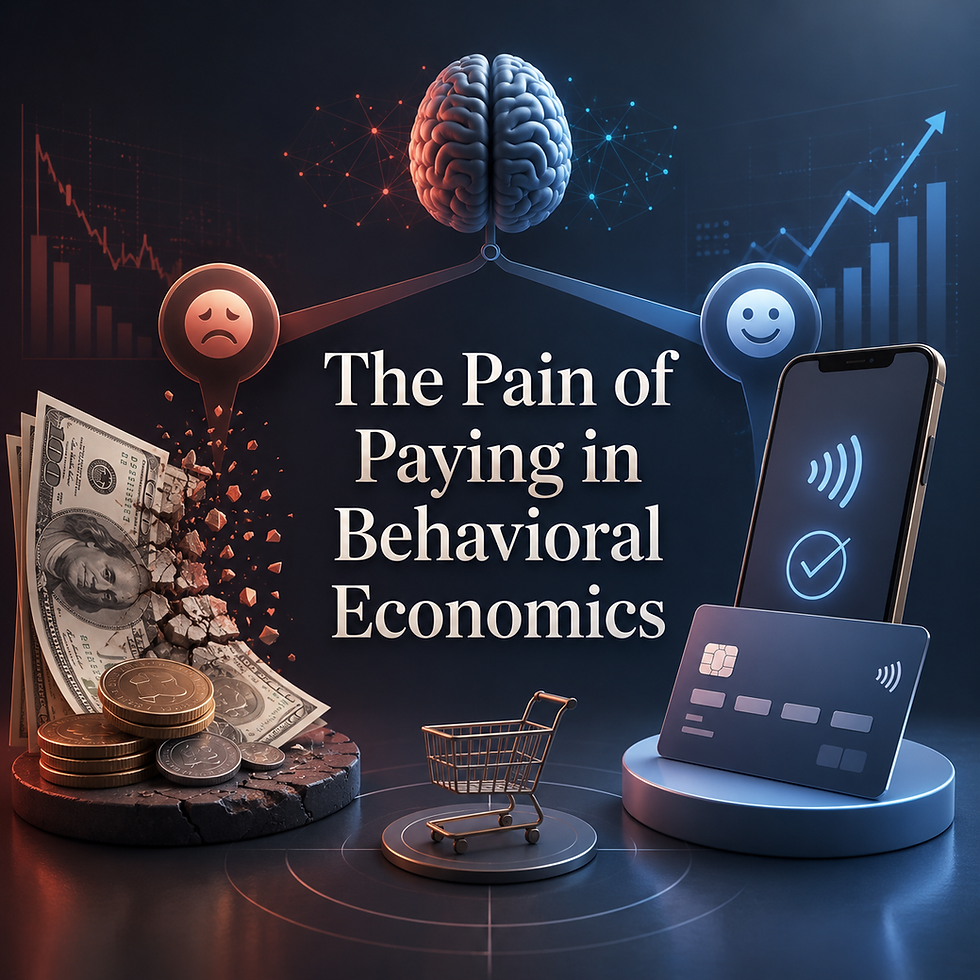
One-click payment is often described as a technical feature, but its real importance is deeper. It shows how digital platforms succeed when technology is designed around human behavior. In online shopping, many customers abandon a purchase when the process feels long, unclear, risky, or tiring. A short and simple payment process can reduce hesitation and support faster decisions. Amazon’s one-click model became an important example of how convenience, trust, speed, and platform growth can work together. This article studies one-click payment through consumer behavior, digital design, and platform strategy. It argues that one-click payment is not successful only because it saves time. It is successful because it reduces friction, lowers mental effort, supports trust, and turns buying into a smooth routine. The article also uses Bourdieu’s ideas about habit and practice, world-systems theory, and institutional isomorphism to explain why such models spread across markets and industries. The article concludes that students and researchers should not view digital success as a result of technology alone. Success often comes from the careful design of systems that match the way people think, feel, decide, and behave.
Keywords: one-click payment, consumer behavior, digital design, e-commerce, platform growth, trust, convenience, Amazon, institutional isomorphism, digital economy
1. Introduction
The growth of digital commerce has changed the way people buy products and services. In earlier forms of shopping, customers needed to travel to a store, compare products physically, speak with sellers, and then complete the payment in person. In online shopping, the store is always open, the product list is large, and the customer can buy from almost anywhere. However, online shopping also creates new problems. Customers may become confused by too many choices, worried about payment security, tired by long forms, or distracted before finishing the purchase.
For this reason, the payment stage is one of the most important moments in digital commerce. A customer may like the product, accept the price, and place the item in the cart, but still leave before paying. This is called purchase abandonment. It is not always caused by lack of interest. It can happen because the process is too long, the website asks for too much information, the customer does not trust the platform, or the final step feels uncomfortable.
One-click payment responds to this problem by making the buying process short, clear, and convenient. The basic idea is simple: once the customer has stored payment and delivery details, a future purchase can be completed with only one action. Amazon’s one-click model became one of the most famous examples of this idea. It showed that a small design change can have a large effect on customer behavior and platform growth.
This topic is important for students because it connects business, technology, psychology, and sociology. One-click payment is not only about software. It is about how people make decisions. It is about how trust is built between a platform and a customer. It is about how design can reduce friction and create repeated behavior. It is also about how successful platform practices spread across global markets.
The central argument of this article is that the success of one-click payment can be understood through the relationship between consumer behavior and digital design. When the buying process is short, clear, and convenient, customers are less likely to abandon the purchase. This does not mean that all customers buy without thinking. Rather, it means that a well-designed system removes unnecessary obstacles between intention and action. The customer who already wants to buy can complete the purchase more easily.
This article also argues that technology alone does not create success. Many companies have access to similar tools, payment systems, and design methods. What matters is how these tools are organized around human behavior. A platform becomes powerful when it understands not only what customers need, but also how customers decide, hesitate, trust, and repeat actions.
The article uses three wider theoretical ideas. First, Bourdieu’s concept of habit and practice helps explain how repeated digital actions become normal routines. Second, world-systems theory helps explain why platform models developed in powerful digital economies can influence global markets. Third, institutional isomorphism helps explain why other companies copy similar payment designs when they see them as legitimate, efficient, and necessary.
By combining these perspectives, the article presents one-click payment as more than a technical convenience. It is a social, economic, and behavioral model. It shows how small design features can influence large patterns of consumption, competition, and platform development.
2. Background and Theoretical Framework
2.1 One-Click Payment as a Digital Design Model
One-click payment is based on a simple promise: reduce the number of steps needed to complete a purchase. In a traditional online checkout, the customer may need to open the cart, confirm the product, enter name and address, choose shipping, enter card information, review the order, and then confirm payment. Each step gives the customer a chance to stop. Sometimes stopping is good, because customers should think before buying. But many stops are not meaningful. They are only friction.
Friction means effort, delay, confusion, or discomfort in a process. In digital commerce, friction can appear in many forms. A form may be too long. A button may be unclear. A page may load slowly. A password may be forgotten. A customer may worry whether the payment is safe. Each small problem can weaken the customer’s intention to buy.
One-click payment reduces this friction. It allows the customer to move directly from desire to purchase. The customer sees a product, trusts the platform, and completes the order quickly. This creates a strong link between design and behavior. The design does not force the customer to buy. Instead, it makes the intended action easier.
From a design perspective, one-click payment follows an important principle: good systems reduce unnecessary cognitive load. Cognitive load means the mental effort needed to complete a task. When customers must remember information, compare many options, or complete many fields, the task becomes heavier. When the process is clear and familiar, the task becomes lighter.
This does not mean that all friction should disappear. Some friction protects the customer, especially for high-cost items, sensitive products, or financial decisions. Responsible digital design must balance convenience with control. The best payment systems are fast but still understandable. They make buying easy but not hidden. They support speed without removing customer awareness.
2.2 Consumer Behavior and the Psychology of Convenience
Consumer behavior research shows that people do not always make decisions through long and careful analysis. Many daily decisions are fast, routine, and influenced by context. A person buying a book, a household item, or a digital service may not want to spend much time on the payment process. The customer has already made the main decision before reaching the checkout stage.
In this context, convenience becomes a major value. Convenience means saving time, reducing effort, and making the process feel easy. It is not only a practical benefit. It also creates a positive feeling. A convenient process tells the customer that the platform understands their time and needs.
One-click payment also relates to the idea of decision fatigue. When people make many decisions, they become tired. Online shopping can create decision fatigue because there are many products, prices, reviews, and delivery options. By the time the customer reaches payment, they may not want more decisions. A simple payment process helps complete the action before tiredness becomes abandonment.
Trust is another important part of consumer behavior. Customers will not use one-click payment if they do not trust the platform. They must believe that their payment details are safe, that the product will arrive, that returns are possible, and that the platform will not misuse their information. Therefore, one-click payment depends on trust built before the click.
This is why Amazon’s example is important. The one-click model did not work only because it was fast. It worked because it was connected to a wider platform system: stored customer details, delivery reliability, product variety, customer reviews, order tracking, and service support. The click was only the visible part of a larger trust structure.
2.3 Bourdieu: Habit, Practice, and Digital Consumption
Pierre Bourdieu’s work is useful for understanding why one-click payment becomes powerful over time. Bourdieu argued that human behavior is shaped by habitus, which can be understood as a system of learned dispositions. People develop ways of acting, choosing, and judging through social experience. These habits are not always conscious. They become part of everyday practice.
In digital commerce, repeated use of a platform can create a digital habitus. Customers learn where to search, how to compare, how to read reviews, and how to buy. Over time, the platform becomes familiar. The customer does not experience each purchase as a new situation. Instead, buying becomes a routine practice.
One-click payment strengthens this routine. The customer does not need to relearn the checkout process. The action becomes simple and familiar. The platform becomes part of the customer’s daily life. In Bourdieu’s terms, the practice becomes embodied in behavior. The user knows what to do without much reflection.
Bourdieu also helps us understand differences between consumers. Not all customers respond to one-click payment in the same way. Some have more digital confidence, more financial resources, and more experience with online platforms. Others may be more careful or less comfortable storing payment details. These differences can be connected to forms of capital, such as economic capital, cultural capital, and digital competence.
A customer with strong digital experience may see one-click payment as normal and efficient. A customer with less experience may see it as risky or too fast. Therefore, the success of one-click payment depends not only on design, but also on the social and cultural position of users. Digital convenience is not experienced equally by everyone.
2.4 World-Systems Theory and the Global Spread of Platform Models
World-systems theory, associated with Immanuel Wallerstein, views the global economy as a system shaped by unequal relations between core, semi-peripheral, and peripheral regions. Core regions often control advanced industries, technology, finance, and knowledge production. Peripheral regions are more dependent on external models, capital, and systems.
This theory can help explain the global spread of platform-based commerce. Many major digital platforms were developed in economically powerful countries with strong technology sectors, large consumer markets, and advanced logistics systems. Their models then influenced other regions. The one-click payment model is part of this wider movement of digital practices from core platform economies into global markets.
When a model such as one-click payment becomes successful in a major market, it can become a standard that others try to follow. Companies in different countries may adopt similar payment methods because customers begin to expect them. Local platforms may feel pressure to offer fast checkout, stored payment details, mobile wallets, and simple delivery options.
However, world-systems theory also reminds us that global adoption is not equal. A design that works well in one region may need adjustment in another. Payment trust, banking access, delivery infrastructure, internet quality, legal rules, and cultural habits all matter. In some markets, cash on delivery may remain important. In others, mobile wallets may be more common than cards. Therefore, one-click design must be adapted to local conditions.
The global success of such models shows both the power and the limits of digital standardization. A platform model may travel globally, but it must meet local trust structures, financial systems, and consumer practices.
2.5 Institutional Isomorphism and the Copying of Successful Models
Institutional isomorphism, explained by DiMaggio and Powell, describes how organizations in the same field become more similar over time. They may copy each other because of competition, professional standards, regulation, or uncertainty. When one model appears successful, other organizations may adopt it to look modern, efficient, and legitimate.
This idea is very useful for studying one-click payment. After leading platforms showed the value of fast checkout, many other companies began to simplify payment. They introduced saved cards, express checkout, digital wallets, subscription renewal, and buy-now buttons. These changes were not only technical improvements. They also became signs of being a serious digital business.
There are three main forms of institutional isomorphism. Coercive isomorphism happens when organizations change because of rules, laws, or pressure from powerful actors. Mimetic isomorphism happens when organizations copy successful models during uncertainty. Normative isomorphism happens when professional standards and expert knowledge spread similar practices.
In digital commerce, mimetic isomorphism is especially visible. If a major platform grows through convenience, other platforms may copy convenience features. They may not copy everything exactly, but they adopt the same logic: fewer steps, faster payment, clearer interface, and stronger account integration. Professional designers, consultants, and payment providers then spread these methods further, creating normative pressure.
This means that one-click payment is not only a company feature. It becomes part of an institutional field. It shapes what customers expect and what businesses feel they must provide.
3. Method
This article uses a conceptual and interpretive method. It does not present a statistical survey or an experiment. Instead, it studies one-click payment as a case of digital design and consumer behavior. The method combines academic theory with practical analysis of e-commerce systems.
The article follows three steps. First, it identifies the main behavioral problem in online shopping: customers often abandon purchases when the process is long, unclear, or inconvenient. Second, it examines how one-click payment responds to this problem by reducing friction and supporting trust. Third, it connects this design model to broader theories: Bourdieu’s theory of practice, world-systems theory, and institutional isomorphism.
This method is suitable because one-click payment is not only a technical object. It is also a social and economic practice. It includes design choices, consumer habits, trust relations, market competition, and global platform influence. A purely technical method would not fully explain why the model became important. A purely psychological method would not fully explain why it spread across industries. A purely economic method would not fully explain why customers feel comfortable using it repeatedly.
The article uses Amazon’s one-click model as an illustrative case. The purpose is not to provide a full company history. The purpose is to understand why this model became meaningful for digital commerce. Amazon is useful as a case because it connected one-click payment with a wider system of customer accounts, logistics, recommendations, reviews, and service support.
The analysis is based on established literature in consumer behavior, digital design, trust, platform economics, and sociological theory. It uses books and academic articles to build a structured explanation. The article is written in simple English so that students can understand the argument, while the structure follows the style of a journal article.
4. Analysis
4.1 The Checkout Stage as a Critical Point
The checkout stage is the final bridge between interest and purchase. At this moment, the customer has already completed many actions. They have searched for a product, compared options, looked at prices, and placed the item in the cart. However, the purchase is not complete until payment is confirmed.
This stage is critical because intention can still fail. A customer may want the product but still leave. This can happen for many reasons. The customer may see unexpected costs. The delivery time may be unclear. The website may ask for too much information. The card process may feel unsafe. The customer may become distracted or decide to think later.
One-click payment changes the meaning of checkout. Instead of being a separate and heavy stage, checkout becomes part of the product page or account experience. The customer does not feel that they are entering a new process. They feel that they are continuing the same action.
This is important because digital behavior is often interrupted. People shop while moving, working, waiting, or using mobile phones. A long checkout process does not fit this environment. A short process fits better with the fragmented attention of modern life.
From a behavioral point of view, one-click payment protects the customer’s intention from delay. The longer the time between decision and action, the more chances there are for abandonment. A fast process keeps the decision active.
4.2 Friction, Cognitive Load, and the Value of Simplicity
Friction is one of the main enemies of digital conversion. In physical shopping, some friction is expected. A customer must walk, carry goods, and wait in line. In digital shopping, customers expect less effort. If the online process feels difficult, the advantage of online shopping becomes weaker.
One-click payment reduces friction in several ways. It removes repeated data entry. It reduces the number of pages. It limits the need for memory. It makes the next step obvious. It also reduces emotional friction because the customer does not need to face the payment process as a new risk each time.
Simplicity is not the same as emptiness. A simple design can still be complex behind the screen. The platform must store details, manage security, confirm inventory, process payment, arrange delivery, and send notifications. The customer sees only the smooth surface. This is one of the main strengths of digital design: complexity is managed by the system, while simplicity is offered to the user.
However, simplicity must be responsible. If the process becomes too automatic, customers may feel that they lost control. Good one-click design should make the action clear. The customer should know what is being bought, where it will be delivered, how it will be paid, and how to cancel or correct mistakes. Trust grows when speed and clarity work together.
4.3 Trust as the Hidden Foundation of One-Click Payment
Trust is the hidden foundation of one-click payment. Without trust, one-click payment may feel dangerous. Customers may fear accidental purchases, hidden charges, misuse of card details, or poor service after payment. Therefore, a platform must earn trust before it can benefit from speed.
Trust in digital commerce has several parts. First, there is technical trust. Customers need to believe that payment information is protected. Second, there is service trust. Customers need to believe that the product will arrive and that problems can be solved. Third, there is institutional trust. Customers need to believe that the company follows rules and can be held accountable. Fourth, there is design trust. Customers need to feel that the interface is honest and understandable.
Amazon’s one-click model worked because it was connected to a larger trust environment. The customer account remembered addresses and payment details. Orders could be tracked. Reviews helped reduce uncertainty. Customer service and return systems reduced fear. The one-click button was not alone. It was supported by the whole platform.
This shows an important lesson: convenience without trust can become suspicion. Trust without convenience can become slow. The strongest model combines both.
4.4 Speed and the Shortening of Consumer Decision Time
Speed is often described as a technical advantage, but it is also a behavioral advantage. A fast system reduces the time in which doubt can grow. When a customer has already decided to buy, speed helps complete the decision.
This does not mean that speed always improves decision quality. For expensive or complex products, customers may need more time. But for routine or low-risk purchases, speed can improve the user experience. It allows customers to finish the task and move on.
In this sense, one-click payment works especially well for repeated purchases, familiar products, books, household goods, digital content, and items where the customer already trusts the seller. It turns buying into a low-effort action. The platform becomes part of everyday life.
Speed also supports platform growth because it increases the number of completed transactions. If fewer customers abandon the checkout, sales may increase. If customers enjoy the experience, they may return more often. If they return more often, the platform gains more data, stronger loyalty, and deeper market position.
4.5 Bourdieu and the Formation of Digital Habits
Bourdieu’s theory helps us see that one-click payment is not only a momentary action. It can become a habit. When customers repeat the same action many times, the platform becomes familiar. The one-click process becomes part of their practical knowledge.
This habit is important because customers often return to systems that feel easy. They may not compare every platform every time. They may choose the platform that already knows them. The saved address, saved payment, order history, and familiar interface create a comfort zone. This comfort zone is not only technical. It is social and behavioral.
Bourdieu’s concept of habitus explains how repeated experience shapes future action. In digital commerce, habitus can include the habit of trusting online reviews, expecting fast delivery, using stored payment, and buying from a familiar account. Once these habits form, they can be difficult for competitors to break.
This also shows why platform growth can become cumulative. The more customers use a platform, the more familiar it becomes. The more familiar it becomes, the more likely they are to use it again. One-click payment supports this cycle by making repeated use easy.
However, Bourdieu also reminds us that habits are shaped by social conditions. Customers with different income levels, education, digital skills, and cultural backgrounds may experience one-click payment differently. Some may see it as freedom from effort. Others may see it as a risk. Therefore, platforms must design for different levels of confidence and access.
4.6 World-Systems Theory and Global Platform Power
One-click payment also reflects wider global economic structures. Major platform innovations often begin in powerful digital economies, where companies have access to capital, technology, skilled labor, logistics networks, and large consumer markets. These conditions allow platforms to test new systems at scale.
When such systems succeed, they influence other markets. Businesses in many countries begin to adopt similar models because customers compare experiences across platforms. A customer who becomes used to fast checkout on one platform may expect the same from others. In this way, one-click payment becomes part of a global digital standard.
World-systems theory helps explain this movement. Core economies often produce the dominant models, while other regions adapt them. This does not mean that innovation only happens in core countries. Many important digital practices also come from semi-peripheral and emerging markets, especially in mobile payments and social commerce. But the global visibility of large platforms gives their models special influence.
The spread of one-click payment also depends on infrastructure. It needs digital payment systems, delivery networks, consumer protection, and data management. In regions where these systems are strong, one-click payment can grow faster. In regions where trust in online payment is lower, platforms may need hybrid models, such as cash on delivery, mobile wallets, or stronger confirmation steps.
Thus, one-click payment is not a universal formula. It is a model that must be translated into local economic and cultural conditions.
4.7 Institutional Isomorphism and the Normalization of Fast Checkout
As one-click payment and similar systems became more common, fast checkout became a sign of professional digital service. Companies started to simplify checkout not only because it improved sales, but also because it became expected.
Institutional isomorphism explains this process. Organizations copy successful models when they face uncertainty. In e-commerce, uncertainty is high. Companies do not always know why customers leave, which design will work, or how to build loyalty. When a leading platform succeeds with convenience, others imitate the model.
This imitation can be useful. It spreads better design standards and improves customer experience. But it can also create risks if companies copy features without understanding the deeper system. A one-click button alone is not enough. It needs trust, clear policies, reliable delivery, secure payment, and customer support.
Normative isomorphism also plays a role. Designers, developers, consultants, and payment companies often share similar ideas about best practice. They recommend fewer steps, clearer buttons, mobile-friendly design, saved payment, and fast confirmation. These professional standards make digital platforms more similar over time.
The result is that one-click payment becomes part of the common language of digital commerce. Customers expect it. Businesses adopt it. Payment providers support it. Designers normalize it.
4.8 Convenience, Loyalty, and Platform Growth
One-click payment supports platform growth because it strengthens the relationship between convenience and loyalty. Customers may return to a platform not only because of price, but because the process is easier. Convenience becomes a form of value.
This is especially important in markets where many sellers offer similar products. If the product is not unique, the experience can become the difference. A customer may choose the platform where buying is easiest, delivery is reliable, and payment is already stored.
This creates a platform advantage. Once customers store their details and develop trust, switching to another platform requires effort. They must create a new account, enter information again, learn a new interface, and test a new service. This is not impossible, but it creates switching costs. The customer may remain with the familiar platform because it feels easier.
One-click payment also supports data-driven growth. Repeated purchases provide information about customer preferences. Platforms can use this information to improve recommendations, stock planning, delivery systems, and customer communication. This creates a cycle: convenience increases use, use creates data, data improves the platform, and the improved platform increases convenience.
However, this cycle must be managed responsibly. Customers should not feel manipulated. They should feel served. The best platform growth is not based on trapping customers, but on giving them reasons to return.
5. Findings
This article identifies several main findings.
First, one-click payment succeeds because it reduces friction at the most sensitive stage of online shopping. The checkout stage is where many customers stop. By shortening this stage, one-click payment helps customers complete purchases they already intended to make.
Second, convenience is both practical and emotional. It saves time, but it also creates comfort. Customers feel that the platform is easy, familiar, and respectful of their attention.
Third, trust is necessary for speed to work. A fast payment system without trust may create fear. Customers must believe that the platform is secure, reliable, and fair.
Fourth, one-click payment supports habit formation. Using Bourdieu’s theory, the model can be understood as part of a digital habitus. Customers develop repeated patterns of action, and the platform becomes part of daily practice.
Fifth, the success of one-click payment is connected to wider global systems. World-systems theory shows how platform models from powerful digital economies can influence global markets, while also needing local adaptation.
Sixth, one-click payment spreads through institutional isomorphism. Other organizations copy fast checkout models because they see them as successful, legitimate, and necessary in competitive markets.
Seventh, technology alone does not explain success. The same technical feature can fail if it is not supported by trust, service quality, clear design, and customer understanding.
Eighth, one-click payment shows the importance of human-centered design. A successful digital system is not only one that works technically. It is one that fits human attention, habit, trust, and decision-making.
6. Conclusion
One-click payment is a simple idea with deep importance. It shows how digital commerce grows when design matches human behavior. Customers often leave online purchases not because they do not want the product, but because the process becomes too long, unclear, or uncomfortable. By reducing steps and lowering effort, one-click payment helps turn intention into action.
Amazon’s one-click model demonstrates the relationship between convenience, trust, speed, and platform growth. The model worked because it was not only a button. It was part of a wider platform system that included stored information, customer accounts, delivery reliability, reviews, service support, and repeated use. The visible click was supported by an invisible structure of trust.
The article also shows that one-click payment can be understood through major social theories. Bourdieu helps explain how digital habits form. World-systems theory helps explain how platform models spread across global markets. Institutional isomorphism helps explain why other companies adopt similar designs and why fast checkout becomes a standard.
For students, the main lesson is clear: technology alone does not create success. A company may have advanced software, but if the system does not match human behavior, customers may not use it. Successful digital platforms understand how people think, hesitate, trust, and repeat actions. They design systems that are not only efficient, but also meaningful and easy to use.
One-click payment is therefore more than a payment method. It is a case study in human-centered digital strategy. It teaches that small design choices can shape large economic outcomes. It also reminds researchers and managers that convenience must be balanced with responsibility, clarity, and trust. The future of digital commerce will depend not only on faster technology, but on better understanding of the people who use it.

Hashtags
#DigitalCommerce #OneClickPayment #ConsumerBehavior #DigitalDesign #EcommerceStrategy #PlatformEconomy #HumanCenteredDesign #TrustInTechnology #OnlineShopping #STULIB
References
Bakos, Y. (1997). Reducing buyer search costs: Implications for electronic marketplaces. Management Science, 43(12), 1676–1692.
Bourdieu, P. (1977). Outline of a Theory of Practice. Cambridge University Press.
Bourdieu, P. (1984). Distinction: A Social Critique of the Judgement of Taste. Harvard University Press.
Brynjolfsson, E., & Smith, M. D. (2000). Frictionless commerce? A comparison of internet and conventional retailers. Management Science, 46(4), 563–585.
Davis, F. D. (1989). Perceived usefulness, perceived ease of use, and user acceptance of information technology. MIS Quarterly, 13(3), 319–340.
DiMaggio, P. J., & Powell, W. W. (1983). The iron cage revisited: Institutional isomorphism and collective rationality in organizational fields. American Sociological Review, 48(2), 147–160.
Gefen, D., Karahanna, E., & Straub, D. W. (2003). Trust and TAM in online shopping: An integrated model. MIS Quarterly, 27(1), 51–90.
Hoffman, D. L., Novak, T. P., & Peralta, M. (1999). Building consumer trust online. Communications of the ACM, 42(4), 80–85.
Kahneman, D. (2011). Thinking, Fast and Slow. Farrar, Straus and Giroux.
Lemon, K. N., & Verhoef, P. C. (2016). Understanding customer experience throughout the customer journey. Journal of Marketing, 80(6), 69–96.
Norman, D. A. (2013). The Design of Everyday Things. Basic Books.
Pavlou, P. A. (2003). Consumer acceptance of electronic commerce: Integrating trust and risk with the technology acceptance model. International Journal of Electronic Commerce, 7(3), 101–134.
Rogers, E. M. (2003). Diffusion of Innovations. Free Press.
Simon, H. A. (1955). A behavioral model of rational choice. The Quarterly Journal of Economics, 69(1), 99–118.
Thaler, R. H., & Sunstein, C. R. (2008). Nudge: Improving Decisions About Health, Wealth, and Happiness. Yale University Press.
Venkatesh, V., Morris, M. G., Davis, G. B., & Davis, F. D. (2003). User acceptance of information technology: Toward a unified view. MIS Quarterly, 27(3), 425–478.
Wallerstein, I. (1974). The Modern World-System I: Capitalist Agriculture and the Origins of the European World-Economy in the Sixteenth Century. Academic Press.
Wallerstein, I. (2004). World-Systems Analysis: An Introduction. Duke University Press.


Comments