Resource-Based View (RBV): How Valuable, Rare, Difficult-to-Copy, and Well-Organized Resources Shape Competitive Advantage
- 1 day ago
- 20 min read
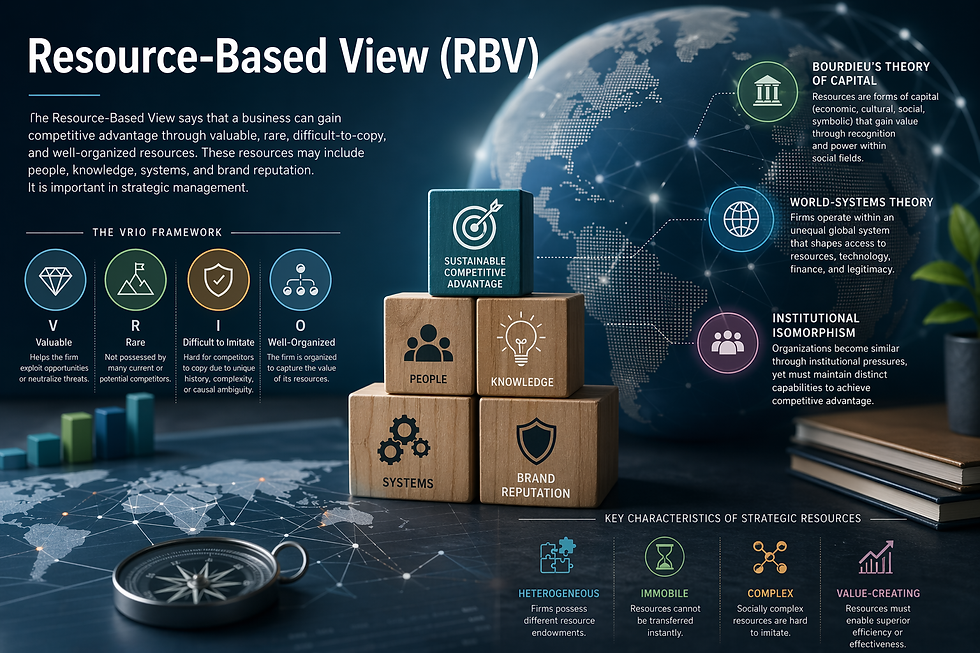
The Resource-Based View, often called RBV, is one of the most influential perspectives in strategic management. It explains why some firms perform better than others by focusing on internal resources rather than only on market position, industry structure, or external competition. According to this view, a business can build and sustain competitive advantage when it possesses resources and capabilities that are valuable, rare, difficult to imitate, and properly organized. These resources may include skilled employees, managerial know-how, routines, technology, data, reputation, organizational culture, intellectual property, and effective systems. RBV remains important because it helps explain long-term differences in firm performance in a practical and human-centered way.
This article examines RBV as a major theory in management studies and places it in wider social and institutional context. It argues that resources do not exist in isolation. Their value is shaped by history, power, culture, institutions, and position in the wider economy. For this reason, the article also engages with Bourdieu’s ideas about capital and social fields, world-systems theory, and institutional isomorphism. These perspectives help deepen RBV by showing that firms do not merely own resources; they operate in environments where legitimacy, social networks, symbolic recognition, and unequal global structures influence what counts as a strategic asset.
Using a conceptual and analytical method based on academic literature, the article explores how RBV explains competitive advantage, how the VRIO logic works in practice, and what limits exist in the theory. The analysis shows that RBV remains highly useful, especially when combined with a broader understanding of institutions and society. The article concludes that firms succeed not only because they hold resources, but because they are able to recognize, combine, protect, and renew them in changing organizational and global conditions.
Hashtags:
#ResourceBasedView #StrategicManagement #CompetitiveAdvantage #BusinessTheory #OrganizationalStrategy #ManagementStudies #InstitutionalTheory #Bourdieu #WorldSystemsTheory
Introduction
Why do some businesses grow, adapt, and remain strong over time while others struggle, even when they appear to operate in the same market? This question stands at the center of strategic management. For many years, scholars tried to answer it by examining industry conditions, market competition, product positioning, and external threats. These factors matter, but they do not explain everything. Businesses within the same sector often show very different results. Some firms build durable strength, while others with similar products or access to similar markets do not. The Resource-Based View offers an important answer to this puzzle.
The main idea of RBV is simple but powerful. A firm can achieve competitive advantage through internal resources and capabilities that competitors cannot easily obtain or copy. The theory shifted attention from the external environment toward the internal structure of the organization. Instead of asking only, “What market should the firm enter?” RBV asks, “What unique strengths does the firm already possess, and how can they be used well?” This changed the study of strategy by focusing on the firm itself as a collection of resources, routines, skills, and knowledge.
RBV became especially influential because it explained long-term advantage in a more realistic way than many earlier models. Not every business can win simply by entering an attractive industry. Firms differ in their people, history, learning patterns, internal culture, technology, and ability to coordinate action. These differences matter. A highly trusted brand, a team with deep specialized expertise, or a well-developed organizational routine may be more important than physical assets alone. In the modern economy, intangible resources often provide the strongest source of value.
At the same time, RBV should not be treated as a complete answer to all strategic questions. A business does not operate in a social vacuum. Resources become meaningful in relation to institutions, cultural expectations, and power structures. A strong brand, for example, is not just a marketing asset; it is also a form of symbolic recognition shaped by society. A professional network is not just a business tool; it is also social capital. The value of education, knowledge, language ability, or managerial style may vary depending on which field, country, or economic system the firm occupies. This is why the theory benefits from dialogue with broader social thought.
Bourdieu’s framework helps show that firms and managers use different forms of capital, including economic, cultural, social, and symbolic capital. World-systems theory adds another useful layer by showing that firms are embedded in an unequal global order where access to technology, finance, skilled labor, and legitimacy is not evenly distributed. Institutional isomorphism further explains why organizations often become similar to one another even while seeking distinct advantage. Together, these perspectives enrich RBV by making it more historically and socially grounded.
This article aims to present RBV in simple, human-readable English while maintaining the structure and depth expected in a Scopus-level journal-style paper. It first reviews the theoretical basis of RBV and related perspectives. It then explains the method used in the article, followed by analysis of the core dimensions of the theory, its practical relevance, and its limits. The article argues that RBV remains a vital strategic framework, but its explanatory power becomes stronger when combined with wider perspectives on social structure, legitimacy, and global inequality.
Background and Theoretical Framework
The Emergence of the Resource-Based View
The origins of RBV can be traced to earlier work that emphasized firm heterogeneity. Edith Penrose played a major role in this development by arguing that firms should be understood as bundles of productive resources. Her work suggested that the growth of the firm depends not simply on market opportunity but on the services that resources can produce when used by managers and employees. This insight became foundational for later strategy scholars.
Later contributions developed the idea more clearly. Wernerfelt introduced the term “resource-based view” and encouraged scholars to think about firms in terms of resource positions rather than only product positions. Barney then offered one of the most influential formulations by arguing that resources can create sustained competitive advantage when they are valuable, rare, imperfectly imitable, and non-substitutable. This later evolved into the widely used VRIO framework, which asks whether resources are valuable, rare, difficult to imitate, and supported by organization.
RBV challenged older approaches that focused mainly on external market structure. In industry-based strategy, the firm often appears as a player responding to competitive forces. In RBV, the firm becomes the center of analysis. This shift was important because it acknowledged that strategy is not only about choosing where to compete but also about understanding what the firm is uniquely able to do.
Defining Resources and Capabilities
In RBV, resources include all assets, knowledge, processes, skills, and attributes that enable a firm to conceive and implement strategy. These may be tangible, such as buildings, machinery, land, or cash reserves. They may also be intangible, such as reputation, trust, patents, routines, technical expertise, leadership, culture, or access to networks. In many sectors, intangible resources matter more than physical ones because they are harder for competitors to observe and copy.
Capabilities are often treated as related but distinct from resources. A resource is something the firm has. A capability is something the firm can do with what it has. For example, talented employees are a resource, but the ability to coordinate them effectively into innovation is a capability. A respected brand is a resource, while the ability to maintain customer loyalty across changing conditions is a capability. Competitive advantage often comes not from isolated resources but from the combination of resources into organized capabilities.
The VRIO Logic
The VRIO framework is one of the most practical expressions of RBV. It asks four questions about a firm’s resources.
First, is the resource valuable? A valuable resource helps the firm exploit opportunities or reduce threats. If a resource does not improve efficiency, differentiation, flexibility, or adaptability, it is unlikely to create advantage.
Second, is it rare? If many competitors possess the same resource, it may be useful but will not create uniqueness. Rarity matters because competitive advantage depends on difference.
Third, is it difficult to imitate? A resource may be valuable and rare, but if competitors can copy it easily, the advantage will not last. Inimitability often comes from history, path dependence, complex routines, causal ambiguity, or social relationships that cannot be reproduced quickly.
Fourth, is the firm organized to use it well? Even excellent resources can remain underused if the organization lacks structure, incentives, coordination, or leadership. Organization converts potential into actual performance.
This logic remains popular because it offers a simple framework for strategic diagnosis. It encourages managers to move beyond visible assets and ask deeper questions about what truly drives lasting strength.
RBV and Strategic Management
RBV became central to strategic management because it explains why firms differ in persistent ways. It also aligns well with modern business conditions where knowledge, data, creativity, and reputation play increasing roles. In manufacturing, service industries, technology, education, finance, healthcare, and cultural sectors, success often depends on assets that are not easily visible on a balance sheet.
The theory also supports long-term thinking. Instead of focusing only on short-term competition, RBV encourages investment in employee development, organizational learning, internal systems, and institutional trust. A firm that trains its people, builds strong routines, preserves brand credibility, and develops distinctive expertise is often preparing the basis for future advantage.
Bourdieu and the Broadening of Resources
RBV speaks of resources, but Bourdieu offers a deeper language for understanding what many of these resources really are. Bourdieu identified several forms of capital: economic capital, cultural capital, social capital, and symbolic capital. This framework is valuable for management studies because firms do not rely only on money or equipment. They also depend on reputation, legitimacy, educational knowledge, social relationships, and recognition within a field.
Economic capital is closest to traditional business assets. Cultural capital includes knowledge, qualifications, language skills, managerial habits, and forms of competence that are recognized as legitimate. Social capital refers to networks, relationships, and connections that provide access to opportunities and support. Symbolic capital refers to prestige, authority, and recognized status.
A firm’s brand reputation can be understood as symbolic capital. Executive education, technical knowledge, and professional language may function as cultural capital. Business partnerships, alumni ties, and industry relationships represent social capital. Seen this way, RBV becomes richer. Resources are not just internal assets; they are forms of capital embedded in fields of power and recognition.
Bourdieu also used the concept of field, meaning a structured social space where actors compete for position, legitimacy, and influence. This is highly relevant to strategic management. Firms compete not only in markets but also in institutional fields shaped by regulators, professional norms, investors, customers, and cultural expectations. A resource has value partly because the field recognizes it as valuable. For example, a certification, a prestigious board member, or a particular professional habit may matter because institutions and audiences treat them as signs of quality.
World-Systems Theory and Unequal Access to Resources
World-systems theory, associated especially with Wallerstein, helps expand RBV beyond the level of the individual firm. It argues that the global economy is structured unequally between core, semi-peripheral, and peripheral positions. These positions influence access to finance, technology, skilled labor, infrastructure, and legitimacy. This matters because firms do not begin with equal opportunities to gather or develop strategic resources.
A company located in a core economy may have greater access to advanced research systems, global financial networks, stable institutions, and well-established legal protections for intellectual property. Firms in peripheral settings may face weaker infrastructure, limited funding, brain drain, or lower international visibility. In such conditions, building valuable and rare resources becomes more difficult, even for capable organizations.
World-systems theory therefore adds an important structural dimension to RBV. Resources are not created under equal historical conditions. Competitive advantage is shaped not only by managerial choice but also by a firm’s location in global hierarchies. This insight is especially relevant in discussions of education, technology transfer, international business, and development strategy.
Institutional Isomorphism and the Tension Between Difference and Similarity
Institutional isomorphism, associated with DiMaggio and Powell, describes how organizations become similar over time because of shared norms, regulations, professional standards, and imitation under uncertainty. This idea appears at first to conflict with RBV. If firms must be different to gain competitive advantage, why do so many organizations become alike?
The answer is that firms pursue two goals at once: legitimacy and advantage. To survive, organizations often need legitimacy in the eyes of regulators, accrediting bodies, investors, customers, and professionals. This pushes them toward similarity. At the same time, to outperform competitors, they need unique resources and capabilities. Strategy therefore involves balancing conformity and distinctiveness.
This perspective improves RBV because it reminds us that not all resources are chosen freely. Some are developed because institutions demand them. Certain systems, reporting standards, governance structures, or professional practices are adopted to appear credible and acceptable. In this sense, resources may serve both efficiency and legitimacy. Competitive strength may come from the ability to satisfy institutional expectations while still maintaining distinct capabilities.
Toward an Integrated Framework
Taken together, these theories suggest that RBV works best when understood in a wider context. Internal resources matter, but they are shaped by social recognition, institutional pressure, and global inequality. Valuable resources may include forms of cultural and symbolic capital. Rarity may depend on historical location within the world economy. Organizational structure may be influenced by institutional expectations. Competitive advantage is therefore not merely technical. It is also social, historical, and relational.
Method
This article uses a conceptual and analytical method based on close reading of major academic literature in strategic management, organizational theory, and social theory. It is not an empirical field study and does not present original survey or interview data. Instead, it aims to synthesize key ideas from foundational and widely cited works and to build an interpretive framework that can support both academic understanding and practical management reflection.
The method has three parts. First, the article identifies the core concepts of the Resource-Based View, especially the understanding of firms as heterogeneous bundles of resources and the use of the VRIO logic to assess strategic assets. Second, it reads RBV alongside selected concepts from Bourdieu, world-systems theory, and institutional isomorphism. These perspectives were chosen because they help answer questions that RBV alone sometimes leaves unclear, such as how resources gain social value, why access to resources is unequal across locations, and why organizations often imitate one another despite seeking competitive advantage. Third, the article applies this combined framework to broader strategic questions concerning management, competitiveness, legitimacy, and organizational development.
The article follows a qualitative mode of analysis. It compares concepts, examines their assumptions, and explores their usefulness for understanding business strategy. This approach is appropriate because the aim is theoretical clarification rather than statistical testing. The article is written in simple English to make a complex body of thought more accessible, but the structure and depth are designed to reflect journal-style academic writing.
A conceptual method has limitations. It cannot prove causality in the way large-scale empirical studies may try to do. It also depends on interpretation, which means different scholars could build slightly different conclusions from the same body of literature. However, conceptual analysis remains essential in management research because theories guide the way empirical work is designed and interpreted. A strong conceptual paper can therefore make an important contribution by clarifying assumptions, connecting separate literatures, and showing new directions for future research.
Analysis
RBV as an Explanation of Firm Heterogeneity
One of the great strengths of RBV is that it explains firm heterogeneity in a convincing way. Two firms may operate in the same market, face the same regulations, and target similar customers, yet perform very differently. Standard economic models often struggle to explain this for long periods. RBV addresses the issue by arguing that firms differ in their resource bases, and these differences are not always easy to erase.
Some firms accumulate deep technical knowledge over years. Others develop trust-based relationships with customers, suppliers, or stakeholders. Some create strong internal routines that support quality and innovation. Others build a reputation that gives them credibility in moments of uncertainty. These resources are often developed slowly and cannot be bought instantly.
This is why RBV is especially useful in sectors where tacit knowledge matters. In consulting, education, hospitality, healthcare, finance, technology, and research-intensive industries, people and routines often carry more value than visible equipment. A competitor may copy a product, but it is much harder to copy the full system of culture, trust, and know-how that produced it.
The Importance of Intangible Resources
RBV helped management studies take intangible resources more seriously. Traditional accounting systems often favor what can be easily counted, but strategy requires attention to what may not appear clearly in financial reports. Brand credibility, institutional trust, team cohesion, leadership quality, and organizational learning are difficult to measure precisely, but they are often decisive.
This point has become even more important in the knowledge economy. Data systems, algorithmic expertise, educational quality, customer trust, research capability, and digital routines now function as major strategic assets. A firm with a respected identity and strong internal knowledge may remain competitive even when physical assets are modest.
Here Bourdieu becomes especially helpful. Many intangible resources resemble forms of capital that operate socially. A recognized qualification, an elite network, a trusted institutional name, or a long-established reputation carries value because others recognize and believe in it. This means that some strategic assets depend on collective perception. They are not merely internal possessions; they are relational achievements.
Social Complexity and Inimitability
A central feature of RBV is the idea that certain resources are hard to imitate. This difficulty often comes from social complexity. A competitor may observe that another firm performs well, but the exact reason may remain unclear. Is the success due to leadership style, internal trust, team selection, culture, history, routines, or all of these together? This causal ambiguity protects advantage.
Socially complex resources include team chemistry, informal communication patterns, shared values, reputation, and long-term relationships. These cannot be copied by simply spending money. They are built through time, interaction, and accumulated experience. Path dependence matters here. A firm’s present capabilities often reflect past decisions, crises, learning episodes, and institutional journeys.
This point again supports the relevance of Bourdieu. Social and symbolic capital are not simple assets. They exist in relationships and recognition. Their strength depends on credibility and history. A brand cannot be copied fully because it is not just a logo; it is a socially produced meaning. A network cannot be copied fully because it depends on trust, status, and accumulated interaction.
Organization as the Missing Link
One of the most practical parts of RBV is the final element of VRIO: organization. Businesses often possess useful resources but fail to gain advantage because they are not organized to use them effectively. A company may hire excellent people but lack communication systems. It may own strong technology but fail to integrate it into decision-making. It may have a respected name but weak internal governance.
Organization includes structure, incentives, control systems, leadership, culture, coordination mechanisms, and learning processes. This is important because resources do not create value automatically. They must be activated. A highly qualified faculty in an educational institution, for example, does not guarantee strategic strength unless the institution also has effective systems for curriculum development, quality assurance, student support, and reputation management.
Institutional theory strengthens this point. Organizational structures are often shaped by external expectations about what a legitimate organization should look like. Therefore, the ability to organize resources is partly strategic and partly institutional. Firms must often build structures that satisfy both internal efficiency and external legitimacy.
RBV and the Problem of Static Thinking
Despite its strengths, RBV has been criticized for becoming too static in some uses. If the theory simply identifies existing resources and asks whether they are valuable and rare, it may overlook change. Markets shift, technologies evolve, consumer expectations move, and institutional environments develop. A resource that creates advantage today may become less useful tomorrow.
This criticism led to related thinking on dynamic capabilities, which focuses on a firm’s ability to integrate, build, and reconfigure resources in changing environments. While distinct from classic RBV, this development shows an important truth: competitive advantage depends not only on having resources but also on renewing them.
A strong brand, for example, can become outdated. A skilled workforce may need retraining. A successful routine can turn into rigidity. A respected organization may become too comfortable with its existing legitimacy and lose its adaptive energy. Strategic management therefore requires both protection and renewal of resources.
This issue also relates to world-systems theory. Global economic shifts can change which resources matter most. Access to digital infrastructure, new regulatory systems, global partnerships, and transnational legitimacy may reshape competitive possibilities. Firms that fail to read broader systemic change may lose advantage even if they once had strong resources.
RBV in Unequal Global Contexts
RBV is often presented as if all firms compete on equal ground, but this is rarely true. Global inequalities shape the acquisition and development of resources. A business in one country may enjoy stable institutions, strong legal protection, abundant finance, and close links to international knowledge centers. Another may operate in a more difficult environment with limited access to advanced inputs or international recognition.
World-systems theory helps make this visible. It reminds scholars that firms are not only strategic actors but also participants in a global order marked by uneven development. In this context, strategic resources are not equally available. The firm’s location within the global system affects its capacity to attract talent, access technology, secure legitimacy, and form international partnerships.
This does not mean that firms outside dominant centers cannot build advantage. On the contrary, many do. But their resource strategies may need to differ. They may rely more on local knowledge, flexible networks, cultural positioning, niche specialization, or hybrid organizational forms. Their competitive strength may come from combining global standards with locally embedded resources.
Legitimacy, Reputation, and Symbolic Power
RBV often includes reputation as a strategic resource, but its meaning becomes clearer through Bourdieu and institutional theory. Reputation is not only a market outcome. It is also a form of symbolic power. It allows organizations to be trusted, heard, and recognized. This trust can influence investor decisions, customer loyalty, partnership opportunities, and institutional access.
Symbolic capital is especially important in sectors where quality is hard to judge directly, such as education, consulting, healthcare, cultural production, and professional services. In these fields, credentials, recognition, affiliation, and public image matter greatly. Firms build advantage not only through technical performance but also through being seen as credible and worthy.
Institutional isomorphism plays a role here because organizations often adopt visible structures and practices to signal legitimacy. Quality systems, governance documents, professional titles, standardized procedures, and certifications may become strategic resources because they are recognized as meaningful by external audiences. Yet if all firms adopt the same legitimacy signals, advantage depends on who can combine them with deeper capabilities and authentic performance.
Isomorphism and Differentiation
A useful insight from the combined framework is that organizations live under dual pressure. They must become sufficiently similar to be seen as legitimate, but sufficiently different to be competitive. This is one of the central tensions of strategy.
For example, a business school, healthcare institution, or technology firm may need standard compliance systems, formal governance, ethical codes, and recognized credentials to be taken seriously. These are forms of institutional conformity. But long-term distinction depends on something more: teaching quality, research capacity, organizational culture, service design, innovation ability, or trusted relationships.
RBV explains the need for difference. Institutional theory explains the pressure toward sameness. Together they offer a more realistic picture of organizational life. Not all resources are chosen because they are rare. Some are adopted because they are necessary for legitimacy. Strategic advantage comes from knowing which elements must follow the field and which must remain distinctive.
Human Resources, Knowledge, and Learning
Among all resources discussed in RBV, people and knowledge remain among the most important. Skilled employees create value through expertise, judgment, creativity, and relational ability. Yet RBV also reminds us that people alone are not enough. Knowledge must be embedded in routines, culture, and systems if it is to outlast turnover and support consistent advantage.
Human capital becomes stronger when linked to social capital and organizational learning. A highly educated workforce may still underperform if internal trust is low or if knowledge remains isolated within departments. By contrast, firms that encourage collaboration, mentorship, reflection, and shared problem-solving often turn individual skill into collective capability.
Bourdieu helps here because knowledge is not neutral. Cultural capital includes styles of communication, recognized qualifications, and familiarity with dominant norms. Organizations that understand this can better interpret why some forms of expertise are valued more than others. They can also see how leadership, recruitment, and promotion may reproduce certain patterns of symbolic advantage.
Brand and Reputation as Strategic Resources
Brand reputation is often mentioned in management practice, but RBV helps explain why it matters strategically. A trusted brand lowers uncertainty for customers, supports premium pricing, encourages loyalty, and opens partnership opportunities. It can also support resilience during crises. But strong brands are difficult to copy because they are rooted in history, consistency, and public recognition.
Reputation also has internal value. Employees often prefer to work for organizations with positive standing. Stakeholders may forgive mistakes more readily when long-term trust exists. In this sense, reputation connects economic value with symbolic capital.
However, reputation must be organized and protected. If internal systems do not support the promises made by the brand, symbolic capital can weaken quickly. This shows again that resources and organization must work together.
The Continuing Relevance of RBV
Despite criticisms, RBV remains highly relevant because it asks an enduring strategic question: what do we have that others cannot easily match, and how can we use it well? In a world of rapid imitation and growing competition, this question remains central.
The theory is especially useful when managers avoid simplistic application. RBV is not a checklist for naming assets. It is a deeper way of thinking about value creation, uniqueness, protection, and coordination. It encourages managers to examine the hidden foundations of success and to think about strategy as a long-term process of resource development and renewal.
When expanded through Bourdieu, world-systems theory, and institutional isomorphism, RBV becomes even stronger. It can explain not only how resources matter, but why they matter in particular social and historical settings. It can also show that advantage depends on both internal strengths and external recognition.
Findings
The analysis of the Resource-Based View leads to several important findings.
First, RBV remains one of the strongest theories for explaining persistent differences in firm performance. Its focus on internal resources helps explain why businesses in similar industries can have very different outcomes over time. This is one of its most valuable contributions to strategic management.
Second, the most important strategic resources are often intangible rather than physical. Knowledge, culture, routines, trust, brand reputation, and learning systems frequently produce more durable advantage than assets that can be purchased easily. This is especially true in service, knowledge, educational, and innovation-based sectors.
Third, the VRIO logic remains useful because it offers a practical way to assess resources. The four questions about value, rarity, imitability, and organization help managers and researchers move beyond surface-level descriptions of advantage. However, the framework works best when applied with depth rather than mechanically.
Fourth, organization is essential. Resources do not produce value automatically. Firms need effective structures, leadership, culture, and coordination systems to turn potential into performance. This means that strategic advantage is not only about possession but also about activation.
Fifth, Bourdieu’s framework improves RBV by showing that many strategic resources are forms of capital shaped by social recognition. Cultural, social, and symbolic capital help explain why reputation, networks, credentials, and legitimacy matter so much in real organizational life.
Sixth, world-systems theory shows that firms develop resources under unequal global conditions. Access to finance, technology, legitimacy, and human capital is influenced by broader structural position. This means that resource development is partly constrained by the wider world economy.
Seventh, institutional isomorphism reveals that organizations face pressure to become similar in order to appear legitimate. This complements RBV by showing that firms must balance distinctiveness with conformity. Sustainable advantage often depends on meeting institutional expectations while preserving unique capabilities.
Eighth, RBV has limits when treated as static. Resources can lose value over time, and firms must continuously adapt. The most successful organizations are not only resource-rich but also capable of renewing, recombining, and protecting their assets in changing conditions.
Overall, the findings suggest that RBV is most powerful when used as part of a broader framework that includes social, institutional, and global dimensions.
Conclusion
The Resource-Based View remains a foundational theory in strategic management because it explains a simple but profound truth: businesses do not succeed only because of market position or external opportunity. They succeed because of what they possess, what they know, what they can do, and how well they organize these strengths. Valuable, rare, difficult-to-copy, and well-organized resources can create competitive advantage that lasts beyond short-term market change.
The enduring relevance of RBV lies in its realistic understanding of firm difference. Organizations are not identical units. They carry distinct histories, cultures, routines, people, and reputations. These differences matter greatly. A company with deep expertise, trusted relationships, a respected name, and effective internal systems may outperform rivals even in difficult environments. In the modern economy, such strengths are often more important than physical assets alone.
At the same time, this article has argued that RBV becomes more useful when connected to wider social theory. Bourdieu helps us see that many resources are forms of capital shaped by recognition and power. World-systems theory reminds us that not all firms build resources from equal starting points. Institutional isomorphism shows that organizations compete while also conforming to shared expectations of legitimacy. These perspectives do not weaken RBV. They deepen it.
A more complete understanding of strategic management therefore requires both internal and external awareness. Managers must identify distinctive resources, but they must also understand the field in which those resources gain meaning. They must protect valuable capabilities, but they must also renew them. They must seek advantage, but they must also maintain legitimacy. They must build internal strength, but they must remain aware of unequal global structures that shape opportunity.
In simple terms, RBV teaches that strategy begins at home, within the firm. But the home itself is shaped by society, institutions, and history. The strongest organizations are not merely those that own good resources. They are those that know how to cultivate, combine, defend, and adapt them in a changing world.
References
Barney, J. B. (1991). Firm resources and sustained competitive advantage. Journal of Management.
Barney, J. B. (2001). Resource-based theories of competitive advantage: A ten-year retrospective on the resource-based view. Journal of Management.
Bourdieu, P. (1986). The forms of capital. In J. Richardson (Ed.), Handbook of Theory and Research for the Sociology of Education.
Bourdieu, P. (1993). The Field of Cultural Production. Columbia University Press.
Collis, D. J., & Montgomery, C. A. (1995). Competing on resources: Strategy in the 1990s. Harvard Business Review.
DiMaggio, P. J., & Powell, W. W. (1983). The iron cage revisited: Institutional isomorphism and collective rationality in organizational fields. American Sociological Review.
Grant, R. M. (1991). The resource-based theory of competitive advantage: Implications for strategy formulation. California Management Review.
Mahoney, J. T., & Pandian, J. R. (1992). The resource-based view within the conversation of strategic management. Strategic Management Journal.
Penrose, E. T. (1959). The Theory of the Growth of the Firm. Oxford University Press.
Peteraf, M. A. (1993). The cornerstones of competitive advantage: A resource-based view. Strategic Management Journal.
Teece, D. J., Pisano, G., & Shuen, A. (1997). Dynamic capabilities and strategic management. Strategic Management Journal.
Wallerstein, I. (2004). World-Systems Analysis: An Introduction. Duke University Press.
Wernerfelt, B. (1984). A resource-based view of the firm. Strategic Management Journal.


Comments