ETOPS as a Case Study in Technology, Regulation, and Trust
- 2 hours ago
- 21 min read
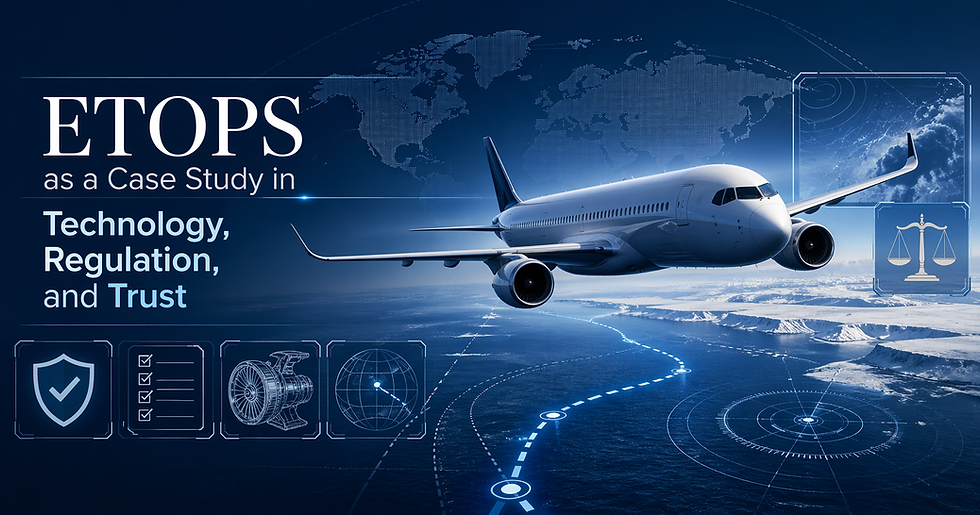
ETOPS, or Extended-range Twin-engine Operational Performance Standards, is one of the most important examples of how modern regulation can change when technology becomes more reliable. In early commercial aviation, twin-engine aircraft were restricted because an engine failure over an ocean or remote area created serious risk. For this reason, airlines had to keep such aircraft within a limited flying time from a suitable airport. Over time, aircraft engines became more dependable, navigation improved, weather forecasting became more accurate, maintenance became more systematic, and airline operational control became more professional. These changes allowed aviation authorities to move from simple distance-based restriction toward evidence-based approval. This article studies ETOPS as a case of technology, regulation, and trust. It explains how extended operations developed from the older 60-minute logic to 180-minute, 240-minute, 330-minute, and higher forms of approval. The article uses a qualitative academic approach and applies institutional theory, Bourdieu’s idea of symbolic capital, world-systems theory, and institutional isomorphism. The main argument is that ETOPS is not only a technical aviation rule. It is also a social and institutional system that shows how trust is produced, tested, documented, and renewed. For students, ETOPS offers a clear lesson: innovation becomes acceptable when institutions can prove that risk is understood and controlled.
Keywords: ETOPS, aviation regulation, risk management, technology, institutional trust, aircraft reliability, airline operations, safety culture
1. Introduction
Modern aviation is built on trust. Passengers trust airlines to operate safely. Airlines trust aircraft manufacturers to design reliable machines. Regulators trust evidence, testing, training, and inspection. Pilots trust aircraft systems, weather information, maintenance records, and operational planning. This trust is not blind. It is not based only on reputation or hope. In aviation, trust is created through rules, data, professional discipline, and repeated proof.
ETOPS is a strong example of this process. The term is commonly used to describe extended operations, especially long-distance flights by twin-engine aircraft over oceans, polar areas, deserts, or other remote regions. The central issue is simple: how far may an aircraft fly from a suitable airport if one engine fails or if another serious emergency happens? In the past, two-engine aircraft were not allowed to fly very far from a possible diversion airport. This was because engine reliability was not yet strong enough to support long remote flights. Larger three-engine or four-engine aircraft were often preferred for long oceanic routes because they were seen as safer for flights far from land.
This changed over time. Aircraft engines became more reliable. Aircraft monitoring systems became more advanced. Maintenance became more predictive and better documented. Flight planning improved. Communication systems became stronger. Weather information became more accurate. Airlines also developed better systems for crew training, emergency procedures, and operational control. Because of these changes, aviation authorities began to allow longer diversion times for approved aircraft and approved operators.
The development from the older 60-minute rule toward 180-minute, 240-minute, 330-minute, and higher extended operations is therefore not only a story about aircraft engines. It is a story about the relationship between technology and regulation. It shows how regulators can allow innovation without abandoning safety. Aviation authorities do not simply remove restrictions because industry asks for freedom. Instead, they create approval systems. Airlines must prove that their aircraft, engines, maintenance programs, pilots, dispatchers, and emergency planning systems are strong enough for extended operations.
For students of business, management, engineering, transport, and public policy, ETOPS is a useful case study. It shows that regulation is not always the enemy of innovation. In many industries, good regulation can make innovation possible. Without strong rules, passengers may not trust long-distance twin-engine flights. Without reliable technology, regulators would not approve them. Without airline discipline, the approval would not remain valid. ETOPS therefore sits at the meeting point of technology, institutions, and public confidence.
This article examines ETOPS from an academic perspective. It explains the historical logic of extended operations, the role of technological progress, the importance of regulation, and the production of institutional trust. It also applies sociological and economic theories to show that aviation safety is not only a technical matter. It is also connected to power, legitimacy, global inequality, professional culture, and organizational imitation.
2. Background and Theoretical Framework
2.1 From Restriction to Evidence-Based Approval
The early logic of long-distance aviation was shaped by caution. When engine reliability was lower, a twin-engine aircraft flying far from an airport created a serious concern. If one engine failed, the aircraft needed to continue safely on the remaining engine until it reached a suitable airport. If the nearest suitable airport was too far away, the risk became unacceptable.
For this reason, regulators used time-distance restrictions. The famous 60-minute logic meant that certain twin-engine operations had to remain within a limited flying time from an adequate airport. This rule was simple and understandable. It did not require complex risk modeling for every possible route. It created a conservative safety boundary.
However, simple rules can become outdated when technology changes. A rule that is reasonable in one technological period may become too restrictive in another. By the late twentieth century, engine reliability had improved greatly. Aircraft manufacturers were producing twin-engine aircraft capable of long-haul operations with high reliability. Airlines also wanted more direct routes, lower fuel costs, and more efficient fleets. Regulators then faced an important question: should older restrictions remain unchanged, or should regulation adapt to new evidence?
ETOPS developed as a regulatory answer to this question. Rather than allowing all twin-engine aircraft to fly anywhere, authorities created a structured approval system. This system asked airlines and manufacturers to demonstrate reliability. Approval was not given only because an aircraft type was modern. It depended on the specific aircraft-engine combination, the airline’s maintenance quality, the crew training system, communication capability, route planning, weather planning, and diversion airport arrangements.
This change is important because it shows the movement from rule-based restriction to performance-based regulation. The older rule focused mainly on a fixed limit. The newer approach focused on demonstrated capability. In simple terms, ETOPS asks: can this aircraft, with this engine, operated by this airline, on this route, under these procedures, manage the risk safely?
2.2 ETOPS as Risk Management
Risk management does not mean removing all risk. No transport system can remove risk completely. Risk management means identifying possible dangers, reducing their probability, preparing for emergencies, and creating systems that make failure less likely and less harmful.
ETOPS risk management includes several layers. The first layer is aircraft design. Engines must be reliable. Critical systems must have redundancy. Fire suppression systems, electrical systems, hydraulic systems, and navigation equipment must support safe flight during an extended diversion.
The second layer is maintenance. Airlines must show that their maintenance systems can prevent avoidable failures. This includes inspections, reliability monitoring, technical records, spare parts control, and corrective action when problems appear.
The third layer is crew training. Pilots must know how to manage an engine failure, depressurization, medical emergency, fire warning, fuel issue, or diversion decision during remote operations. Cabin crew must also be prepared for long emergency situations.
The fourth layer is operational control. Dispatchers and operations centers must plan routes carefully, check alternate airports, monitor weather, calculate fuel, and support pilots during flight.
The fifth layer is regulatory oversight. Authorities must review data, approve procedures, inspect operators, and require corrective action when standards are not met.
The ETOPS system therefore works like a chain. If one part of the chain is weak, the operation becomes less safe. A reliable aircraft is not enough if the airline has poor maintenance. Good pilots are not enough if the weather planning is weak. Good regulation is not enough if the operator treats compliance as paperwork only. The strength of ETOPS comes from the connection between all these elements.
2.3 Bourdieu: Technical Capital, Symbolic Capital, and Trust
Pierre Bourdieu’s ideas can help explain ETOPS in a wider social sense. Bourdieu argued that societies are structured by different forms of capital. Economic capital refers to money and financial resources. Cultural capital refers to knowledge, education, and professional competence. Social capital refers to networks and relationships. Symbolic capital refers to recognized status, legitimacy, and honor.
In aviation, airlines need more than financial capital. They also need technical and symbolic capital. Technical capital appears in trained engineers, professional pilots, safety systems, maintenance records, and operational knowledge. Symbolic capital appears when regulators, passengers, industry partners, and airports recognize the airline as safe and professional.
ETOPS approval can be understood as a form of symbolic capital. When an airline receives extended-operation approval, it gains a recognized sign of competence. This approval tells the market that the airline has met strict technical and operational standards. It can support public trust, route expansion, and commercial reputation. However, symbolic capital can be lost. If an airline fails to maintain standards, trust can decline quickly.
Bourdieu’s framework also shows that aviation is a field. A field is a social space where actors compete for position, resources, and legitimacy. In the aviation field, airlines, manufacturers, regulators, pilots, engineers, insurers, airports, and passengers all play roles. ETOPS approval becomes one of the tools through which airlines compete. It allows them to operate more direct long-haul routes, reduce fuel use, and offer better schedules. But this competition is controlled by safety rules. The field rewards both efficiency and discipline.
2.4 World-Systems Theory and Global Aviation
World-systems theory, associated with Immanuel Wallerstein, explains the world economy as a system with core, semi-peripheral, and peripheral regions. Core regions often control advanced technology, finance, regulation, and high-value industries. Peripheral regions may depend more on external technology, imported systems, and global standards.
ETOPS can be studied through this theory because aviation is a global system. Aircraft manufacturers, engine producers, major regulators, training systems, insurance markets, and global airline alliances are not equally distributed around the world. Many of the most powerful aviation institutions are located in economically advanced regions. Their standards influence airlines across the world.
This does not mean that airlines outside core regions are passive. Many airlines in the Middle East, Asia, Africa, and Latin America have developed strong technical and operational capabilities. Some have become global leaders. However, they operate within a world system shaped by international standards, aircraft manufacturers, certification authorities, and global market expectations.
ETOPS approval shows how global standards can support safety across borders. A passenger flying from one continent to another benefits from shared rules, common training principles, and internationally recognized safety expectations. At the same time, world-systems theory reminds us that access to technology, training, finance, and maintenance infrastructure is uneven. Not all airlines can reach the same level at the same speed. Regulation may be global, but capacity is often unequal.
2.5 Institutional Isomorphism
Institutional isomorphism is a concept from organizational theory. It explains why organizations in the same field often become similar over time. Paul DiMaggio and Walter Powell identified three main types: coercive, mimetic, and normative isomorphism.
Coercive isomorphism happens when organizations change because of laws, regulations, or powerful institutions. In ETOPS, airlines must follow regulatory requirements if they want approval. This creates similarity because airlines must build comparable maintenance programs, training systems, and operational procedures.
Mimetic isomorphism happens when organizations copy successful competitors, especially under uncertainty. If leading airlines use ETOPS-approved aircraft to open efficient long-haul routes, other airlines may follow similar strategies. They may choose similar aircraft types, training systems, or operational models.
Normative isomorphism happens through professional standards and education. Pilots, engineers, safety managers, auditors, and regulators often share common training backgrounds and professional norms. These norms shape how safety is understood and practiced.
ETOPS is therefore not only a set of technical rules. It is part of an institutional environment that makes airlines more similar in their safety practices. This similarity can be positive because it spreads high standards. However, it also requires care. Organizations should not copy procedures only for appearance. They must understand the real safety logic behind them.
3. Method
This article uses a qualitative conceptual method. It does not present new statistical data or flight records. Instead, it studies ETOPS as an academic case by combining aviation safety concepts with sociological and institutional theory.
The method has four steps.
First, the article identifies ETOPS as a historical change in aviation regulation. It examines the movement from time-based restriction toward evidence-based approval.
Second, it analyzes the main technical and organizational elements that make extended operations possible. These include engine reliability, aircraft systems, maintenance, crew training, flight planning, weather forecasting, communications, and diversion airports.
Third, it applies theoretical frameworks. Bourdieu is used to explain professional trust and symbolic capital. World-systems theory is used to place ETOPS within global aviation inequality and international standardization. Institutional isomorphism is used to explain why airlines and regulators develop similar safety systems.
Fourth, the article draws educational findings for students. The aim is not only to explain aviation rules, but also to show wider lessons about innovation, risk, regulation, and trust.
This method is suitable because ETOPS is not only a technical topic. It is also an example of how modern societies manage risk in high-reliability industries. Similar lessons can be applied to medicine, nuclear energy, banking, cybersecurity, artificial intelligence, and other sectors where failure can have serious consequences.
4. Analysis
4.1 The Meaning of the 60-Minute Rule
The 60-minute rule can be understood as a conservative safety response to technological limits. In earlier periods, regulators could not assume that a twin-engine aircraft could safely continue for long periods after an engine failure. Therefore, the aircraft had to remain close enough to a suitable airport.
This rule was easy to understand. It created a clear safety boundary. It also protected public confidence. Passengers did not need to know all the technical details of engine reliability. The rule communicated that aircraft would not be too far from help.
However, the rule also had economic and operational costs. It limited route choices. Aircraft sometimes had to fly longer paths to remain close to diversion airports. Longer routes meant more fuel, more time, higher costs, and less efficient fleet use. Airlines operating long-haul routes often preferred aircraft with three or four engines because they faced fewer restrictions.
The development of ETOPS changed this situation. It allowed twin-engine aircraft to operate on longer and more direct routes if the airline and aircraft met strict conditions. This helped reshape airline business models. Twin-engine long-haul aircraft became more attractive because they could offer lower operating costs while maintaining safety.
For students, the lesson is clear: regulation often reflects the technology of its time. When technology improves, regulation may change. But serious regulation does not change only because an industry wants profit. It changes when evidence supports a new safety model.
4.2 Engine Reliability and the Transformation of Trust
The heart of ETOPS is engine reliability. If engines fail frequently, extended twin-engine operations are not acceptable. If engines are highly reliable, and if the aircraft can safely continue after one engine fails, longer operations become possible.
Modern aircraft engines are products of advanced engineering, materials science, digital monitoring, testing, and maintenance. Their reliability is not accidental. It is produced by design, certification, manufacturing quality, inspection, operational feedback, and continuous improvement.
Trust in engine reliability is therefore institutional. Regulators do not simply trust a manufacturer’s promise. They require data. Airlines do not simply trust an aircraft because it is new. They monitor performance. Maintenance teams do not simply wait for failures. They use inspections, trend monitoring, and reliability programs.
This is where ETOPS becomes a case study in modern trust. In everyday language, trust may sound emotional. In aviation, trust is structured. It is built through documentation, audits, training, and measurable performance. An aircraft-engine combination earns confidence over time.
This process also shows the difference between belief and evidence. A passenger may believe an airline is safe because of its brand. A regulator needs more than brand image. The regulator needs proof that systems work. ETOPS approval is therefore a bridge between technical evidence and public confidence.
4.3 Maintenance as an Institutional Practice
Maintenance is one of the most important parts of ETOPS. A modern aircraft may be well designed, but poor maintenance can destroy safety. ETOPS requires airlines to treat maintenance as a disciplined system, not as a reactive repair activity.
In a simple repair culture, maintenance responds after something breaks. In a safety culture, maintenance also prevents failure before it happens. This means tracking technical issues, studying repeated faults, replacing parts before risk increases, and making sure that all work is recorded correctly.
ETOPS maintenance also requires special attention to critical systems. A problem that may be manageable on a short domestic flight can become more serious on a remote oceanic route. For example, a failure linked to fire suppression, electrical power, fuel systems, or communication may have greater consequences when the aircraft is far from diversion airports.
Maintenance records are also important because they create accountability. If an aircraft is approved for extended operations, the airline must show that it has followed required procedures. Documentation becomes part of safety. This may look like bureaucracy, but in aviation it has real value. A missing record can hide a missing action. A weak procedure can become a weak safety barrier.
Bourdieu’s concept of cultural capital is useful here. Maintenance engineers hold specialized knowledge. Their training, experience, and professional judgment are forms of cultural capital. When this knowledge is recognized by regulators and airlines, it becomes part of the airline’s symbolic capital. In other words, a strong maintenance culture helps an airline become trusted.
4.4 Crew Training and Human Decision-Making
ETOPS is not only about machines. It is also about people. Pilots must be trained to manage abnormal situations during extended operations. This includes technical failures, medical emergencies, severe weather, fuel planning, navigation problems, communication difficulties, and diversion decisions.
A diversion decision can be complex. The nearest airport may not always be the best airport. Weather may change. Runway conditions may be uncertain. Medical needs may be urgent. Fuel must be calculated carefully. The crew must communicate with operational control, air traffic services, and cabin crew. They must also manage passengers.
Training prepares crews for these situations. It helps them avoid panic, follow procedures, and make professional judgments. However, training must not reduce pilots to automatic rule-followers. Aviation needs disciplined judgment. A checklist is important, but so is the ability to understand the situation.
This is why ETOPS training includes both procedure and thinking. Crews must understand why procedures exist. When people understand the reason behind a rule, they are more likely to apply it correctly under pressure.
For students, this is a valuable management lesson. In any high-risk organization, training should not only teach employees what to do. It should teach them why it matters. The best safety systems combine rules, knowledge, and judgment.
4.5 Weather Forecasting, Navigation, and Communication
Extended operations depend heavily on information. A long-haul aircraft may cross remote oceanic areas where airports are far apart and weather can change. Safe planning requires reliable weather forecasts, accurate navigation, and strong communication systems.
Weather forecasting helps airlines decide whether diversion airports are suitable. An airport may exist on the map, but it may not be usable if weather is below safe landing standards, if the runway is closed, or if emergency services are not available. ETOPS planning therefore requires more than drawing a route. It requires careful checking of alternates.
Navigation systems also matter. Modern aircraft use advanced navigation technologies that allow accurate flight across remote areas. This reduces uncertainty and supports fuel planning. Communication systems allow crews to receive updates and coordinate with operational control.
These technologies show how innovation creates regulatory possibility. Without reliable communication and navigation, extended operations would be harder to approve. Technology does not remove the need for regulation. Instead, it gives regulation new tools.
This is important for students studying digital transformation. A new technology becomes valuable when it supports better decisions. In aviation, digital tools are not used only for convenience. They are part of safety infrastructure.
4.6 Diversion Airports and the Geography of Safety
ETOPS depends on suitable diversion airports. These airports are part of the hidden geography of long-haul aviation. Passengers usually think about departure and arrival airports. Pilots and dispatchers must also think about airports that may be needed in an emergency.
A suitable diversion airport must meet several conditions. It must have an appropriate runway, acceptable weather, available services, and the ability to handle the aircraft and passengers. In remote regions, suitable alternates may be limited. This makes planning more complex.
World-systems theory helps explain this issue. Global aviation safety depends partly on infrastructure that is unevenly distributed. Core regions often have dense airport networks and strong emergency services. Remote oceans, polar regions, deserts, and less developed regions may have fewer options. This affects route planning and regulatory approval.
The geography of diversion also has economic meaning. If more airports become suitable alternates, airlines may operate more efficient routes. If infrastructure is weak, route options may be limited. Investment in airports, weather systems, communication networks, and emergency services can therefore support wider economic connectivity.
This shows that aviation safety is not only inside the aircraft. It is also on the ground. A safe flight depends on a network of airports, regulators, engineers, meteorologists, air traffic controllers, and emergency services.
4.7 Airline Economics and Route Efficiency
ETOPS changed airline economics. Before long-range twin-engine operations became widely accepted, many long-haul routes depended on three-engine or four-engine aircraft. These aircraft provided operational flexibility but often used more fuel and had higher operating costs.
Modern twin-engine aircraft can be more efficient. They may consume less fuel, require less maintenance, and offer better economics for long-haul routes. ETOPS approval allowed airlines to use such aircraft on routes that were previously difficult or impossible for twins.
This created several business advantages. Airlines could open thinner long-haul routes where demand did not justify very large aircraft. They could reduce fuel costs. They could offer more direct services. They could improve fleet flexibility. Passengers benefited from shorter travel times and more route choices.
However, the economic benefit depends on safety approval. ETOPS is not simply a cost-cutting tool. It is a controlled permission system. Airlines receive economic advantages only after proving operational strength. This is a useful example of how regulation can align safety and efficiency.
For business students, ETOPS shows that innovation often creates value when it passes through institutional approval. A company may have a new product or method, but markets may not accept it until trust is established. In aviation, trust is created through regulation, certification, and performance.
4.8 Institutional Isomorphism in Airline Safety
ETOPS has helped create similarity across airlines. Operators seeking extended-operation approval often develop similar systems: reliability programs, training modules, dispatch procedures, maintenance controls, and documentation practices.
This similarity is partly coercive because regulators require certain standards. It is partly mimetic because airlines learn from successful operators. It is partly normative because aviation professionals share common safety values.
This process can improve safety across the industry. When strong practices spread, weaker systems may improve. International aviation benefits from shared expectations. A pilot trained in one country can understand many procedures used in another. Regulators can compare operators more easily. Manufacturers can design aircraft around common standards.
However, institutional isomorphism also has risks. Organizations may copy the form of compliance without building the substance. They may create manuals, checklists, and training records that look correct but are not deeply understood. This is sometimes called ceremonial compliance. It means the organization appears compliant but does not fully live the safety culture.
ETOPS helps prevent this risk by requiring evidence and continuing oversight. Approval is not a one-time trophy. It must be maintained. Reliability data, audits, and operational performance continue to matter.
4.9 ETOPS and the Sociology of Trust
Trust in aviation is layered. Passengers trust airlines. Airlines trust pilots and engineers. Regulators trust evidence. Manufacturers trust design and testing. Insurers trust risk models. Governments trust aviation systems to support trade, tourism, and national connectivity.
ETOPS is a case of managed trust. It does not ask society to trust blindly. It creates a system where trust is earned. This is important because modern societies depend on complex systems that ordinary people cannot fully inspect. A passenger cannot personally check engine reliability, maintenance records, pilot training, weather data, and diversion planning before boarding a flight. Society therefore depends on institutions.
This makes institutional trust one of the most important assets in aviation. If trust declines, the effect can be serious. Passengers may avoid certain airlines. Regulators may suspend approvals. Insurance costs may rise. Commercial reputation may suffer.
Bourdieu’s symbolic capital is useful again here. A safe reputation is a form of symbolic capital. It has economic value, but it cannot be bought directly. It must be built through repeated professional behavior. ETOPS approval contributes to this symbolic capital because it shows that an airline meets a high operational standard.
4.10 Technology Does Not Replace Regulation
A common mistake in modern business thinking is to assume that technology alone solves risk. ETOPS shows that this is not true. Better engines, better navigation, and better forecasting made extended operations possible, but they did not remove the need for rules.
Technology creates capability. Regulation creates controlled permission. Organizational culture creates daily practice. All three are needed.
For example, a highly reliable aircraft can still be operated poorly. A strong regulation can still fail if oversight is weak. A well-trained crew can still be placed at risk if maintenance is careless. Safety depends on the whole system.
This lesson is useful far beyond aviation. In artificial intelligence, medicine, banking, energy, and cybersecurity, new technology often creates new opportunities and new risks. Societies need approval systems, professional standards, auditing, and accountability. ETOPS offers a mature example of this balance.
4.11 The Educational Value of ETOPS
ETOPS is a valuable teaching case because it is concrete and understandable. Students can easily understand the basic question: how far should a twin-engine aircraft be allowed to fly from an airport? From this simple question, many academic themes appear.
In engineering, ETOPS teaches reliability and redundancy. In management, it teaches operational control and safety culture. In economics, it teaches cost efficiency and route planning. In law and public policy, it teaches evidence-based regulation. In sociology, it teaches institutional trust and professional legitimacy.
The case also helps students avoid simple thinking. It is not correct to say that regulators block progress. It is also not correct to say that companies should be free to innovate without limits. ETOPS shows a better model: progress with proof.
This model can be applied to many fields. A hospital may introduce robotic surgery only after training, testing, and approval. A bank may use digital finance tools only after risk controls are in place. A university may introduce online examinations only after identity, fairness, and quality systems are ready. A company may use artificial intelligence only after governance rules are clear.
In each case, innovation becomes stronger when trust is built carefully.
5. Findings
The analysis leads to several findings.
First, ETOPS shows that regulation can evolve with technology. The movement from the older 60-minute logic to longer diversion approvals was not a sudden removal of safety limits. It was a controlled change based on evidence, reliability, and operational maturity.
Second, ETOPS proves that trust in high-risk industries is institutional. People trust long-haul twin-engine flights because aircraft, airlines, regulators, pilots, engineers, and support systems operate within a strict framework.
Third, engine reliability is necessary but not sufficient. Extended operations also require maintenance discipline, crew training, weather planning, communication, route analysis, and diversion readiness.
Fourth, ETOPS approval creates symbolic capital for airlines. It signals competence and professionalism. This can support business growth, route expansion, and market confidence.
Fifth, world-systems theory shows that ETOPS operates within unequal global infrastructure. Airlines in different regions may face different levels of access to training, maintenance resources, airport networks, and regulatory capacity. Global safety standards are important, but they require real institutional support.
Sixth, institutional isomorphism helps explain why airline safety systems become similar. Regulation, professional norms, and competitive imitation encourage airlines to adopt comparable ETOPS procedures. This can improve safety, but only when compliance is real and not ceremonial.
Seventh, ETOPS shows that economic efficiency and safety can support each other. More direct routes, lower fuel use, and better fleet flexibility are possible because safety systems have become stronger.
Eighth, the ETOPS case teaches students that innovation should be connected to accountability. The right question is not only “Can we do this?” but also “Can we prove that we can do this safely?”
6. Discussion
ETOPS is sometimes explained in a very technical way. It is often discussed through diversion times, aircraft-engine combinations, reliability numbers, and regulatory approvals. These details are important, but they are not the whole story. ETOPS is also a social achievement.
Modern passengers may board a twin-engine aircraft for a long oceanic flight without thinking deeply about diversion airports or engine-out cruise speeds. This calmness is the result of decades of engineering, regulation, and professional learning. What appears normal today was once controversial. This is common in technological history. Many innovations first appear risky, then become accepted after systems of control develop.
The same pattern can be seen in other sectors. Online banking was once viewed with high concern. Today it is normal because encryption, regulation, identity systems, and consumer protection have improved. Telemedicine was once limited, but it expanded when technology, medical rules, and patient trust developed. Artificial intelligence is now going through a similar stage. Societies are asking how to allow innovation while controlling risk.
ETOPS teaches that responsible innovation requires proof. It also teaches that regulation should not be frozen in the past. A rule designed for older technology may need revision when evidence changes. However, revision must be careful. Removing limits without a replacement system can create danger. ETOPS did not simply remove the 60-minute logic. It replaced it with a more detailed system of approval and monitoring.
This is a mature model of governance. It respects innovation but does not worship it. It respects safety but does not use safety as an excuse to block all change. It creates a middle path where industry can progress if it earns trust.
For students, this is one of the most important lessons. In many public debates, people speak as if there are only two choices: strict control or full freedom. ETOPS shows a third choice: controlled freedom based on evidence. Airlines gain freedom to operate longer routes, but only when they meet higher responsibilities.
This is also a lesson about institutions. Strong institutions make complex systems possible. Without regulators, certification bodies, maintenance standards, training programs, and international cooperation, modern aviation would not have the same level of public trust. Markets alone would not be enough. Technology alone would not be enough. Professional culture alone would not be enough. The strength comes from the combination.
7. Conclusion
ETOPS is an important case study in technology, regulation, and trust. It shows how aviation moved from older restrictions on twin-engine aircraft toward modern extended operations based on evidence and approval. This development was made possible by improvements in engine reliability, aircraft systems, navigation, communication, weather forecasting, maintenance, training, and operational control.
The main lesson is that aviation authorities do not simply remove limits when technology improves. They replace older limits with structured approval systems. Airlines must prove that they can manage risk professionally. This includes aircraft reliability, crew competence, maintenance quality, emergency planning, route analysis, and continuous monitoring.
From an academic perspective, ETOPS can be understood through several theories. Bourdieu helps explain how technical competence becomes symbolic capital and public trust. World-systems theory shows that extended operations exist within a global aviation system shaped by unequal access to technology and infrastructure. Institutional isomorphism explains why airlines develop similar safety systems under regulatory, professional, and competitive pressure.
ETOPS also offers a wider lesson for students. In modern society, innovation is not only a technical matter. It is also institutional. A new technology becomes socially useful when people can trust it. That trust must be earned through evidence, rules, training, and accountability.
The history of ETOPS therefore teaches a positive and practical message: progress and safety can grow together. When technology improves, regulation can adapt. When regulation is intelligent, innovation can expand. When organizations act responsibly, trust becomes stronger. This is why ETOPS remains one of the best examples of how modern industries can manage risk while opening new possibilities.
Hashtags
#ETOPS #AviationSafety #RiskManagement #TechnologyAndRegulation #InstitutionalTrust #AirlineOperations #TransportStudies #SafetyCulture #BusinessEducation #STULIB
References
Bourdieu, P. (1984). Distinction: A Social Critique of the Judgement of Taste. Harvard University Press.
Bourdieu, P. (1986). “The Forms of Capital.” In J. Richardson (Ed.), Handbook of Theory and Research for the Sociology of Education. Greenwood Press.
Dekker, S. (2014). The Field Guide to Understanding Human Error. Ashgate.
DiMaggio, P. J., and Powell, W. W. (1983). “The Iron Cage Revisited: Institutional Isomorphism and Collective Rationality in Organizational Fields.” American Sociological Review, 48(2), 147–160.
Giddens, A. (1990). The Consequences of Modernity. Stanford University Press.
Hood, C., Rothstein, H., and Baldwin, R. (2001). The Government of Risk: Understanding Risk Regulation Regimes. Oxford University Press.
Perrow, C. (1999). Normal Accidents: Living with High-Risk Technologies. Princeton University Press.
Reason, J. (1997). Managing the Risks of Organizational Accidents. Ashgate.
Rochlin, G. I. (1999). “Safe Operation as a Social Construct.” Ergonomics, 42(11), 1549–1560.
Weick, K. E., and Sutcliffe, K. M. (2007). Managing the Unexpected: Resilient Performance in an Age of Uncertainty. Jossey-Bass.
Wallerstein, I. (2004). World-Systems Analysis: An Introduction. Duke University Press.


Comments