Understanding the “Necessary Evil” in Human Resource Management
- 2 hours ago
- 23 min read
Human Resource Management is often described as the human side of the organization. It is expected to support employees, protect dignity, encourage motivation, and create a fair working environment. At the same time, HR is also responsible for actions that many employees may experience as uncomfortable or even negative. These actions include performance monitoring, disciplinary procedures, conflict management, internal investigations, restructuring, and the termination of employment contracts. This article examines the idea of the “necessary evil” in Human Resource Management. The term does not mean that HR should act harshly or unfairly. Rather, it describes practices that may create short-term pressure but can serve important long-term organizational and ethical purposes when applied correctly.
Using a conceptual and interpretive method, the article explores how HR balances employee care with institutional protection. It draws on Bourdieu’s theory of power and capital, world-systems theory, and institutional isomorphism to explain why HR practices are shaped not only by internal organizational needs but also by wider social, economic, and professional pressures. The analysis shows that HR becomes problematic when control is used without fairness, transparency, or documentation. However, HR becomes valuable when difficult practices are guided by clear rules, ethical judgment, communication, and proportionality. The article finds that the “necessary evil” in HR is not the existence of control itself, but the possibility of using control without justice. A mature HR system should therefore combine kindness with accountability, flexibility with consistency, and employee support with responsible governance.
Keywords: Human Resource Management, necessary evil, organizational ethics, performance evaluation, institutional isomorphism, Bourdieu, workplace governance, employee relations
1. Introduction
Human Resource Management is often presented as a positive and supportive function. In many organizations, HR is connected with recruitment, training, employee well-being, career development, diversity, and workplace culture. These areas are important because organizations depend on people. A company, school, hospital, public office, or international institution cannot perform well if its people are ignored, mistreated, or poorly supported. For this reason, HR is commonly described as the bridge between the organization and its employees.
However, this description is incomplete. HR is not only a department of support. It is also a department of control, discipline, documentation, investigation, and risk management. HR sometimes asks difficult questions. It may evaluate weak performance, investigate complaints, record misconduct, enforce attendance rules, manage conflicts between employees, or support the legal termination of employment. These actions can be uncomfortable for employees and managers alike. They may create fear, pressure, or resistance. Yet, without them, organizations can become unfair, unsafe, inefficient, or legally exposed.
This is where the idea of the “necessary evil” becomes useful. In HR studies, a “necessary evil” refers to a practice that may appear negative in the short term but may serve an important function in the long term. The phrase is sensitive because it can be misunderstood. It should not be used to justify cruelty, unfairness, or abuse of power. Rather, it helps explain a real tension inside HR work. Some HR actions are not pleasant, but they may be necessary to protect the organization, protect employees, maintain standards, and support fairness.
For example, performance evaluation may create stress for employees. Some workers may fear criticism or feel that they are being judged. However, when performance evaluation is done fairly, it can identify training needs, reward strong performance, and help weak employees improve before problems become serious. In this case, the practice has a difficult side, but it also has a developmental purpose. The problem is not evaluation itself. The problem appears when evaluation becomes biased, unclear, humiliating, or disconnected from real evidence.
The same logic applies to disciplinary action. No employee enjoys receiving a warning. No manager enjoys giving one. Yet a workplace without discipline can become unjust. If one employee repeatedly violates rules and management does nothing, other employees may feel that fairness has disappeared. They may lose trust in the institution. In this case, avoiding difficult action may appear kind in the short term, but it can harm the organization in the long term.
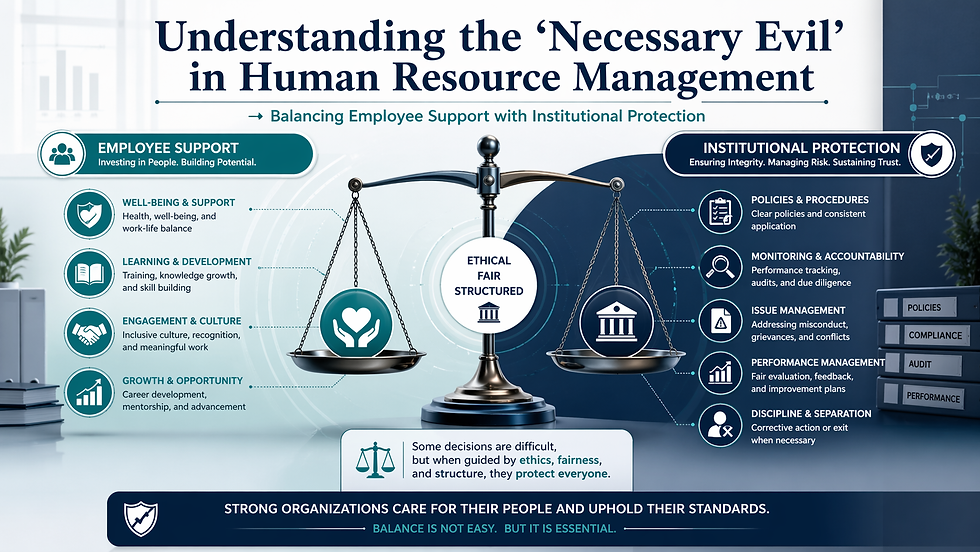
The central argument of this article is that HR must balance two responsibilities. First, HR must support employees as human beings with dignity, needs, and rights. Second, HR must protect the institution as a structured organization with rules, goals, duties, and risks. A strong HR system cannot grow through kindness alone, because kindness without accountability can allow poor behavior to continue. At the same time, an organization cannot survive through control alone, because control without trust can damage motivation, creativity, loyalty, and moral legitimacy.
This article examines the “necessary evil” in HR from an academic but practical point of view. It asks the following questions: Why do difficult HR practices exist? When are they legitimate? When do they become harmful? How can HR apply authority without becoming unfair? How can organizations design systems that are both humane and effective?
To answer these questions, the article uses a conceptual method and draws on three theoretical perspectives. Bourdieu’s theory helps explain how HR is connected to power, social position, and different forms of capital inside organizations. World-systems theory helps explain how HR practices are shaped by global economic pressures, competition, outsourcing, and labor market inequality. Institutional isomorphism helps explain why organizations often adopt similar HR practices to appear legitimate, professional, and compliant.
The article is written in simple English but follows the structure of an academic journal article. It includes an abstract, introduction, theoretical framework, method, analysis, findings, conclusion, hashtags, and references. Its purpose is to help students, researchers, managers, and HR practitioners understand that the difficult side of HR should not be hidden. It should be studied, improved, and ethically managed.
2. Background and Theoretical Framework
2.1 Human Resource Management as Care and Control
Human Resource Management has developed from older personnel administration into a broader strategic function. In the past, personnel departments often focused on payroll, contracts, attendance records, and administrative procedures. Modern HR is expected to contribute to organizational strategy, talent development, leadership culture, compliance, employee engagement, and institutional reputation.
Despite this development, HR still carries a dual identity. It is both supportive and regulatory. It helps employees enter the organization, grow within it, and sometimes leave it. It designs training programs, but it also records poor performance. It promotes inclusion, but it also investigates misconduct. It encourages trust, but it also monitors behavior. This dual identity creates ethical tension.
Employees may see HR as a place of help when they need advice, but they may also fear HR when there is a complaint, investigation, or disciplinary matter. Managers may expect HR to protect the organization from legal and operational risk, while employees may expect HR to protect them from unfair management. HR is therefore positioned between different expectations.
This position makes HR work complex. If HR supports employees without considering organizational needs, it may fail to protect the institution. If HR protects the institution without considering employee dignity, it may become a tool of domination. The best HR systems try to combine both roles. They understand that employee well-being and organizational stability are not enemies. In the long term, they depend on each other.
2.2 The Meaning of “Necessary Evil” in HR
The phrase “necessary evil” is often used in everyday language to describe something unpleasant but unavoidable. In HR, the phrase can refer to practices such as:
Performance monitoringDisciplinary proceduresWorkplace investigationsConflict managementPolicy enforcementAttendance controlCompliance documentationRedundancy or restructuringTermination of employment contracts
These practices may be viewed negatively because they involve judgment, pressure, conflict, or loss. However, they may be necessary because organizations require rules, evidence, fairness, and accountability.
For example, a workplace investigation may be stressful for everyone involved. The person who complains may feel vulnerable. The accused person may feel anxious. Witnesses may fear involvement. Managers may worry about reputation. Yet, if a serious complaint is ignored, the organization may allow harm to continue. Investigation is therefore not only a control mechanism. It is also a protection mechanism.
The ethical question is not whether HR should ever investigate, evaluate, or discipline. The ethical question is how these practices are conducted. Are employees informed of the rules? Is evidence collected carefully? Are decisions documented? Is the process consistent? Is the response proportional? Is the employee allowed to respond? Is confidentiality respected? These questions define whether the “necessary evil” remains necessary or becomes simply harmful.
2.3 Bourdieu: Power, Capital, and Symbolic Authority
Pierre Bourdieu’s theory is useful for understanding HR because organizations are social fields. A field is a structured space where people compete, cooperate, and struggle over resources, status, and recognition. In the workplace, employees do not only bring technical skills. They also bring social capital, cultural capital, symbolic capital, and economic needs.
Cultural capital may include education, language skills, professional habits, certificates, and knowledge of organizational norms. Social capital may include networks, relationships, and access to influential people. Symbolic capital may include reputation, title, prestige, or perceived professionalism. HR systems often evaluate these forms of capital, sometimes openly and sometimes indirectly.
For example, performance evaluation may appear neutral, but it can reward certain communication styles, educational backgrounds, or cultural behaviors more than others. A confident employee who knows how to present achievements may be evaluated more positively than a quiet employee who works effectively but does not promote himself or herself. In this sense, HR practices may reproduce hidden inequalities if they are not carefully designed.
Bourdieu also helps explain symbolic power. HR policies carry symbolic authority because they define what counts as acceptable behavior, professional conduct, performance, and misconduct. When HR writes rules, applies procedures, or records warnings, it is not only managing administration. It is shaping the meaning of legitimacy inside the organization.
This does not mean HR authority is always negative. Authority can protect fairness. However, Bourdieu reminds us that power often hides behind neutral language. A policy may appear objective, but it may reflect the interests of dominant groups. Therefore, HR must regularly examine whether its rules are fair in practice, not only fair on paper.
2.4 World-Systems Theory: HR in a Global Economy
World-systems theory, associated with Immanuel Wallerstein, explains how the global economy is structured through unequal relationships between core, semi-peripheral, and peripheral regions. Although the theory is often used to study international political economy, it also helps explain modern HR pressures.
Organizations today operate in a global labor system. Companies outsource work, hire remote employees, compare salaries across countries, and compete for talent internationally. Labor is not managed only within one local office. It is connected to global markets, supply chains, migration, digital platforms, and regulatory differences.
This global context affects HR in many ways. Organizations may face pressure to reduce costs, increase flexibility, use temporary contracts, automate work, or relocate tasks. HR may then become responsible for implementing difficult decisions that originate from global competition rather than local preference. For example, restructuring may be presented as an internal HR process, but it may be caused by international market pressure, currency changes, investor expectations, or competition from lower-cost regions.
World-systems theory helps students understand that the “necessary evil” in HR is not always created by HR itself. Sometimes HR becomes the local face of wider economic forces. A manager may announce layoffs, but the cause may be global cost pressure. An HR officer may enforce productivity targets, but the targets may come from competition in a global market. This does not remove HR’s ethical responsibility. It means HR must understand the wider system in which decisions are made.
2.5 Institutional Isomorphism: Why HR Practices Become Similar
Institutional isomorphism is a concept developed by DiMaggio and Powell. It explains why organizations in the same field often become similar over time. This similarity does not always happen because one method is technically the best. It may happen because organizations seek legitimacy.
There are three common forms of institutional isomorphism. Coercive isomorphism occurs when organizations adopt practices because of laws, regulations, or external requirements. Mimetic isomorphism occurs when organizations copy others, especially under uncertainty. Normative isomorphism occurs when professional standards, education, and expert networks shape similar behavior.
In HR, institutional isomorphism is very visible. Many organizations adopt similar employee handbooks, performance appraisal systems, compliance procedures, diversity policies, codes of conduct, and investigation protocols. Some of these practices are useful. Others may become symbolic documents that exist mainly to show professionalism.
For example, an organization may introduce a performance management system because regulators, investors, accreditation bodies, or professional consultants expect it. The system may improve accountability, but it may also become a bureaucratic ritual if managers treat it as paperwork rather than meaningful feedback.
Institutional isomorphism helps explain why HR often feels formal and procedural. Organizations adopt HR systems to protect themselves legally and to appear legitimate. This is not necessarily bad. Formal procedures can protect employees from arbitrary decisions. But when procedures are copied without ethical understanding, they may become empty rituals. A policy is not fair simply because it exists. It becomes fair when it is understood, applied consistently, and reviewed honestly.
3. Method
This article uses a qualitative conceptual method. It does not present new survey data or statistical testing. Instead, it examines existing ideas in Human Resource Management, organizational theory, and social theory to interpret the meaning of the “necessary evil” in HR.
The method is based on four steps.
First, the article identifies HR practices that are commonly experienced as difficult or negative. These include performance evaluation, monitoring, discipline, investigations, conflict management, compliance, restructuring, and termination.
Second, it examines why these practices exist. The article considers their organizational functions, such as maintaining fairness, protecting employees, reducing legal risk, improving performance, and preserving institutional order.
Third, it interprets these practices through selected theoretical lenses. Bourdieu is used to understand power, capital, and symbolic authority. World-systems theory is used to understand global economic pressures on HR. Institutional isomorphism is used to explain the spread of similar HR procedures across organizations.
Fourth, the article develops practical findings about ethical HR governance. These findings focus on fairness, documentation, communication, proportionality, transparency, and the balance between care and control.
This method is suitable because the topic is not only technical but also ethical and sociological. The “necessary evil” in HR cannot be understood by looking only at procedures. It must also be understood through power relations, institutional pressures, and the human experience of organizational life.
The article uses simple language because HR is not only a subject for specialists. Students, managers, employees, entrepreneurs, and public administrators all need to understand how HR decisions affect people and institutions. A clear explanation can support better practice.
4. Analysis
4.1 Performance Evaluation: Pressure and Development
Performance evaluation is one of the clearest examples of a “necessary evil” in HR. Many employees dislike being evaluated. They may feel nervous before appraisal meetings. They may fear unfair judgment, negative comments, or damage to their career. Some may see performance evaluation as a tool of control rather than a tool of growth.
These concerns are real. Poorly designed performance evaluation can harm morale. If criteria are unclear, employees may not know how they are being judged. If managers are biased, evaluation can reproduce inequality. If feedback is given harshly, employees may feel attacked rather than supported. If evaluation is linked only to punishment, people may hide problems instead of improving them.
However, the absence of evaluation can also be harmful. Without evaluation, strong employees may not be recognized. Weak performance may continue without support. Training needs may remain hidden. Managers may make promotion decisions based on personal preference rather than evidence. Employees may not receive clear guidance about expectations.
A fair performance evaluation system should therefore have several features. It should use clear criteria. It should connect evaluation to the actual job. It should include evidence rather than personal opinion only. It should allow employees to discuss their achievements and challenges. It should identify development needs. It should distinguish between lack of skill, lack of resources, lack of motivation, and external obstacles.
In this sense, performance evaluation is not automatically negative. It becomes negative when it is unfair, secretive, biased, or purely punitive. It becomes useful when it helps people improve and helps organizations allocate support responsibly.
From Bourdieu’s perspective, performance evaluation can also be seen as a process that defines legitimate capital inside the organization. The system tells employees which skills, behaviors, and forms of communication are valued. If the system values only visible confidence, it may disadvantage quiet but capable workers. If it values only formal education, it may ignore practical experience. If it values only short-term output, it may ignore teamwork, mentoring, and ethical behavior.
Therefore, HR must ask not only “Who performed well?” but also “How do we define performance?” This question is deeply important because definitions of performance shape careers.
4.2 Monitoring and Surveillance: Safety or Distrust?
Employee monitoring has become more common in modern organizations. It may include attendance systems, productivity software, email policies, workplace cameras, access logs, or digital performance dashboards. In remote work settings, some employers use software to track activity, login time, or task completion.
Monitoring can be justified for several reasons. Organizations need to protect data, ensure productivity, prevent fraud, comply with regulations, and maintain safety. In some industries, monitoring is necessary because mistakes can cause serious harm. For example, healthcare, aviation, finance, education, and security-related fields require documentation and accountability.
However, monitoring can also damage trust. If employees feel constantly watched, they may experience stress, reduced autonomy, and lower morale. Excessive surveillance can create a workplace culture where people focus on appearing busy rather than doing meaningful work. It may also produce resistance, silence, or fear.
The ethical issue is proportionality. Monitoring should match a legitimate organizational need. It should not be used simply because technology makes it possible. Employees should know what is being monitored and why. Data should not be collected secretly unless there is a serious legal reason. The organization should protect privacy and avoid using monitoring data out of context.
Monitoring becomes a “necessary evil” when it protects safety, fairness, and compliance. It becomes an abuse when it treats all employees as suspects. HR must therefore design monitoring policies that protect both institutional interests and human dignity.
World-systems theory adds another dimension. In a global digital economy, monitoring is often connected to efficiency competition. Companies may track employees more closely because they compete with lower-cost labor markets or automated systems. This pressure can turn human work into measurable data. HR must resist the idea that every valuable human contribution can be reduced to numbers. Some forms of work, such as mentoring, creativity, emotional labor, and ethical judgment, are difficult to measure but still valuable.
4.3 Policy Enforcement: Fairness Through Rules
Policies are essential in organizations. They explain expectations, rights, responsibilities, and procedures. Without policies, decisions may become arbitrary. Employees may be treated differently depending on personal relationships, favoritism, or informal power.
Policy enforcement may seem strict, but it can protect fairness. For example, attendance rules can prevent some employees from carrying the workload of others. Anti-harassment policies can protect vulnerable employees. Conflict-of-interest policies can protect institutional trust. Data protection rules can prevent serious legal and reputational harm.
However, policy enforcement can also become rigid. If HR applies rules without context, it may produce unfair outcomes. For example, an employee who is late because of a documented emergency should not be treated the same as an employee who repeatedly ignores working hours without explanation. Fairness does not always mean treating every case identically. It means treating similar cases similarly and different cases with responsible attention to context.
Institutional isomorphism explains why many organizations have similar policies. They copy standard templates, follow legal advice, or adopt professional norms. This can be useful because it creates structure. But copied policies may not fit the organization’s culture, size, or workforce. A policy that works in a large multinational company may not work in the same way in a small educational institution. HR must therefore adapt policies thoughtfully.
A policy is only ethical when employees can understand it. If the language is too complex, the policy may protect the organization legally but fail to guide employees practically. Good HR writing should be clear, accessible, and realistic.
4.4 Conflict Management: The Difficult Work of Listening
Conflict is normal in organizations. People disagree about tasks, authority, recognition, workload, communication, and values. Some conflicts are minor. Others become serious and damage the workplace.
HR often becomes involved when conflict cannot be solved informally. This role is difficult because each side may believe it is right. Employees may expect HR to take their side. Managers may expect HR to protect authority. If HR appears biased, trust can quickly disappear.
Conflict management may be a “necessary evil” because it requires uncomfortable conversations. HR may need to question people, challenge assumptions, document statements, and identify responsibility. Avoiding conflict may feel easier, but unresolved conflict can become worse. It can lead to stress, absenteeism, resignations, discrimination claims, or workplace hostility.
A strong HR approach to conflict should begin with listening. Listening does not mean agreeing with everyone. It means understanding facts, emotions, context, and expectations. HR should separate personal dislike from policy violation. It should also distinguish between conflict caused by personality differences and conflict caused by structural problems such as unclear roles, unfair workload, or poor leadership.
Bourdieu’s theory helps here because workplace conflict is often connected to power. A conflict between a senior manager and a junior employee is not equal in social position. The junior employee may fear retaliation. The senior manager may control evaluation, promotion, or workload. HR must therefore consider power differences, not only spoken claims.
The goal of conflict management is not always to make everyone happy. Sometimes the goal is to restore professional behavior, clarify expectations, and prevent harm. This may require firm decisions. Yet even firm decisions should be communicated respectfully.
4.5 Workplace Investigations: Protecting Truth and Procedure
Workplace investigations are among the most sensitive HR practices. They may involve complaints about harassment, discrimination, fraud, misconduct, bullying, safety violations, or ethical breaches. Investigations can affect reputations, careers, and emotional well-being.
Because investigations are stressful, some organizations avoid them. They may try to solve serious complaints informally or ignore them to protect reputation. This is dangerous. Failure to investigate can harm victims, protect misconduct, and expose the organization to legal risk.
At the same time, investigations must be fair to all parties. The person who makes a complaint deserves to be heard. The person accused deserves a fair opportunity to respond. Witnesses deserve protection from pressure. The organization deserves a clear and evidence-based process.
An ethical investigation should include confidentiality, impartiality, documentation, timely action, and careful communication. HR should not assume guilt before evidence is reviewed. It should also not dismiss complaints simply because they are uncomfortable. The investigator must avoid bias and follow procedure.
This is a strong example of the “necessary evil” because the process itself may be painful, but the absence of process may be more harmful. A fair investigation protects the dignity of all parties by replacing rumor with evidence.
Institutional isomorphism is also relevant. Many organizations create investigation procedures because of legal and professional expectations. However, having a procedure is not enough. HR staff must be trained to use it correctly. A written procedure without competence can create false confidence.
4.6 Discipline: Correcting Behavior Without Humiliation
Discipline is often viewed negatively because it is associated with punishment. However, discipline in HR should not be understood only as punishment. In a mature system, discipline is a structured response to behavior that violates expectations. Its purpose should be correction, fairness, and protection, not revenge.
Disciplinary action may include verbal guidance, written warnings, performance improvement plans, suspension, or termination. The level of response should depend on the seriousness of the issue, previous history, evidence, and organizational policy.
Discipline becomes unethical when it is humiliating, inconsistent, discriminatory, or used to silence employees. For example, if one employee is punished for behavior that others are allowed to continue, the system loses legitimacy. If discipline is used against employees who raise genuine concerns, HR becomes a tool of fear.
A fair disciplinary system should be progressive where appropriate. It should give employees a chance to understand and correct behavior, unless the misconduct is severe. Documentation is important because it protects both the employee and the organization. It shows what happened, what was communicated, and what opportunity was given.
From Bourdieu’s perspective, discipline is an exercise of symbolic power. It defines what behavior is acceptable and who has authority to judge. This power must be controlled by rules. Otherwise, discipline becomes domination.
4.7 Termination of Employment: The Hardest HR Decision
Ending an employment contract is one of the most difficult HR actions. It affects income, identity, family stability, and career path. Even when legally justified, termination is emotionally serious.
Termination may happen because of misconduct, repeated poor performance, redundancy, restructuring, end of contract, or business closure. In some cases, termination protects the organization and other employees. For example, if an employee repeatedly harasses colleagues, ignores safety rules, or commits fraud, keeping that person may harm others. In other cases, termination may result from economic pressure rather than individual fault.
The ethical challenge is to manage termination with dignity. Employees should not be surprised by termination if the issue was known and could have been addressed earlier. They should receive clear communication, documentation, and respect. The process should follow law and policy. Confidentiality should be protected. Managers should avoid humiliating language or public embarrassment.
World-systems theory is especially relevant in cases of restructuring and redundancy. Organizations may reduce staff because of global competition, automation, outsourcing, or financial pressure. HR may be required to implement decisions that are economically rational but socially painful. In such cases, HR should advocate for fair criteria, support measures, notice periods, and humane communication.
Termination is sometimes necessary, but it should never become casual. A responsible organization remembers that every employment file represents a human life.
4.8 HR as Institutional Protection
One reason HR practices may appear harsh is that HR protects the institution. This includes legal protection, reputational protection, financial protection, and operational protection. Some employees may see this as a betrayal, especially if they expect HR to be purely employee-centered.
However, institutional protection is not automatically anti-employee. If an organization collapses because of unmanaged risk, all employees may suffer. If misconduct is ignored, good employees may leave. If performance problems are not addressed, customers, students, patients, or clients may be harmed. If policies are not enforced, the workplace may become unstable.
The problem arises when institutional protection is understood narrowly as protecting management from accountability. HR should protect the institution as a whole, not only the leadership group. The institution includes employees, mission, rules, stakeholders, reputation, and long-term sustainability.
This distinction is important. Ethical HR does not ask, “How can we protect the organization at any cost?” It asks, “How can we protect the organization in a way that is fair, lawful, and humane?”
4.9 HR as Employee Support
HR also has a support role. This includes recruitment, onboarding, training, coaching, benefits, health and safety, career development, employee relations, and well-being. If HR becomes only a control function, employees will not trust it.
Support does not mean saying yes to every employee request. It means helping employees understand expectations, access resources, solve problems, and work in a fair environment. Sometimes support includes difficult truth. For example, telling an employee that performance is below expectation can be supportive if it is done early, clearly, and with guidance for improvement.
A strong HR system integrates support and accountability. It does not separate them completely. Performance management should include development. Discipline should include explanation. Investigation should include fairness. Termination should include dignity.
4.10 The Ethical Balance: Kindness and Control
Organizations cannot grow through kindness alone. If kindness means avoiding all difficult decisions, then it can become irresponsible. Employees who work hard may feel abandoned when poor behavior is tolerated. Customers or stakeholders may suffer when standards are ignored. Managers may lose the ability to lead.
Organizations also cannot survive through control alone. If control becomes the dominant culture, employees may become silent, defensive, and disengaged. Creativity declines when people fear mistakes. Loyalty declines when people feel replaceable. Trust declines when every action is monitored.
The ethical balance is therefore central. HR should practice disciplined kindness and humane control. Disciplined kindness means caring for employees while still maintaining standards. Humane control means enforcing rules while respecting dignity.
This balance is not easy. It requires trained HR professionals, ethical leadership, clear policies, and a culture of accountability. It also requires courage. Sometimes HR must challenge managers who misuse power. Sometimes HR must tell employees difficult truths. Sometimes HR must protect confidentiality even when people demand quick answers. Sometimes HR must recommend action that is unpopular but necessary.
5. Findings
This article identifies several key findings about the “necessary evil” in Human Resource Management.
5.1 Difficult HR Practices Are Not Automatically Unethical
Practices such as monitoring, evaluation, investigation, discipline, and termination may feel negative, but they are not automatically unethical. Their ethical quality depends on purpose, process, evidence, proportionality, and communication. A difficult practice can serve fairness when it is applied responsibly.
5.2 The Main Danger Is Not Control, but Unfair Control
Organizations need some level of control. The real danger is control without transparency, documentation, appeal, or ethical judgment. When HR power is unchecked, it can reproduce inequality, silence employees, or protect dominant groups. Bourdieu’s theory helps show how power can hide behind neutral procedures.
5.3 HR Must Balance Employee Dignity and Institutional Stability
HR should not choose between employees and the organization as if they are enemies. A healthy institution needs both employee dignity and organizational stability. Supporting employees includes protecting them from unfairness, but it also includes maintaining standards and addressing harmful behavior.
5.4 Documentation Is an Ethical Tool, Not Only a Legal Tool
Documentation is often viewed as bureaucratic. However, good documentation protects fairness. It reduces memory errors, prevents arbitrary decisions, and creates evidence of communication. Documentation should be accurate, respectful, and relevant.
5.5 Global Economic Pressure Shapes HR Decisions
World-systems theory shows that HR decisions are often influenced by global competition, cost pressure, outsourcing, automation, and labor market inequality. HR professionals must understand these pressures but should not use them as excuses for careless treatment of employees.
5.6 HR Practices Often Spread Because of Legitimacy Pressures
Institutional isomorphism explains why organizations adopt similar HR policies and systems. This can improve professionalism, but it can also create empty bureaucracy. Organizations should not copy HR systems without adapting them to their real context.
5.7 Communication Determines Whether Difficult HR Actions Are Understood
Employees may accept difficult decisions more easily when they understand the reason, process, evidence, and expectations. Poor communication can turn even a fair decision into a source of mistrust. Good communication does not remove pain, but it can reduce confusion and resentment.
5.8 Ethical HR Requires Courage
HR work is not only administrative. It requires moral courage. HR may need to challenge unfair managers, confront misconduct, defend due process, or explain unpopular decisions. The “necessary evil” becomes less harmful when HR professionals act with integrity.
6. Discussion
The idea of the “necessary evil” in HR should be used carefully. It should not become a slogan that excuses harsh management. If leaders say, “This is necessary,” they must still prove why it is necessary, whether it is fair, and whether a less harmful option exists. Necessity should never be assumed. It should be examined.
A mature HR system uses authority with limits. It understands that power is part of organizational life, but power must be made accountable. Rules should be clear. Decisions should be documented. Employees should be heard. Managers should be trained. Policies should be reviewed. Data should be used responsibly. Investigations should be impartial. Termination should be dignified.
Bourdieu’s theory reminds us that HR does not operate in a neutral space. People enter organizations with different forms of capital. Some know how to speak the language of power. Others may be equally capable but less familiar with professional codes. HR must be careful not to confuse cultural style with competence. It must also avoid rewarding only those who already possess social advantage.
World-systems theory reminds us that HR operates inside global capitalism. Decisions about labor are shaped by competition, cost, technology, and inequality. HR professionals may not control these forces, but they still have responsibility for how decisions are implemented. A global economy should not be an excuse for local disrespect.
Institutional isomorphism reminds us that HR systems can become similar because organizations seek legitimacy. This can support good governance, especially when it spreads professional standards. But it can also create symbolic compliance. A policy is not enough. Ethical practice requires real understanding and consistent application.
For students, this topic is important because it shows that management is not only about motivation and leadership inspiration. It is also about difficult responsibility. A manager may need to evaluate performance honestly. An HR officer may need to investigate a complaint carefully. A leader may need to enforce rules even when it is uncomfortable. These actions are part of organizational life.
However, the article also shows that difficult responsibility should never remove humanity. The best HR systems do not enjoy control. They use it carefully. They do not hide behind policy. They explain policy. They do not treat employees as files. They remember that files represent people. They do not confuse kindness with weakness or authority with cruelty.
7. Practical Implications
For HR professionals, the article suggests that ethical practice requires more than knowledge of procedures. HR professionals should develop judgment, listening skills, documentation skills, legal awareness, and moral courage. They should also understand the social effects of HR decisions.
For managers, the article suggests that HR should not be used only when problems become serious. Managers should work with HR early to clarify expectations, support employees, and prevent conflict. They should also avoid using HR as a weapon against employees.
For employees, the article suggests that HR systems should be understood as both support and governance. Employees should know their rights, responsibilities, policies, and available channels for communication.
For organizations, the article suggests that strong HR systems require investment. Poor HR may appear cheaper in the short term, but it can create legal risk, conflict, turnover, reputational damage, and low trust. Ethical HR is not a luxury. It is part of institutional sustainability.
For students, the article offers a simple lesson: organizations need both care and accountability. A workplace based only on kindness may avoid difficult decisions until problems become serious. A workplace based only on control may lose trust and creativity. Responsible HR stands between these extremes.
8. Conclusion
The “necessary evil” in Human Resource Management describes a real and important tension. HR is expected to support employees, but it is also expected to protect the organization. It must encourage development, but it must also evaluate performance. It must listen to employees, but it must also investigate facts. It must promote trust, but it must also enforce rules. It must protect dignity, but it must sometimes support difficult decisions such as discipline or termination.
This article has argued that the difficult side of HR is not automatically wrong. Performance evaluation, monitoring, policy enforcement, conflict management, investigations, and termination can all serve legitimate purposes when they are applied fairly. The ethical problem begins when these practices are used without transparency, evidence, proportionality, communication, or respect.
Using Bourdieu, the article showed that HR practices are connected to power, capital, and symbolic authority. HR defines what counts as professional, valuable, and acceptable. This power must be used carefully because it can reproduce hidden inequalities. Using world-systems theory, the article showed that HR decisions are shaped by global economic pressures, competition, and labor market structures. Using institutional isomorphism, the article showed why organizations often adopt similar HR systems to appear legitimate and professional, even when those systems need deeper ethical application.
The main conclusion is that the “necessary evil” in HR should be transformed into responsible governance. HR should not avoid difficult practices, but it should humanize them. It should not reject authority, but it should limit authority through fairness. It should not promise comfort in every situation, but it should protect dignity in every process.
A strong organization cannot grow through kindness alone, and it cannot survive through control alone. It needs a balanced HR system where rules are clear, people are respected, evidence matters, communication is honest, and power is accountable. In this balance, HR becomes more than an administrative department. It becomes a guardian of both human dignity and institutional responsibility.
Hashtags
#HumanResourceManagement #OrganizationalEthics #WorkplaceGovernance #EmployeeRelations #PerformanceManagement #HRLeadership #InstitutionalTheory #BusinessEducation #STULIB #ManagementStudies
References
Bourdieu, P. (1977). Outline of a Theory of Practice. Cambridge University Press.
Bourdieu, P. (1984). Distinction: A Social Critique of the Judgement of Taste. Harvard University Press.
Bourdieu, P. (1990). The Logic of Practice. Stanford University Press.
Boxall, P., Purcell, J., & Wright, P. (Eds.). (2007). The Oxford Handbook of Human Resource Management. Oxford University Press.
Bratton, J., & Gold, J. (2017). Human Resource Management: Theory and Practice. Palgrave Macmillan.
DiMaggio, P. J., & Powell, W. W. (1983). “The Iron Cage Revisited: Institutional Isomorphism and Collective Rationality in Organizational Fields.” American Sociological Review, 48(2), 147–160.
Guest, D. E. (1997). “Human Resource Management and Performance: A Review and Research Agenda.” International Journal of Human Resource Management, 8(3), 263–276.
Legge, K. (2005). Human Resource Management: Rhetorics and Realities. Palgrave Macmillan.
March, J. G., & Simon, H. A. (1958). Organizations. Wiley.
Meyer, J. W., & Rowan, B. (1977). “Institutionalized Organizations: Formal Structure as Myth and Ceremony.” American Journal of Sociology, 83(2), 340–363.
Storey, J. (1992). Developments in the Management of Human Resources. Blackwell.
Ulrich, D. (1997). Human Resource Champions. Harvard Business School Press.
Wallerstein, I. (1974). The Modern World-System I. Academic Press.
Weber, M. (1978). Economy and Society. University of California Press.



Comments