Contingency Theory: Why Effective Management Depends on the Situation
- 1 day ago
- 21 min read
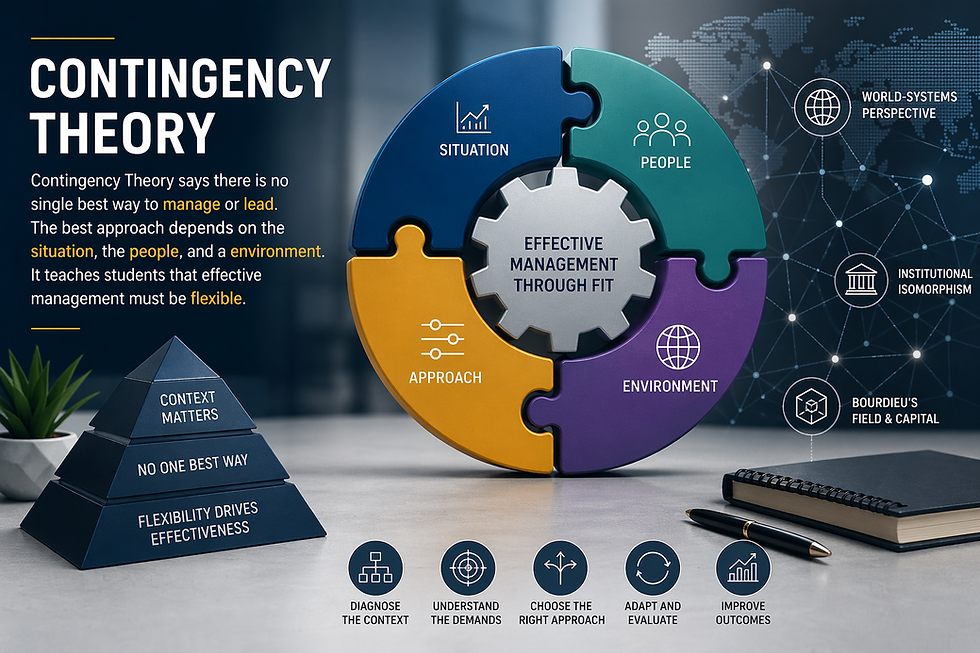
Contingency theory remains one of the most practical and influential ideas in management and leadership studies. Its central claim is simple: there is no single best way to organize, lead, or manage people in every setting. Instead, the most effective managerial approach depends on the situation, including the nature of the task, the capabilities of employees, the structure of the organization, the pressures of the external environment, and the wider social context in which decisions are made. This article examines contingency theory as a major framework in modern management thought and explains why it continues to matter in contemporary organizations. Although contingency theory emerged as a response to universal models of management, its relevance has grown in a world shaped by uncertainty, globalization, technological change, and institutional complexity.
The article is structured like a journal paper but written in simple, human-readable English. It first introduces the development of contingency theory and its key assumptions. It then places the theory within a broader theoretical framework by connecting it to Bourdieu’s understanding of power, capital, and field; to world-systems theory and global organizational variation; and to institutional isomorphism and the pressures organizations face to appear legitimate. The method section uses a qualitative analytical approach based on conceptual interpretation and comparative discussion. The analysis section shows how contingency theory helps explain leadership, organizational design, decision-making, conflict management, and adaptation across different contexts. The findings suggest that flexibility is not merely a managerial preference but a necessary response to social and organizational complexity. At the same time, the article argues that contingency theory should not be understood as unlimited relativism. Not every approach is equally effective, and context-sensitive management still requires judgment, evidence, and ethical awareness.
The article concludes that contingency theory offers an important lesson for students, managers, and institutions: effectiveness depends on fit. Good leadership is not based on rigid formulas but on the capacity to read situations carefully and respond in ways that match real conditions. In this sense, contingency theory remains one of the clearest bridges between management theory and practical decision-making.
Introduction
Management studies have long searched for the best way to organize work, motivate employees, and lead institutions. Early management thinkers often believed that one ideal structure or leadership style could be applied across many organizations. Scientific management emphasized efficiency, standardization, and close supervision. Administrative theory stressed clear principles of authority, order, and planning. Human relations theory later highlighted the importance of social needs, motivation, and communication. Each of these traditions made valuable contributions, yet each also tended, at least at certain stages, to suggest general principles that might apply widely.
Contingency theory challenged that way of thinking. It argued that management cannot be separated from context. A leadership style that works in a stable manufacturing company may fail in a fast-changing technology firm. A formal structure that supports quality control in one institution may create delay and frustration in another. A participative approach may help highly skilled teams, while a more directive style may be necessary in emergencies or under conditions of low experience. In short, effectiveness depends on fit between organizational practices and situational conditions.
This idea had a major impact on management education because it replaced certainty with judgment. Instead of asking, “What is the best style of management?” contingency theory asks, “What style is most appropriate under these circumstances?” That shift is important for students because it reflects the reality of organizational life. Managers rarely work in simple environments. They face different personalities, different tasks, changing markets, uneven resources, cultural variation, and external pressures from regulation, competition, and public expectations. Under such conditions, a fixed managerial formula often performs poorly.
Contingency theory also matters because it encourages practical thinking without abandoning theory. It does not reject concepts, models, or evidence. Rather, it teaches that concepts must be applied with sensitivity to conditions. This helps explain why the theory has remained influential across leadership studies, organizational design, strategic management, and public administration. It is flexible enough to address different institutional environments while still offering a disciplined way to think about effectiveness.
In contemporary settings, the value of contingency theory is even more visible. Organizations operate in a world marked by rapid technological transformation, digital communication, global supply chains, political uncertainty, and changing workforce expectations. Hybrid work arrangements, cross-border teams, economic crises, and social pressures all create conditions in which managers must adjust their methods. The assumption that one model fits all situations becomes increasingly difficult to defend.
At the same time, contingency theory should not be treated as a simple slogan about flexibility. Saying that “it depends” is not enough. The real strength of the theory lies in identifying what it depends on and how different variables shape outcomes. Those variables may include task uncertainty, organizational size, leadership-member relations, technological complexity, environmental turbulence, or cultural expectations. Effective use of contingency theory therefore requires careful analysis rather than improvisation alone.
This article explores contingency theory in depth. It examines its main assumptions, traces its intellectual foundations, and discusses its continuing relevance in management education. It also expands the discussion by bringing contingency theory into conversation with broader social theory. Bourdieu helps explain how power, position, and different forms of capital affect managerial choices inside organizational fields. World-systems theory helps situate contingency within global inequalities and uneven organizational environments. Institutional isomorphism adds another important layer by showing that organizations do not only adapt to tasks and technologies; they also adapt to social expectations, professional norms, and pressures for legitimacy.
By combining management theory with wider social analysis, this article argues that contingency theory remains useful not only because it explains organizational flexibility, but also because it helps us understand why management choices are shaped by social structure as well as immediate organizational conditions. The theory therefore remains highly relevant for both academic study and practical leadership.
Background and Theoretical Framework
The Basic Idea of Contingency Theory
Contingency theory developed as a reaction against universal approaches to management. Instead of assuming that one organizational form or leadership style is always superior, contingency theorists argued that organizational effectiveness depends on the alignment between internal arrangements and external conditions. The concept of “fit” became central. A structure, practice, or leadership style is effective when it matches the demands of the situation.
This basic idea can be seen in several major strands of contingency thinking. One stream focused on organizational structure. Scholars such as Burns and Stalker distinguished between mechanistic and organic systems. Mechanistic structures were seen as more effective in stable environments, where tasks are routine and roles can be clearly defined. Organic structures were better suited to dynamic environments, where adaptation, communication, and flexibility are more important. Lawrence and Lorsch similarly argued that different parts of an organization may need different structures depending on the uncertainty of their sub-environments, and that integration becomes critical when differentiation increases.
Another major stream focused on leadership. Fiedler’s contingency model argued that leadership effectiveness depends on the match between a leader’s style and situational favorableness, which includes leader-member relations, task structure, and position power. Later theories, such as path-goal theory and situational leadership, also developed the idea that leaders must adjust their behavior according to the needs of followers and the nature of tasks. Across these approaches, the common point is clear: leadership cannot be judged without reference to context.
A third stream addressed decision-making and organizational systems more broadly. Technology, size, environment, and strategy were all treated as variables that shape appropriate organizational responses. The theory therefore became less a single model than a wider perspective on management.
Core Assumptions of the Theory
Contingency theory rests on several assumptions. First, organizations are open systems. They do not operate in isolation. Their performance depends on interactions with the external environment, including markets, regulations, social expectations, technological change, and resource flows. Second, different environments create different demands. A stable environment rewards consistency and efficiency, while a turbulent environment requires innovation and speed. Third, internal arrangements must align with these demands. Structure, leadership, communication, and control systems must fit the level of uncertainty and complexity facing the organization. Fourth, managerial effectiveness depends on diagnosis. Leaders must understand the situation before selecting an approach. Finally, contingency theory assumes that organizations and managers have some room to adapt, although that room may be constrained by resources, traditions, and institutional pressures.
These assumptions make the theory attractive because they reflect organizational reality more closely than rigid formulas do. However, they also make the theory more demanding. It is easier to teach a universal rule than to teach diagnostic judgment. Contingency theory asks managers not only to act, but to interpret.
Contingency Theory and Bourdieu
Bringing Bourdieu into the discussion deepens our understanding of contingency theory. Bourdieu’s work on field, habitus, and capital helps explain why management choices are never purely technical. Organizations are located in fields, which are structured spaces of competition, power, and struggle. Actors within these fields occupy different positions depending on the volume and type of capital they hold, whether economic, cultural, social, or symbolic. Their perceptions and decisions are shaped by habitus, the durable dispositions formed through past experience and social position.
From this perspective, contingency is not only about objective conditions such as task structure or market uncertainty. It is also about how actors perceive those conditions and how much power they have to define appropriate responses. For example, a senior manager with strong symbolic capital may be able to present a restructuring decision as rational and necessary, even when alternative paths exist. A professional group with high cultural capital may resist highly mechanistic controls because such controls threaten its autonomy. A leader’s flexibility may therefore depend not only on managerial skill but also on position within the organizational field.
Bourdieu also reminds us that organizational fit is shaped by inequality. Not all employees have equal capacity to influence how situations are defined. The same organizational environment can be experienced differently by executives, middle managers, and frontline workers. Contingency theory often focuses on the match between structure and environment, but Bourdieu encourages attention to the power relations inside that process of matching. Who decides what the situation requires? Whose knowledge counts? Whose interests are protected by claims about necessity or fit? These questions help make contingency theory more sociologically aware.
Contingency Theory and World-Systems Theory
World-systems theory adds a global dimension. It argues that the world economy is structured unequally between core, semi-peripheral, and peripheral regions. These positions influence access to capital, technology, markets, and institutional stability. When applied to management theory, world-systems analysis suggests that contingency conditions are not evenly distributed across the world. Organizations in different regions face different kinds of uncertainty, regulation, dependency, and resource constraints.
This means that contingency theory should not be interpreted as if all organizations operate on equal ground. A multinational company in a core economy may adopt flexible, decentralized management because it has access to capital, advanced communication systems, and highly trained labor. A small organization in a peripheral context may face greater environmental instability, infrastructural limitations, political risk, or dependency on stronger external actors. The best managerial fit in one location may not be realistic in another.
World-systems theory therefore helps correct a common weakness in management literature: the tendency to treat theories developed in powerful industrial settings as universally applicable. Contingency theory is more adaptable than universal models, but it can still become narrow if it ignores global inequality. A fuller understanding requires recognizing that context includes not only firm-level conditions but also historical and geopolitical position.
Contingency Theory and Institutional Isomorphism
Institutional isomorphism, associated with DiMaggio and Powell, offers another useful extension. It argues that organizations often become similar over time because of coercive, normative, and mimetic pressures. Coercive pressures come from law, regulation, and dependence on powerful actors. Normative pressures come from professional education and shared standards. Mimetic pressures arise when organizations copy others under uncertainty.
This perspective matters because contingency theory sometimes assumes that organizations adapt rationally to their environments in order to improve efficiency. Institutional theory shows that organizations also adapt in order to appear legitimate. A management system may be adopted not because it is the technically best fit, but because it is widely respected, professionally fashionable, or expected by regulators and stakeholders.
This insight complicates contingency theory in a productive way. Managers do not only ask, “What works?” They also ask, “What will be accepted?” In many institutions, especially universities, hospitals, public agencies, and large corporations, legitimacy matters as much as technical efficiency. A leader may adopt formal planning systems, performance metrics, or participative structures partly because these practices signal professionalism and credibility. The organizational environment is therefore both technical and institutional.
When combined, contingency theory and institutional isomorphism provide a richer account of management. Organizations seek fit with tasks and environments, but they do so under pressures to conform to recognized models. Effective management must therefore balance practical demands with social legitimacy.
Why This Theoretical Combination Matters
The combination of contingency theory with Bourdieu, world-systems theory, and institutional isomorphism produces a more complete framework for management studies. Contingency theory explains why there is no single best way to manage. Bourdieu explains how power and capital shape the interpretation of situations. World-systems theory shows that contingency is embedded in unequal global structures. Institutional isomorphism demonstrates that organizations adapt not only for efficiency but also for legitimacy.
Together, these perspectives move management theory beyond narrow technical reasoning. They show that flexibility is necessary, but also that flexibility is shaped by power, history, and institutional expectation. This broader framework is especially valuable for students because it links practical managerial choices to wider social realities. It teaches that management is not only about choosing methods. It is also about understanding context in its fullest sense.
Method
This article uses a qualitative conceptual method. It does not present new statistical data or field experiments. Instead, it offers an interpretive analysis of contingency theory through close engagement with major management ideas and broader social theory. The purpose is explanatory rather than predictive. The article seeks to clarify what contingency theory means, how it developed, why it remains important, and how it can be enriched through interdisciplinary reflection.
The method involves four steps. First, the article identifies the core claims of contingency theory in management and leadership studies. This includes attention to organizational structure, leadership style, decision-making, and adaptation to environmental change. Second, it compares these claims with wider theoretical perspectives, particularly Bourdieu’s theory of field and capital, world-systems theory, and institutional isomorphism. Third, it applies this combined framework to recurring organizational themes such as leadership, organizational design, employee management, and strategic response to uncertainty. Fourth, it draws analytical findings about the educational and practical value of contingency theory.
A conceptual method is appropriate here for several reasons. First, contingency theory is itself a broad perspective rather than a single narrow model. Its meaning is best understood through interpretation of its assumptions and applications. Second, the article aims to make the theory accessible to students in simple English while maintaining academic depth. A conceptual approach allows clear explanation without reducing the discussion to technical measurement. Third, the inclusion of sociological perspectives such as Bourdieu and world-systems theory requires a method that can connect different traditions of thought rather than test one variable against another.
The article uses comparative reasoning rather than formal hypothesis testing. Different organizational situations are discussed to show how management effectiveness depends on context. These situations are not presented as detailed case studies from one single organization. Instead, they are treated as analytical examples that help illustrate how contingency theory works in practice. This allows the discussion to remain broad enough for teaching purposes while still addressing realistic managerial problems.
One limitation of this method is that it cannot prove causality in the strict empirical sense. It does not measure performance outcomes across a sample of firms. Another limitation is that conceptual writing may risk overgeneralization if it is not grounded in recognized theory. To reduce that risk, the article relies on established management and sociological literature and treats its claims as analytical interpretations rather than universal laws.
Despite these limits, the method is suitable for the aims of the article. Management education often requires conceptual clarity before empirical testing. Students need to understand why a theory matters, what problems it addresses, and how it connects with other ways of thinking. By using a structured analytical method, this article aims to provide that clarity.
Analysis
Contingency Theory as a Rejection of Managerial Absolutism
One of the greatest strengths of contingency theory is its rejection of managerial absolutism. In many early models of management, the search for universal principles was treated as a scientific goal. Yet organizations differ too widely for absolute rules to work consistently. Industries differ. Workers differ. Technologies differ. National and institutional settings differ. Even the same organization may face radically different conditions over time. A startup, a mature corporation, a public university, and an emergency response unit cannot all be managed in the same way.
Contingency theory recognizes this diversity and offers a more realistic view of management. It suggests that effectiveness lies not in loyalty to one doctrine, but in the capacity to align methods with conditions. This does not mean managers should be inconsistent or opportunistic. It means they should be responsive to the demands of the situation. In practice, this often separates thoughtful leadership from mechanical administration.
For example, a leader facing a crisis may need to act quickly, communicate clearly, and centralize decisions for a short period. The same leader, in a period of strategic planning or innovation, may need to invite participation, encourage experimentation, and decentralize authority. Both approaches may be appropriate at different moments. The failure lies not in choosing one or the other, but in applying the wrong one to the wrong situation.
Leadership and the Problem of Fit
Leadership is one of the clearest areas where contingency theory has practical value. Students are often taught different leadership styles such as authoritarian, democratic, transformational, transactional, participative, or supportive. Without contingency thinking, these styles may appear as competing ideals, with one imagined as morally or practically superior in all cases. Contingency theory corrects this by asking when each style is likely to be effective.
A highly experienced research team may respond well to participative leadership because members value autonomy and possess strong technical knowledge. A newly formed team with unclear roles may need more structure and direction. Workers dealing with repetitive tasks may benefit from clarity, predictability, and incentive systems. Creative professionals may need broader discretion and trust. In dangerous or time-sensitive settings, prolonged consultation may reduce effectiveness. In knowledge-intensive settings, excessive control may reduce initiative and morale.
This does not mean that all leadership styles are equally desirable. Some styles may be ethically problematic or damaging over time. However, contingency theory shows that leadership cannot be judged by form alone. It must be evaluated in relation to people, tasks, timing, and environment.
Here Bourdieu offers an important supplement. Leaders do not operate in neutral space. Their authority depends partly on symbolic capital, recognized legitimacy, and institutional position. A leader may attempt a participative style, but if followers do not see that leader as credible, participation may remain formal rather than real. Likewise, a directive approach may be accepted in one field because hierarchy is strongly institutionalized, but resisted in another where professional autonomy is deeply valued. Leadership fit is therefore not only situational in a technical sense; it is also relational and symbolic.
Organizational Structure and Environmental Uncertainty
Contingency theory has had strong influence on the study of organizational structure. Stable environments often support mechanistic structures with clear authority, formal rules, and specialized roles. These structures may improve consistency, coordination, and control. Dynamic environments, by contrast, often require more organic structures, with flexible roles, lateral communication, and faster adaptation.
This distinction remains highly relevant. Consider the difference between a traditional manufacturing operation with predictable processes and a digital platform company in a fast-moving market. The first may depend on quality control, standardization, and routine monitoring. The second may depend on experimentation, rapid adjustment, and cross-functional teamwork. A rigid structure in the second setting may slow innovation. An overly loose structure in the first may reduce reliability and increase costs.
Yet contingency theory also shows that no structure is fully stable. Organizations often face mixed conditions. One department may operate in a stable environment while another faces uncertainty. Finance departments may require formal control, while research units need flexibility. This creates a need for differentiation and integration, a classic challenge in organizational design. Managers must allow different units to operate in ways suited to their tasks while ensuring the whole organization remains coordinated.
Institutional isomorphism complicates this process. Organizations may adopt fashionable structures because they signal modernity, even when those structures are not the best operational fit. For example, flatter hierarchies, agile teams, or matrix systems may be introduced because other successful organizations use them. Such adoption may increase legitimacy but also create tension if internal conditions are not ready for them. Contingency theory helps remind managers that structural imitation is not enough. Fit must be examined, not assumed.
Employee Motivation and Human Differences
Contingency theory also improves our understanding of employee motivation. Workers are not identical, and motivation does not arise from one universal source. Some employees value autonomy and developmental opportunity. Others prioritize income security, recognition, stability, or clear guidance. A reward system that motivates one group may disappoint another. Similarly, a communication style that suits one workplace culture may fail in a different one.
This is why contingency theory remains important in human resource management. Performance systems, feedback methods, training models, and conflict resolution approaches should all be adjusted to the character of the workforce and the nature of the work. Highly skilled employees may respond positively to empowerment and professional trust. Workers facing routine conditions may prefer consistent expectations and practical support. International teams may require greater cultural awareness and communication sensitivity than more homogeneous groups.
Bourdieu helps deepen this point by showing that employees carry unequal forms of capital into the workplace. Educational credentials, language ability, social networks, and cultural familiarity all shape how workers respond to management. A policy that appears neutral may benefit those already comfortable with institutional expectations while disadvantaging others. Thus, contingency in employee management includes not only task and personality, but also social position and access to resources.
Strategy, Change, and Adaptation
Contingency theory is especially useful in strategy because strategy always unfolds under uncertainty. A firm operating in a stable and protected market may benefit from efficiency, disciplined planning, and incremental improvement. A firm facing rapid disruption may need experimentation, alliances, and quicker reallocation of resources. Public institutions may need to balance political accountability with service flexibility. Educational organizations may face changing student expectations, technological shifts, and regulatory pressures all at once.
In this sense, contingency theory teaches strategic humility. Managers should not assume that methods which produced success in the past will continue to work unchanged. Fit is temporary, not permanent. As environments change, organizations must reassess their structures, leadership patterns, and decision systems.
World-systems theory is useful here because it shows that strategic adaptation is shaped by global hierarchy. Organizations in core regions may have greater capacity to diversify and experiment. Those in weaker positions may face stronger dependency on external capital, imported technology, or volatile demand. Their strategy may need to focus more on resilience, partnership, or selective specialization. What counts as strategic flexibility is therefore influenced by global structure.
This also matters in education. Students often learn management theory through examples from large corporations in powerful economies. Contingency theory encourages a more careful question: under what conditions did those strategies work, and are those conditions present elsewhere? This question is essential for avoiding shallow transfer of models across very different contexts.
Decision-Making Under Complexity
Contingency theory treats decision-making as context-bound rather than purely rational in the abstract. Decisions differ depending on time pressure, information quality, task ambiguity, organizational culture, and stakeholder expectations. In some situations, broad consultation improves decision quality because it brings diverse knowledge into the process. In other situations, it slows response and creates confusion. Sometimes formal analysis is essential; at other times, experienced judgment matters more because information is incomplete.
This insight is highly relevant in contemporary organizations where data are abundant but not always clear. The growth of digital systems has not removed contingency. In many ways, it has increased it. Managers often have more information than before, but also more noise, more speed, and more visibility. Decision-making must therefore be matched not only to strategic goals but also to the organization’s ability to interpret and use information.
Institutional isomorphism again adds complexity. Decision systems are often shaped by professional norms, audits, reporting expectations, and standard procedures. These systems can improve accountability, but they can also reduce flexibility if treated as fixed ends rather than tools. Contingency theory helps restore balance by asking when standardization supports effectiveness and when it becomes a burden.
Contingency Theory in Educational and Public Institutions
Although contingency theory developed largely in organizational and management research, it is highly relevant in educational institutions and public administration. Schools, universities, and public agencies operate under multiple and sometimes conflicting pressures. They must satisfy regulatory requirements, professional standards, public expectations, and internal educational goals. Their work is often difficult to measure with simple efficiency models.
In such settings, contingency theory is particularly valuable because it avoids one-dimensional thinking. A highly centralized system may ensure compliance but weaken local responsiveness. A fully decentralized system may support innovation but reduce consistency and accountability. Leadership in these institutions must often shift between consultation, formal coordination, and strategic direction depending on the issue at hand.
Institutional isomorphism is especially visible here. Educational institutions often adopt similar quality systems, reporting structures, and managerial language because of accreditation, policy, and professional expectation. Yet the real effectiveness of such systems depends on context. A reporting tool that supports improvement in one institution may become a symbolic exercise in another. Contingency theory therefore helps distinguish meaningful adaptation from symbolic conformity.
The Limits of Contingency Theory
Despite its strengths, contingency theory has limits. One criticism is that it can become too descriptive. If every outcome is explained by saying “it depends,” the theory risks losing sharpness. Another concern is measurement. It is often difficult to determine which variables matter most in a given situation and how they interact. Real organizations face multiple contingencies at once, and these do not always point in the same direction.
Another limitation is that contingency theory can appear politically neutral when it is not. Decisions about fit may serve some interests more than others. A restructuring described as necessary for environmental adaptation may also shift power upward or reduce worker autonomy. Bourdieu helps reveal this issue by showing that claims about necessity are often embedded in struggles over capital and authority.
A further limit is that contingency theory may understate the role of values. Management decisions are not only technical responses to situations. They also involve ethical choices. A highly effective control system may increase output while reducing dignity or trust. A contingency approach that focuses only on performance may miss these concerns. Good management must therefore combine situational fit with ethical reflection.
Even with these limits, contingency theory remains valuable because it encourages a realistic and disciplined approach to complexity. Its weaknesses can be reduced when it is connected to broader social theory, as this article has attempted to do.
Findings
Several major findings emerge from this analysis.
First, contingency theory remains one of the most useful frameworks in management studies because it rejects the idea of universal managerial solutions. Its core lesson is still highly relevant: effectiveness depends on the relationship between management approach and situational conditions. This makes the theory especially important in complex and changing environments.
Second, the theory is strongest when understood through the concept of fit. Leadership style, organizational structure, decision-making systems, and employee management practices are not effective in isolation. Their value depends on how well they align with the task, the people involved, the level of uncertainty, and the external environment. This makes diagnostic skill central to management.
Third, contingency theory becomes richer when linked with broader social theory. Bourdieu shows that context is shaped by power, position, and different forms of capital. Management choices are not simply technical; they are socially structured. World-systems theory reveals that contingency conditions are unevenly distributed across the global system, meaning that organizational strategies cannot be separated from historical and geopolitical inequality. Institutional isomorphism demonstrates that organizations adapt not only for efficiency but also for legitimacy, which means management choices are influenced by social expectations and professional norms.
Fourth, flexibility should not be confused with randomness. Contingency theory does not suggest that managers should change style constantly without reason. Rather, it suggests disciplined adaptation based on careful reading of conditions. Good managers are not those who follow every trend, but those who understand what their specific situation requires.
Fifth, the theory has major educational value. For students, contingency theory offers a practical bridge between abstract concepts and real organizational problems. It teaches them to ask better questions: What kind of environment is this? What kind of people are involved? What degree of structure is needed? What external pressures shape the organization? What counts as legitimacy here? These questions are essential for developing managerial judgment.
Sixth, contingency theory is especially relevant in the present era. Rapid technological change, global interdependence, hybrid work, institutional pressure, and uncertain markets all make fixed management formulas less convincing. In this environment, the ability to adapt intelligently becomes a central leadership skill.
Finally, the article finds that contingency theory must be used critically. It should not become a neutral language that hides power or justifies inequality. Managers and scholars must remain aware that claims about fit can support some groups over others. The best use of contingency theory therefore combines practical flexibility with sociological insight and ethical responsibility.
Conclusion
Contingency theory has earned its place as a foundational idea in management and leadership studies because it reflects a simple but powerful truth: there is no single best way to manage. Effective leadership depends on the situation, the people, the task, the organization, and the environment. This lesson is highly important for students because it moves management education away from rigid formulas and toward careful judgment.
The theory emerged as a challenge to universal approaches, yet it did more than criticize earlier models. It offered a constructive alternative built around fit, adaptation, and contextual understanding. Whether the topic is leadership style, organizational design, employee motivation, strategic response, or decision-making, contingency theory reminds us that effectiveness is relational. A method works not because it is fashionable or permanent, but because it matches real conditions.
This article has argued that contingency theory becomes even more valuable when connected to broader social thought. Bourdieu helps explain that management takes place within fields shaped by power, capital, and position. World-systems theory reminds us that organizational conditions vary across unequal global contexts. Institutional isomorphism shows that organizations respond not only to technical problems but also to social pressures for legitimacy. These perspectives deepen contingency theory by showing that context is never only operational; it is also social, historical, and political.
For modern organizations, the importance of contingency theory is difficult to overstate. The contemporary environment is marked by uncertainty, rapid change, and institutional complexity. Under such conditions, rigid management doctrines are often too narrow. Managers need flexibility, but not loose improvisation. They need the ability to diagnose conditions, understand people, read institutional pressures, and select responses that fit the moment without losing ethical direction.
For students, this is perhaps the most important lesson. Management is not the art of applying one formula everywhere. It is the practice of making thoughtful choices in changing conditions. Contingency theory teaches that strong leadership is not built on stubborn consistency alone, but on informed adaptability. A good manager knows that methods must serve reality, not the other way around.
In the end, contingency theory remains valuable because it treats management as a living practice rather than a closed system of rules. It encourages humility, observation, flexibility, and judgment. In a world where organizations face different pressures and people bring different needs, this remains one of the most realistic and educational approaches available in the study of management.
Hashtags
#ContingencyTheory #ManagementStudies #LeadershipTheory #OrganizationalBehavior #StrategicManagement #HigherEducation #InstitutionalTheory #Bourdieu #WorldSystemsTheory #STULIB
References
Bourdieu, P. (1986). The forms of capital. In J. Richardson (Ed.), Handbook of Theory and Research for the Sociology of Education. Greenwood.
Bourdieu, P. (1990). The Logic of Practice. Stanford University Press.
Bourdieu, P., & Wacquant, L. J. D. (1992). An Invitation to Reflexive Sociology. University of Chicago Press.
Burns, T., & Stalker, G. M. (1961). The Management of Innovation. Tavistock.
Child, J. (1972). Organizational structure, environment and performance: The role of strategic choice. Sociology, 6(1), 1–22.
DiMaggio, P. J., & Powell, W. W. (1983). The iron cage revisited: Institutional isomorphism and collective rationality in organizational fields. American Sociological Review, 48(2), 147–160.
Donaldson, L. (2001). The Contingency Theory of Organizations. Sage.
Fiedler, F. E. (1967). A Theory of Leadership Effectiveness. McGraw-Hill.
Lawrence, P. R., & Lorsch, J. W. (1967). Organization and Environment: Managing Differentiation and Integration. Harvard University Press.
Mintzberg, H. (1979). The Structuring of Organizations. Prentice Hall.
Morgan, G. (2006). Images of Organization. Sage.
Perrow, C. (1986). Complex Organizations: A Critical Essay. McGraw-Hill.
Scott, W. R. (2014). Institutions and Organizations: Ideas, Interests, and Identities. Sage.
Thompson, J. D. (1967). Organizations in Action. McGraw-Hill.
Wallerstein, I. (1974). The Modern World-System. Academic Press.
Wallerstein, I. (2004). World-Systems Analysis: An Introduction. Duke University Press.
Woodward, J. (1965). Industrial Organization: Theory and Practice. Oxford University Press.


Comments