Cultural Dimensions Theory: Explaining Power Distance, Individualism, and Uncertainty Avoidance to Students
- 1 hour ago
- 18 min read
Abstract
This article explains #Cultural_Dimensions_Theory in plain language for students while keeping the rigour expected of a scholarly review. The theory, developed by Geert #Hofstede from a large survey of employees working for one multinational company, proposes that the values held by people in different countries can be compared along a small number of measurable scales. The best known of these are #power_distance, #individualism versus #collectivism, and #uncertainty_avoidance, alongside masculinity–femininity, long- and short-term orientation, and indulgence versus restraint. The article does three things. First, it defines each dimension simply, using everyday classroom and workplace examples so that learners can grasp the ideas without prior training in statistics or sociology. Second, it sets the theory inside a wider conversation by reading it against three other bodies of work: Pierre #Bourdieu's account of #habitus and #cultural_capital, Immanuel Wallerstein's #world_systems_theory, and the #institutional_isomorphism of DiMaggio and Powell. These lenses help students see what the dimensions reveal and what they hide. Third, the article draws out teaching implications, arguing that #national_culture scores work well as starting questions but poorly as final answers. Recent validation studies suggest the original scores need revision, and that culture is better understood as a moving, contested practice than as a fixed national trait. The conclusion offers practical guidance for using the framework responsibly in #cross_cultural education, and proposes that the dimensions are most valuable when paired with theories of power, structure, and convergence rather than taught in isolation.
1. Introduction
Students today rarely study, work, or even socialise inside a single national bubble. A first-year class may contain people from a dozen countries; a group project may connect learners across three time zones; a future employer may post staff across continents. In these settings, differences in how people behave are obvious, and the question that follows is just as natural: why do groups of people, on average, tend to value different things? #Cultural_Dimensions_Theory is one of the most widely taught attempts to answer that question, and for many students it is their first formal encounter with the idea that culture can be described, compared, and even scored.
The appeal of the theory is easy to understand. It takes something that feels vague and personal, the "feel" of a place, and turns it into a set of numbers that can be placed side by side. A learner can look at two countries, read off their #power_distance scores, and form a quick expectation about how a meeting in each place might run. This is genuinely useful as a first orientation. It gives beginners a shared language, a way to put their hunches into words and to test those hunches against evidence rather than guesswork. The danger, and the reason this article exists, is that the same numbers are easy to misuse. Treated carelessly, they harden into #stereotypes, encourage learners to predict an individual's behaviour from a national average, and present culture as a fixed inheritance rather than something people make, contest, and remake over time.
The gap between these two outcomes is mostly a matter of how the material is taught. A single number attached to a country is a powerful teaching aid and a powerful trap at the same time. Used as a verdict, it tells a student that they already know what a person from a given country will do. Used as a question, the same number tells a student where to start looking and what to ask next. This article is built around that distinction, and it argues that the difference between a label and a question is precisely what the standard presentation of the theory tends to leave out.
The purpose of the article is therefore twofold. The first aim is plain explanation: to set out what #Hofstede actually proposed, in language a student can follow, with examples that connect to lived experience. The second aim is careful framing. Rather than presenting the dimensions as the whole story, the article reads them against three other traditions in social science. #Bourdieu reminds us that culture is not just a set of shared values floating above society but a resource that is unevenly distributed and used to maintain advantage. #World_systems_theory reminds us that countries are not free-standing islands of #national_culture but positions within a single global economy that has #core and #periphery zones. #Institutional_isomorphism reminds us that organisations across the world often come to resemble one another, which complicates any tidy story of stable national difference.
Three questions guide the discussion. How can the central dimensions be explained accurately and simply to learners who are new to the field? What do the three critical lenses add that the dimensions alone leave out? And what does responsible teaching of this material look like in practice? By the end, the reader should be able to use the framework as a thinking tool rather than a labelling machine, and to recognise both its real strengths and its well-documented limits.
2. Background and Theoretical Framework
2.1 The origins of the theory
The framework grew out of a practical accident. In the late 1960s and early 1970s, #Hofstede had access to a very large set of employee attitude surveys gathered inside a single multinational corporation, often identified in later accounts as IBM. Because the employees did similar work for the same firm, many obvious explanations for differences in their answers, such as company policy or job type, could be held roughly constant. What remained, Hofstede argued, was the influence of the country people came from. From this material he built statistical patterns and named them as dimensions of #national_culture (Hofstede, Hofstede, & Minkov, 2010).
The original work proposed four dimensions, later expanded to six. Each is presented as a continuum rather than a box, and each country is given a score that locates it relative to others. It is worth stressing to students from the very start that these are #averages: they describe a tendency across millions of people, not a rule that fits any single person. Two individuals from a high-scoring country may differ from each other far more than the two national averages differ. This single point, repeated often, prevents most of the misunderstandings that follow.
2.2 The six dimensions in plain terms
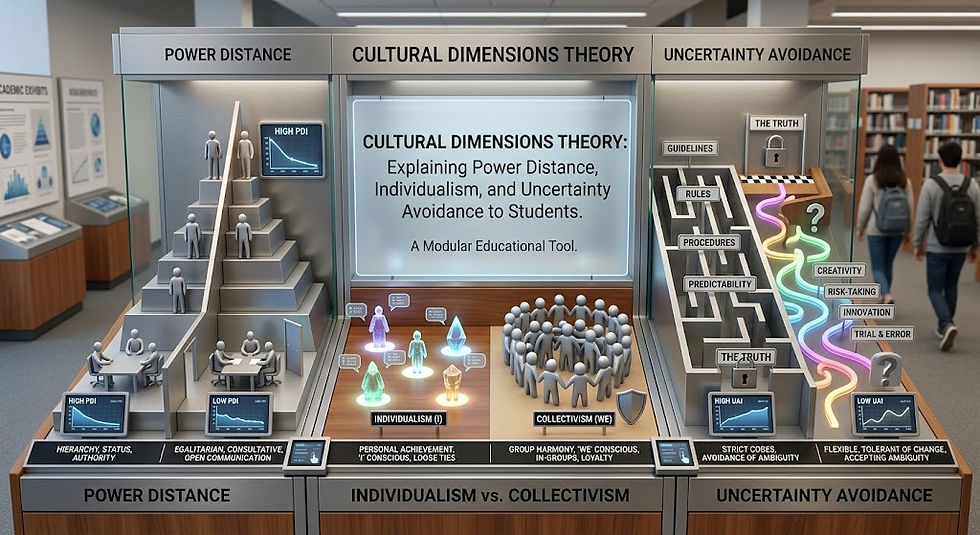
#Power_distance describes how readily people in a society accept that power is distributed unequally. In a high-power-distance setting, a large gap between a boss and a junior employee, or between a teacher and a student, feels normal and is rarely questioned out loud. Decisions flow downward, and disagreeing with a senior figure in public can seem disrespectful. In a low-power-distance setting, people expect to be consulted, titles matter less, and challenging a senior figure is more acceptable and even welcomed (Hofstede, 2011). A student can test the idea by imagining how comfortable they would feel openly correcting a professor in front of the class.
#Individualism and #collectivism sit at two ends of one scale. In an individualist society, people are expected to look after themselves and their immediate family, personal achievement is prized, and identity is built around the self. In a collectivist society, people are tied from birth into wider, loyal groups, often extended families or communities, and the interests of the group frequently come before the wishes of the individual. The same behaviour can look like admirable independence through one lens and like selfishness through the other, which is exactly why the scale is useful for noticing one's own assumptions.
#Uncertainty_avoidance captures how comfortable people are with ambiguity and the unknown. Societies high on this dimension tend to prefer clear rules, detailed plans, formal procedures, and predictable routines, and they can feel anxious when situations are left open-ended. Societies low on the dimension are more relaxed about improvisation and tolerate difference, risk, and unstructured situations more easily. It is important to separate this from risk-taking: a society can dislike ambiguity while still tolerating familiar, well-understood risks.
The remaining three dimensions round out the picture. #Masculinity versus #femininity contrasts societies that reward competition, assertiveness, and visible success with those that place more weight on care, modesty, quality of life, and cooperation. #Long_term_orientation distinguishes cultures that emphasise perseverance, thrift, and future rewards from those more focused on tradition, social obligation, and the present. #Indulgence versus restraint separates societies that allow relatively free gratification of enjoyment and fun from those that regulate it through strict social norms. Taught together, the six dimensions give learners a compact map of where societies tend to differ, even before any deeper theory is added.
2.3 Three critical lenses
A student who learns only the six dimensions has learned a vocabulary, but not its limits. Three further traditions help locate the vocabulary inside a fuller account of social life, and each answers a question the dimensions leave open.
The first is the work of Pierre #Bourdieu. For Bourdieu, behaviour is shaped by #habitus, a set of dispositions, tastes, and reflexes that people absorb so deeply from their upbringing that the behaviour feels natural rather than learned. People also hold #cultural_capital, which includes the knowledge, manners, credentials, accents, and styles that a society treats as valuable and that can be converted into advantage in school or work. Crucially, cultural capital is unequally shared, and those who hold the dominant forms can exercise #symbolic_power, making their own way of doing things appear as the correct or even the only natural way (Bourdieu, 1986). Read through this lens, a national culture is not a single shared set of values but a contested field in which some groups set the standards and others are measured against them. Recent work has carried these ideas directly into encounters between cultures, arguing that moving between social worlds can produce a strained or "cleft" habitus, and that the capacity to operate across cultural settings is itself a form of capital worth studying (Pöllmann, 2021).
The second lens is #world_systems_theory, associated with Immanuel Wallerstein. This approach asks us to stop studying nations one at a time and instead treat the whole planet as a single, integrated capitalist economy divided into zones. #Core countries hold advanced industry, high wages, and economic dominance; #periphery countries supply raw materials and cheap labour and remain dependent; and a #semi_periphery sits between the two, both exploited by the core and exploiting the periphery in turn (Wallerstein, 2004). The point for our purposes is that what looks like a free-standing #national_culture may partly reflect a country's position within this hierarchy. Values connected to risk, planning, ambition, or hierarchy may track economic power and history as much as any deep cultural essence, and treating them as pure national character can quietly hide the structure underneath.
The third lens is #institutional_isomorphism, set out by Paul DiMaggio and Walter Powell. They observed that organisations operating in the same field tend to grow more alike over time, even when becoming similar does not make them more efficient. They named three pressures driving this convergence. #Coercive_isomorphism comes from laws, regulations, and powerful funders that force organisations to adopt particular structures. #Mimetic_isomorphism happens when, facing uncertainty, organisations copy others they regard as successful, hoping to borrow their legitimacy. #Normative_isomorphism flows from professions and shared training, so that managers educated in similar business schools carry similar templates wherever they go (DiMaggio & Powell, 1983). The authors have since revisited the idea, noting both its lasting reach and the need to account for cases where fields pull apart rather than converge (Powell & DiMaggio, 2023; Beckert, 2010). For students of culture, this raises a sharp question: if a global business class is trained in the same models and copies the same practices, how stable can purely national differences really be?
Together these three lenses do not replace #Cultural_Dimensions_Theory. They surround it. Bourdieu adds power and inequality inside a society. World-systems theory adds global economic structure between societies. Institutional isomorphism adds the forces pushing societies and their organisations to converge. The dimensions describe a snapshot; these traditions describe the pressures shaping and reshaping the picture.
2.4 From verdict to question
Before moving to method, it is worth stating the framing principle that ties the lenses together. A dimension score answers the question "how does this society compare on this scale?" The three traditions reframe that answer as the beginning of further questions: who benefits from this pattern, where does the society sit in the world economy, and how fast are its institutions converging with others? Teaching the dimensions as the end of inquiry produces stereotypes. Teaching them as the opening of inquiry produces genuine #cross_cultural understanding. The rest of the article works out what that shift means in practice.
3. Method
This article is a conceptual and narrative review rather than an empirical study, and it is honest with the reader about what that means. No new survey data were collected, and no fresh statistical scores were generated. Instead, the method is interpretive: established sources were gathered, read against one another, and organised around a teaching problem, namely how to present Cultural Dimensions Theory to students in a way that is both clear and critically responsible.
Sources were selected in two groups. The first group consists of foundational statements of each theory, included because they are the primary records of the ideas: Hofstede's own accounts of the dimensions, #Bourdieu on forms of capital, Wallerstein on world-systems analysis, and DiMaggio and Powell on institutional isomorphism. These are older than five years by necessity, because they are the origin points of the frameworks under discussion, and no summary can responsibly replace the original statements. The second group consists of recent work, published within roughly the last five years, that tests, revises, or extends these ideas. This includes validation research on whether the cultural dimensions hold up statistically, recent reflections by the original isomorphism authors, and recent applications of Bourdieu to intercultural settings. Combining the two groups lets the article respect the origins of each theory while taking current scholarship seriously.
The analytic strategy has three steps. First, each dimension is restated in plain terms with concrete examples, prioritising clarity for a student audience over technical completeness. Second, each is examined through one or more of the critical lenses, asking what the lens reveals that the dimension alone misses. Third, the results are synthesised into teaching guidance, so that the article ends with something a reader can actually use in a classroom. The standard for including a claim was deliberately conservative: where recent evidence challenges the original framework, that challenge is reported plainly rather than smoothed over, and where the framework holds up, that too is reported.
The limits of this method should be stated openly. A narrative review reflects the choices of its author and cannot claim the completeness of a systematic review that screens every available study against fixed criteria. The examples used to illustrate dimensions are simplified for teaching and should not be read as findings about any specific country. And because the article spans several theoretical traditions, it summarises each at a level suitable for learners rather than for specialists in any one of them; a Bourdieu scholar or a world-systems theorist will find the treatment of their field compressed. These limits are acceptable for the article's stated purpose, which is educational synthesis rather than original measurement, but readers should keep them in view.
4. Analysis
4.1 Power distance read through symbolic power
#Power_distance, taught on its own, can sound like a simple description: some societies accept hierarchy, others resist it. #Bourdieu's contribution is to ask where that acceptance comes from and whom it serves. From his angle, a high tolerance of inequality is not a neutral cultural preference floating in the air. It is reproduced through #symbolic_power, the capacity of dominant groups to make their authority seem natural and deserved rather than imposed (Bourdieu, 1986). A student who reads only a power-distance score might conclude that "people in country X simply respect authority." Reading the same situation through habitus and cultural capital invites a sharper question: who benefits when respect for authority is treated as a shared national value, and what resources allow some people to set the rules that others are expected to follow?
This matters for the classroom directly, because schools and universities are among the main places where #cultural_capital is distributed and where hierarchy is both taught and felt. Recent extensions of Bourdieu argue that the manners, language, and tastes rewarded in education often match those of already-advantaged groups, so that what looks like pure individual merit can quietly reproduce existing advantage across generations (Pöllmann, 2021). A power-distance score captures the surface of this arrangement; the Bourdieu lens captures the machinery underneath. For students, the practical lesson is to treat a high or low score not as an explanation but as a clue pointing toward questions about who holds power and how that power is made to look ordinary.
4.2 Individualism, collectivism, and the world economy
The #individualism–#collectivism scale is probably the most cited part of the whole framework, and it is also where #world_systems_theory has the most to say. Standard teaching links high individualism to wealthy Western economies and higher collectivism to many lower-income societies. Wallerstein's framework warns against reading this as a story about national character alone. If wealthy #core countries tend to score high on individualism while poorer #periphery countries score lower, then part of what the scale measures may be economic position within a single global system rather than a free-floating set of values (Wallerstein, 2004).
This reframing protects students from a subtle and common error: the assumption that values cause economic outcomes in a one-way street, so that "individualist" countries prosper simply because of their individualism. The world-systems view treats the relationship as entangled and historical. The core did not merely hold better values; it occupied an advantaged position built over centuries of unequal exchange, colonial extraction, and accumulated capital. The semi-periphery, including several large industrialising economies, shows mixed and shifting cultural patterns precisely because it sits between the zones, displaying features of both. For a learner, the lesson is to hold the dimension and the global structure together, rather than letting a tidy cultural score explain away an inequality that has deep economic roots.
4.3 Uncertainty avoidance and the pull toward convergence
#Uncertainty_avoidance describes a society's comfort with ambiguity, and #institutional_isomorphism shows why that comfort may be on the move rather than fixed. When organisations face uncertainty, DiMaggio and Powell argue, they tend to copy others they see as successful, a pattern they called #mimetic_isomorphism (DiMaggio & Powell, 1983). On a global scale, this means firms in very different countries may adopt the same management models, the same software platforms, and the same financial reporting standards, not because their underlying values changed but because copying a respected model reduces the risk of being judged to have acted wrongly. Coercive pressure from regulators and powerful partners pushes in the same direction, while shared professional training spreads common templates, so that managers educated in similar programmes carry similar habits across borders.
The implication for uncertainty avoidance is significant. A country's score might suggest a deep and stable preference for rules and predictability, yet the organisations within it may be steadily importing standardised practices from elsewhere, gradually narrowing the visible differences between national business environments. The original authors have themselves revisited the theory and acknowledged that fields do not always converge; under some conditions the very mechanisms that drive similarity can also support divergence, as actors adapt borrowed templates to local needs (Powell & DiMaggio, 2023; Beckert, 2010). For students, this is a useful corrective to any image of culture as frozen in place. The pressures of #globalization are constantly nudging organisations toward common forms, even where popular images of sharp national difference remain strong and emotionally satisfying.
4.4 A worked example for the classroom
It helps to bring the lenses together on a single, simple scenario. Imagine a multinational team in which a senior manager from a high-power-distance background works with junior colleagues from a low-power-distance background, all inside a company that has adopted a global "flat" management style learned from a well-known competitor. The #Cultural_Dimensions_Theory reading is immediate: the manager and the juniors will clash over how freely the juniors should speak up. That reading is useful, but partial. The #Bourdieu lens asks whose communication style counts as "professional" in this company and whose has to be corrected, revealing that the supposedly neutral flat style may itself be the cultural capital of one dominant group. The #world_systems_theory lens asks where the company's headquarters sits and whose practices travel outward as the default, noting that #core economies tend to export their templates to the rest. The institutional-isomorphism lens explains why the "flat" style was adopted in the first place: it was copied from an admired competitor under uncertainty, not chosen because it fit local conditions. A single scenario, read four ways, turns a flat prediction about clashing styles into a layered analysis of power, structure, and convergence. This is the kind of thinking the combined approach is meant to produce in students.
4.5 How solid are the scores?
A responsible analysis cannot stop at conceptual critique; it must also report what measurement studies have found, because students deserve to know whether the numbers they are being taught are reliable. Here the recent evidence is mixed and genuinely important. On one hand, careful replication work has examined whether the survey instruments behind the dimensions actually produce consistent, valid results, and has raised real concerns about how reliably some scales perform when retested on new samples (Gerlach & Eriksson, 2021). On the other hand, large validation efforts have tried to rebuild the model on fresh data, producing revised scores for many countries and suggesting that the framework can be updated and partly defended rather than simply abandoned (Minkov & Kaasa, 2022). A recurring finding across this work is that some dimensions hold together better than others, and that scores designed to compare whole countries should never be used to predict the behaviour of single individuals.
These results support a balanced verdict that students can carry with them. The dimensions are not pseudoscience to be thrown out, nor are they fixed laws of national culture to be obeyed. They are contested measurements: useful at the level of broad comparison, in need of periodic revision, and easily abused when applied to individuals or treated as permanent. Earlier critics had already argued that the model treats culture as too uniform within borders and too static over time (Williamson, 2002), and the recent validation literature gives that older critique a sharper empirical edge.
4.6 Bringing the lenses together
Each dimension, then, gains depth from a different angle. #Power_distance becomes a question about #symbolic_power and who gets to set the rules. Individualism and collectivism become questions about a country's place in the core and periphery structure of the world economy. Uncertainty avoidance becomes a question about how far #institutional_isomorphism is quietly standardising practice across borders. Across all three, Bourdieu's reminder holds: culture is something people do and contest, shaped by habitus and by unequally distributed cultural capital, not a single value set that every member of a nation carries identically. The dimensions give students a shared language; the lenses keep that language from hardening into caricature.
5. Findings
The synthesis points to several findings that can be stated clearly for a student audience.
First, #Cultural_Dimensions_Theory is best understood as a set of comparative heuristics, not a predictive law. The dimensions help learners ask good first questions about an unfamiliar setting, but they describe #averages across large populations and cannot forecast how any particular person will act. Teaching that keeps this distinction in plain view avoids the single most common misuse of the framework, which is the slide from "the country tends toward X" to "this person from that country will do X."
Second, #national_culture is dynamic rather than fixed. The forces named by institutional isomorphism, especially the copying of successful models under uncertainty and the spread of shared professional training, push organisations in different countries toward similar forms. A society's measured tolerance of ambiguity or hierarchy can therefore drift as its institutions absorb global templates, even while older images of difference persist in popular imagination. A score is a photograph of a moving subject, not a fixed portrait.
Third, cultural difference cannot be separated from structural inequality. #World_systems_theory shows that countries occupy positions in a single global economy, so apparent differences in values may partly reflect #core and #periphery roles rather than independent national character. Bourdieu shows that within any society, dominant groups shape what counts as the legitimate way to behave through symbolic power and unequal cultural capital. Either lens, applied honestly, blocks the lazy move of using a cultural score to explain inequality as though it were a free and equal choice of values.
Fourth, the measurements themselves are open to revision. Recent validation research supports keeping the framework while updating its scores and treating some dimensions as more robust than others (Minkov & Kaasa, 2022; Gerlach & Eriksson, 2021). Students should be taught the numbers alongside the debates about the numbers, not as settled and final facts, so that they inherit a healthy and accurate scepticism rather than false certainty.
Fifth, and following from the rest, the framework works best in combination. On its own it risks #stereotyping. Paired with relational and structural theories, it becomes a starting point for genuine inquiry: a way to notice difference and then ask why the difference exists, who benefits from it, and whether it is changing. This combined use is the central pedagogical finding of the article, and the worked example in the analysis shows what it looks like when a single situation is read through several lenses at once.
6. Conclusion
#Cultural_Dimensions_Theory has earned its place in classrooms because it does something rare: it makes the abstract idea of culture concrete enough to discuss, compare, and study without specialist training. For a student meeting #cross_cultural questions for the first time, the dimensions of power distance, individualism, and uncertainty avoidance offer a clear and memorable vocabulary. That value is real and should not be dismissed in the rush to criticise.
The argument of this article is that the vocabulary is a beginning, not an end. Used alone, national scores invite stereotypes and present culture as a fixed inheritance. Used alongside #Bourdieu, #world_systems_theory, and #institutional_isomorphism, the same scores become prompts for deeper questions. Bourdieu turns attention to power and inequality inside a society. World-systems theory locates each national culture within a global hierarchy of core and periphery. Institutional isomorphism reveals the steady pressure pushing organisations everywhere toward common forms. Recent measurement studies add a final note of humility: the scores need updating, some dimensions are sturdier than others, and country averages must never be read as descriptions of individuals.
For teaching, the practical guidance is straightforward. Introduce the dimensions clearly and honestly. Show their usefulness for first comparisons, and let students enjoy the satisfaction of having a precise language for what they had only sensed before. Then immediately complicate the picture, asking who benefits from a given cultural pattern, how a country's economic position shapes its values, and how #globalization is changing the picture even as the lesson is taught. The limitation of this article is the limitation of any narrative review: it synthesises and interprets rather than measuring anew, and its examples are simplified for learning. Future work could test directly how students reason about culture before and after being taught the critical lenses, and whether the combined approach measurably reduces stereotyping in their judgements. The aim throughout has been to help learners hold two ideas at once: that culture can be compared, and that no comparison ever tells the whole story.
#power_distance #individualism #collectivism #uncertainty_avoidance #cultural_dimensions_theory #Hofstede #cross_cultural_management #national_culture #Bourdieu #world_systems_theory #institutional_isomorphism #intercultural_communication #cultural_capital #globalization #STULIB
References
Beckert, J. (2010). Institutional isomorphism revisited: Convergence and divergence in institutional change. Sociological Theory, 28(2), 150–166.
Bourdieu, P. (1986). The forms of capital. In J. G. Richardson (Ed.), Handbook of theory and research for the sociology of education (pp. 241–258). Greenwood Press.
DiMaggio, P. J., & Powell, W. W. (1983). The iron cage revisited: Institutional isomorphism and collective rationality in organizational fields. American Sociological Review, 48(2), 147–160.
Gerlach, P., & Eriksson, K. (2021). Measuring cultural dimensions: External validity and internal consistency of Hofstede's VSM 2013 scales. Frontiers in Psychology, 12, 662604.
Hofstede, G. (2011). Dimensionalizing cultures: The Hofstede model in context. Online Readings in Psychology and Culture, 2(1), 1–26.
Hofstede, G., Hofstede, G. J., & Minkov, M. (2010). Cultures and organizations: Software of the mind (3rd ed.). McGraw-Hill.
Minkov, M., & Kaasa, A. (2022). Do dimensions of culture exist objectively? A validation of the revised Minkov–Hofstede model of culture with World Values Survey items and scores for 102 countries. Journal of International Management, 28(4), 100971.
Pöllmann, A. (2021). Bourdieu and the quest for intercultural transformations. SAGE Open, 11(4), 1–10.
Powell, W. W., & DiMaggio, P. J. (2023). The iron cage redux: Looking back and forward. Organization Theory, 4(4), 1–18.
Wallerstein, I. (2004). World-systems analysis: An introduction. Duke University Press.
Williamson, D. (2002). Forward from a critique of Hofstede's model of national culture. Human Relations, 55(11), 1373–1395.



Comments