Bureaucratic Theory — Explaining Formal Organizations Through Hierarchy, Rules, Roles, and Procedures
- 9 hours ago
- 22 min read
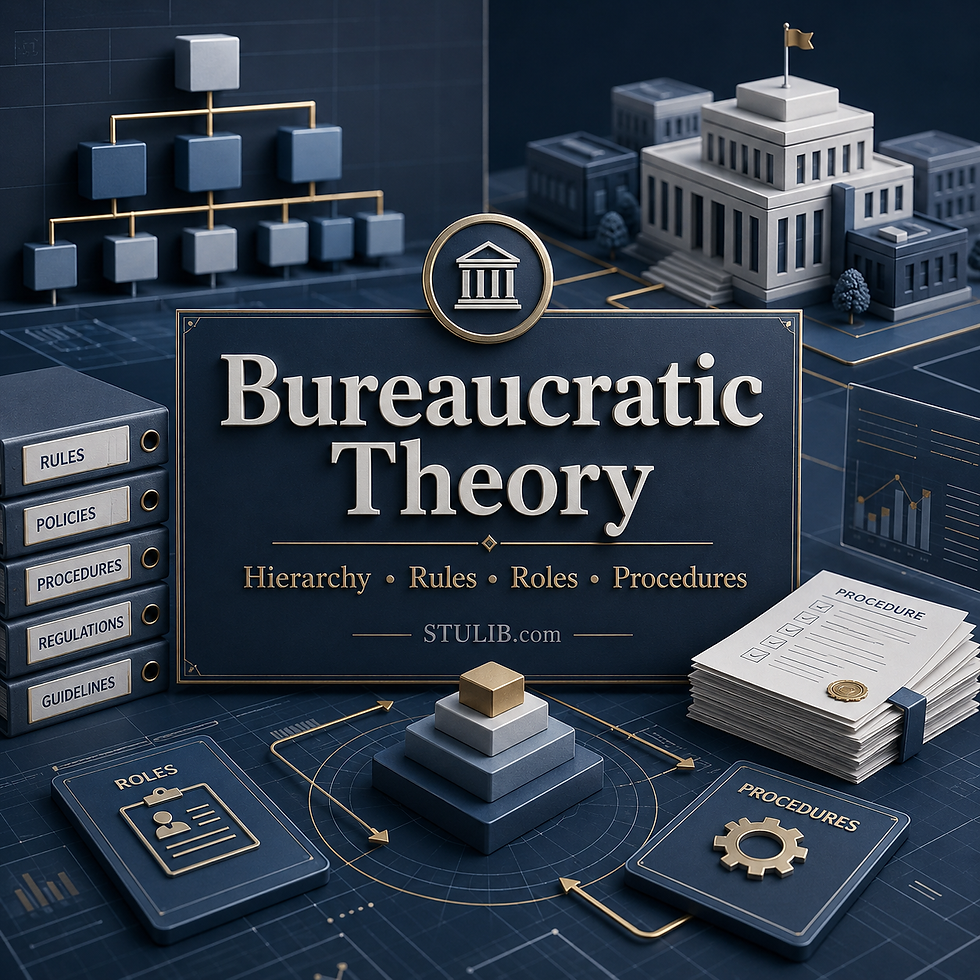
#Bureaucratic_Theory is one of the most important classical theories in the study of #organizations, #management, and #public_administration. It explains how formal organizations operate through clear #hierarchy, written #rules, defined #roles, stable #procedures, and rational authority. The theory is strongly associated with Max Weber, who argued that modern societies need organized systems that can manage complex tasks in a predictable and fair way. For students, #bureaucracy is often understood only as slow paperwork or rigid administration. However, in academic theory, bureaucracy is more than delay or formality. It is a model of organization designed to create order, continuity, responsibility, and efficiency.
This article explains Bureaucratic Theory in simple English while keeping the structure of a Scopus-level academic article. It presents the theoretical background of bureaucracy, its main principles, its strengths, its weaknesses, and its relevance for students of business, education, sociology, and public administration. The article also connects Bureaucratic Theory with #Bourdieu’s ideas of field, capital, and symbolic power; #world_systems_theory, which explains how organizations operate inside global systems of power; and #institutional_isomorphism, which explains why organizations often become similar to one another. The method of the article is conceptual and interpretive. It reviews major theoretical ideas and applies them to modern formal organizations such as universities, companies, hospitals, government offices, international agencies, and quality assurance bodies.
The findings suggest that bureaucracy remains necessary in modern life because large organizations cannot function only through personal relationships or informal decisions. At the same time, bureaucracy can create problems when rules become more important than people, when procedures become too complex, or when hierarchy prevents innovation. The article concludes that students should understand Bureaucratic Theory not as an outdated theory, but as a foundation for analyzing how modern organizations create order, authority, fairness, control, and sometimes inequality.
Introduction
Modern life is organized through formal institutions. People study in #schools and #universities, work in companies, receive services from government offices, visit hospitals, travel through airports, and communicate with banks, courts, ministries, and international organizations. Each of these institutions depends on a system of #roles, #rules, files, departments, responsibilities, records, and procedures. This organized structure is what scholars often call #bureaucracy.
In daily speech, the word bureaucracy is sometimes used negatively. People may say that bureaucracy means “too much paperwork,” “slow offices,” “unnecessary forms,” or “many approvals.” These experiences are real, and they show one side of bureaucracy. However, in social science and management theory, #bureaucracy has a deeper meaning. It refers to a formal way of organizing people and tasks so that large organizations can operate in a stable, predictable, and rational manner.
Bureaucratic Theory is mainly connected with the German sociologist Max Weber. Weber studied the rise of modern society and asked an important question: how do large organizations maintain order when they become too complex for personal control? In small communities, people may manage activities through trust, family relations, friendship, or direct communication. But in large organizations, these informal methods are not enough. A government ministry, a multinational company, a university system, or a hospital network cannot depend only on personal relations. It needs official positions, clear authority, written rules, and standard procedures.
For Weber, bureaucracy was part of a larger historical movement toward #rationalization. This means that modern societies increasingly organize life through calculation, planning, rules, records, and technical knowledge. Bureaucracy was therefore not simply an administrative tool. It was one of the main forms of modern power. It allowed organizations to become more efficient, more predictable, and more impersonal. In Weber’s view, bureaucracy was technically superior to many older forms of organization because it replaced personal favoritism with formal rules and replaced unclear authority with defined responsibility.
This article explains Bureaucratic Theory to students in a clear and academic way. It does not treat bureaucracy as only good or only bad. Instead, it presents bureaucracy as a powerful organizational form with both advantages and risks. On the positive side, bureaucracy can support fairness, transparency, efficiency, accountability, and continuity. On the negative side, it can produce rigidity, delay, distance from human needs, excessive control, and hidden inequalities.
The article also shows that Bureaucratic Theory is not limited to Weber. Later theories help us understand bureaucracy in wider social and global contexts. #Bourdieu helps explain how bureaucratic organizations distribute symbolic power, cultural capital, and institutional recognition. #World_systems_theory helps explain how bureaucracies are connected to global inequalities, international standards, and center-periphery relations. #Institutional_isomorphism helps explain why organizations often copy similar structures, procedures, rankings, accreditation systems, quality labels, and reporting practices.
For students, this topic is useful because bureaucracy is everywhere. Students meet bureaucracy when they register for courses, submit assignments, apply for visas, receive certificates, request transcripts, follow academic regulations, or deal with institutional policies. Later, as professionals, they may work inside bureaucratic organizations or manage them. Understanding Bureaucratic Theory therefore helps students understand not only organizations, but also their own daily experiences inside modern institutional life.
Background and Theoretical Framework
The Classical Origin of Bureaucratic Theory
The classical form of Bureaucratic Theory comes from Max Weber’s analysis of authority and organization. Weber argued that social order depends on forms of legitimate authority. He identified three ideal types of authority: traditional authority, charismatic authority, and rational-legal authority.
#Traditional_authority is based on customs, heritage, and long-standing beliefs. A traditional leader has power because people accept old traditions. #Charismatic_authority is based on the personal qualities of a leader. A charismatic leader inspires followers through personality, vision, courage, or extraordinary appeal. #Rational_legal_authority is based on formal rules, laws, and official positions. Bureaucracy belongs mainly to this third type.
In a bureaucratic organization, authority does not belong to a person as a private possession. It belongs to an office or position. For example, a university dean, a judge, a ministry officer, or a department manager has authority because of the formal position they hold. When they leave that position, the authority remains with the office, not with the individual. This is a key idea in Bureaucratic_Theory.
Weber described bureaucracy as an “ideal type.” This does not mean that bureaucracy is perfect. In social science, an ideal type is a conceptual model that helps us understand reality. Real organizations may not follow the model completely, but the model allows us to analyze their structure. Weber’s ideal bureaucracy includes several main features: a clear hierarchy, division of labor, written rules, formal procedures, technical competence, impersonal relations, record keeping, and career-based employment.
Hierarchy as a Structure of Authority
One of the main features of #bureaucracy is #hierarchy. Hierarchy means that positions are arranged in levels of authority. Each lower office is supervised by a higher office. This creates a chain of command. In a university, for example, lecturers may report to department heads, department heads may report to deans, deans may report to vice presidents, and vice presidents may report to the president or board. In a company, employees may report to supervisors, supervisors to managers, managers to directors, and directors to executives.
Hierarchy helps organizations coordinate activities. It clarifies who has authority to make decisions, who is responsible for implementation, and who can review or correct actions. Without hierarchy, large organizations may face confusion because many people may not know who decides, who approves, or who is accountable.
However, hierarchy also creates distance. People at lower levels may feel that decision-makers do not understand their reality. Information may move slowly upward, and decisions may move slowly downward. Hierarchy can also create fear, silence, or dependence if lower-level employees feel unable to question authority. Therefore, hierarchy is useful for order, but it must be balanced with communication, participation, and ethical leadership.
Rules and Procedures
A second central feature of Bureaucratic_Theory is the use of written #rules and #procedures. Rules define what people are allowed to do, what they must do, and how decisions should be made. Procedures describe the steps that must be followed to complete a task.
Rules and procedures are important because they reduce uncertainty. They make organizational behavior more predictable. For example, a university needs rules for admission, assessment, graduation, academic integrity, student appeals, and staff responsibilities. A hospital needs procedures for patient records, medicine control, surgery preparation, hygiene, and emergency response. A bank needs procedures for account opening, risk control, loan approval, and compliance.
Written rules can also protect people from arbitrary decisions. If admission rules are clear, applicants can understand the criteria. If assessment procedures are clear, students can understand how grades are given. If employee promotion rules are clear, staff can understand what is expected. In this sense, bureaucracy can support #fairness and #accountability.
Yet rules can also become too rigid. When people follow procedures without thinking about the purpose behind them, organizations may become mechanical. This problem is sometimes called #goal_displacement. It happens when following the rule becomes more important than achieving the real goal. For example, an office may reject a request because one minor form is missing, even when the person clearly deserves help. In this case, the procedure controls the human purpose instead of serving it.
Division of Labor and Specialization
Bureaucratic organizations are based on #division_of_labor. This means that work is divided into specialized tasks. Each person or department has a defined function. In a university, there may be departments for admission, registration, finance, academic affairs, quality assurance, student support, research, and international relations. In a company, there may be departments for marketing, accounting, human resources, operations, legal affairs, and customer service.
Specialization allows people to develop expertise. It also allows organizations to manage complex tasks more efficiently. A person who works every day in student registration will usually understand registration systems better than someone who does it only occasionally. A finance officer will usually understand budgets better than a general employee. This is why bureaucracy values technical competence and training.
However, specialization can also create narrow thinking. Employees may focus only on their small part of the organization and lose sight of the whole mission. Departments may protect their own interests instead of cooperating. Students and customers may be sent from one office to another because each office says, “This is not our responsibility.” This is one of the common weaknesses of bureaucratic systems.
Impersonality and Formal Equality
Weber argued that bureaucracy is based on #impersonality. This means that decisions should be made according to formal rules, not personal feelings, friendship, family relations, or favoritism. In principle, this is a strong ethical idea. It means that people should be treated equally because the same rules apply to everyone.
For example, a student should not receive a grade because the teacher likes or dislikes the student. An employee should not be promoted only because of friendship with a manager. A citizen should not receive a public service only because they know someone inside an office. Bureaucracy tries to reduce such personal favoritism through formal procedures and written records.
At the same time, impersonality can make organizations feel cold or distant. People are not only file numbers, applications, or cases. They have personal situations, emotions, difficulties, and needs. A good bureaucratic organization must therefore combine formal equality with human understanding. Rules are necessary, but they should be applied with judgment, empathy, and proportionality.
Record Keeping and Written Documents
Modern bureaucracy depends heavily on #documents and #records. Written records preserve institutional memory. They allow organizations to track decisions, prove actions, review performance, and maintain continuity when employees change. Without records, organizations would depend too much on personal memory, which is unstable and subjective.
In education, records include student files, transcripts, attendance reports, assessment results, accreditation documents, course descriptions, policies, and minutes of meetings. In public administration, records include legal documents, licenses, permits, official letters, budgets, and reports. In companies, records include contracts, invoices, financial statements, human resource files, and strategic plans.
Record keeping supports #transparency and #accountability. It allows decisions to be reviewed. It also protects organizations from confusion. However, excessive documentation can become a burden. Organizations may spend too much time producing reports and not enough time improving real performance. This problem is especially visible in modern quality assurance systems, where documentation is necessary but can become too heavy if not managed carefully.
Bureaucracy and Rationalization
Weber’s theory of bureaucracy is part of his wider theory of #rationalization. Rationalization means that modern life becomes increasingly organized through calculation, planning, measurement, and technical control. Bureaucracy is a rational form of organization because it depends on rules, records, expertise, and formal authority.
Rationalization has many benefits. It helps societies build stable institutions, manage large populations, deliver public services, organize education, support economic activity, and coordinate international systems. Without rational organization, modern states, universities, transport systems, legal systems, hospitals, and companies would not function effectively.
However, Weber also warned that rationalization can create an “iron cage.” This means that people may become trapped inside systems of rules and technical control. Bureaucracy may limit creativity, personal freedom, and moral judgment. People may follow systems that they do not fully control or understand. This warning remains relevant today, especially in organizations shaped by digital platforms, automated decision-making, compliance systems, ranking systems, and performance indicators.
Bourdieu and Bureaucratic Power
#Bourdieu’s theory helps deepen our understanding of bureaucracy. Bourdieu argued that society is organized into fields. A #field is a social space where people and institutions compete for resources, status, and recognition. Examples include the field of education, the field of politics, the field of business, and the field of culture.
Bureaucratic organizations are important actors inside these fields. They distribute different forms of #capital. Economic capital refers to money and material resources. Cultural capital refers to knowledge, qualifications, language skills, and educational background. Social capital refers to networks and relationships. Symbolic capital refers to prestige, legitimacy, and recognized status.
For example, a university bureaucracy does not only process student files. It also grants certificates, degrees, grades, titles, and institutional recognition. These are forms of #symbolic_capital. A ministry does not only issue documents. It grants legal recognition and official legitimacy. A professional body does not only evaluate programs. It gives quality signals that can affect reputation and trust.
Bourdieu also helps us see that bureaucracy may reproduce inequality. Even when rules look neutral, people with more cultural capital may understand the system better. They may know how to write applications, prepare documents, speak the correct institutional language, and navigate procedures. People with less cultural capital may struggle, not because they lack ability, but because the bureaucratic field uses codes that are unfamiliar to them.
This means bureaucracy can be formally equal but socially unequal in practice. The same rule may apply to everyone, but not everyone has the same capacity to understand or use the rule. For students, this is an important point: fairness is not only about having rules. It is also about making rules understandable, accessible, and supportive.
World-Systems Theory and Global Bureaucracy
#World_systems_theory, developed mainly by Immanuel Wallerstein, explains how the world economy is structured through unequal relations between core, semi-peripheral, and peripheral regions. Core countries usually control advanced industries, strong institutions, and global standards. Peripheral countries often have weaker economic power and depend more on external systems. Semi-peripheral countries stand between these positions.
This theory can be connected to bureaucracy because many organizations today operate inside global systems of rules, standards, rankings, certifications, and reporting requirements. Universities, companies, governments, and non-profit organizations often follow international procedures to gain legitimacy. They may adopt global quality systems, accreditation models, financial reporting standards, governance codes, and performance indicators.
From a #world_systems perspective, bureaucracy is not only internal administration. It is also part of global order. Institutions in less powerful regions may feel pressure to follow standards created by more powerful regions. This can support improvement, transparency, and international cooperation. But it can also create dependency if local institutions must constantly adjust themselves to external expectations.
For example, universities around the world may design programs, reports, and quality systems according to international models. This can help students gain mobility and recognition. At the same time, it may reduce local flexibility if institutions feel forced to imitate external standards without adapting them to local needs. Therefore, bureaucracy must be understood both as an organizational tool and as part of global governance.
Institutional Isomorphism
#Institutional_isomorphism is a concept from organizational sociology, especially associated with Paul DiMaggio and Walter Powell. It explains why organizations in the same field often become similar over time. Even when organizations begin differently, they may adopt similar structures, policies, departments, and procedures because they face similar pressures.
There are three main forms of institutional isomorphism. #Coercive_isomorphism happens when organizations change because of laws, regulations, state requirements, or powerful external bodies. For example, a school may adopt certain policies because the ministry requires them. #Mimetic_isomorphism happens when organizations copy others, especially during uncertainty. For example, a new university may copy the structure of established universities because it wants to appear credible. #Normative_isomorphism happens through professional education, expert networks, consultants, and shared professional norms. For example, quality assurance officers may use similar templates because they were trained in similar systems.
Institutional isomorphism helps explain why bureaucratic structures spread across the world. Organizations may create similar offices, job titles, committees, policy documents, strategic plans, quality manuals, and reporting systems. This similarity can improve trust and coordination. However, it can also lead to ceremonial bureaucracy, where organizations adopt formal structures mainly to look legitimate, even if the structures do not deeply improve practice.
For students, this concept is useful because it shows that organizations do not only become bureaucratic for technical reasons. They also become bureaucratic because they seek legitimacy, recognition, and acceptance in their institutional environment.
Method
This article uses a #conceptual_method. It does not present a statistical survey, experiment, or interview study. Instead, it explains and analyzes major theoretical ideas related to #Bureaucratic_Theory. The purpose is educational and analytical. The article aims to help students understand bureaucracy as both a management structure and a social theory.
The method includes four steps. First, it reviews the classical ideas of Max Weber, especially rational-legal authority, hierarchy, formal rules, division of labor, impersonality, and written records. Second, it connects these ideas to later sociological theories, especially #Bourdieu, #world_systems_theory, and #institutional_isomorphism. Third, it analyzes the strengths and weaknesses of bureaucracy in formal organizations. Fourth, it translates complex academic ideas into simple English so that students can apply them to real organizational examples.
The article follows an interpretive approach. This means it does not treat bureaucracy as a fixed object with one simple meaning. Instead, it understands bureaucracy as a social form that changes depending on context. Bureaucracy in a university is not exactly the same as bureaucracy in a hospital, ministry, company, or international agency. Yet these organizations share common elements: authority, rules, roles, procedures, records, and accountability.
The article is also written from a critical but balanced perspective. It recognizes the value of bureaucracy for modern organization, but it also examines its limitations. This balanced approach is important because students often hear two extreme views. One view says bureaucracy is necessary for order and fairness. Another view says bureaucracy is slow, rigid, and harmful. Both views contain truth. A serious academic understanding must examine both sides.
Analysis
Bureaucracy as an Answer to Organizational Complexity
The first major function of #bureaucracy is to manage complexity. As organizations grow, tasks become more difficult to coordinate. A small family business may operate through direct conversation. A large company with thousands of employees cannot. A small classroom may work through informal agreements. A national education system cannot. A local clinic may depend on personal trust. A hospital network needs formal procedures.
Bureaucracy creates a structure that allows many people to work together even when they do not know each other personally. It defines who does what, who reports to whom, which rules apply, and which documents must be produced. This makes large-scale cooperation possible.
For example, a university must coordinate admissions, teaching, assessment, student records, finance, quality assurance, research, partnerships, graduation, and alumni services. Without formal roles and procedures, students may receive inconsistent treatment. Grades may not be recorded properly. Certificates may not be reliable. Financial matters may become unclear. Academic standards may differ from one department to another. Bureaucracy helps prevent this disorder.
The same applies to public administration. A state must collect taxes, issue identity documents, regulate businesses, manage public health, maintain courts, and provide education. Such tasks require a stable administrative system. Bureaucracy allows government to operate beyond the personality of individual leaders. This is why Weber saw bureaucracy as central to the modern state.
Bureaucracy and Fairness
One of the strongest arguments in favor of #Bureaucratic_Theory is that formal rules can support #fairness. When rules are written and known, people can understand the basis of decisions. This reduces the risk of favoritism. In principle, bureaucracy treats people according to official criteria rather than personal relationships.
For students, this can be seen in assessment systems. If a course has clear learning outcomes, grading criteria, appeal procedures, and academic integrity rules, students are better protected. They may not always agree with every decision, but they can see the formal basis of the decision. If there is a problem, they can appeal through a defined procedure.
In employment, bureaucracy can also support fairness. Job descriptions, recruitment criteria, performance evaluation systems, and promotion policies can reduce arbitrary decisions. They can also protect organizations from discrimination and personal bias. In public administration, rules can help ensure that citizens receive equal treatment.
However, fairness in bureaucracy is never automatic. Rules may be poorly designed. Procedures may be difficult to understand. People with more education or social resources may use the system more effectively. This is where #Bourdieu’s ideas are important. Formal equality may hide unequal access to cultural capital. A person who understands legal language, academic language, or administrative language has an advantage. Therefore, a fair bureaucracy must not only create rules. It must also make rules clear, accessible, and humane.
Bureaucracy and Efficiency
Bureaucracy is often criticized for being inefficient, but Weber originally saw bureaucracy as a highly efficient form of organization. This may surprise students. The reason is that Weber compared bureaucracy with older systems based on personal loyalty, tradition, or unclear authority. Compared with those systems, bureaucracy could be faster, more reliable, and more technically competent.
Efficiency comes from specialization, clear duties, written procedures, and trained officials. When each person knows their task, work can be completed in a systematic way. When procedures are standardized, organizations do not need to invent a new solution every time. When records are kept, information can be retrieved and reviewed.
For example, a passport office can process many applications because it has standard forms, defined requirements, trained staff, and record systems. A hospital can treat patients more safely because it has procedures for diagnosis, medication, surgery, and emergency care. A university can graduate thousands of students because it has systems for registration, assessment, credit calculation, and certification.
But bureaucracy can lose efficiency when procedures multiply without review. Over time, organizations may add new forms, approvals, reports, and committees, but rarely remove old ones. This creates administrative overload. Employees may spend more time proving that they are working than actually doing meaningful work. In such cases, bureaucracy becomes inefficient not because rules exist, but because rules are poorly managed.
Bureaucracy and Accountability
#Accountability means that people and organizations can be held responsible for their actions. Bureaucracy supports accountability through records, formal authority, and defined responsibilities. If a decision is documented, it can be reviewed. If a role is defined, responsibility can be assigned. If procedures exist, actions can be compared with expected standards.
This is very important in education, healthcare, finance, and public administration. For example, if a student complains about unfair grading, the university needs records of assessment criteria, submitted work, grading decisions, and appeal procedures. If a patient receives wrong medication, the hospital needs records to understand what happened. If public money is spent, government offices need financial records to show accountability.
Accountability also protects employees. When duties are clear, employees know what they are responsible for and what lies outside their authority. This can reduce confusion and conflict. It also protects organizations from informal decision-making that cannot be reviewed.
However, accountability can become a culture of fear if it is used only for blame. In healthy organizations, accountability should support learning and improvement. In unhealthy organizations, it may lead to defensive behavior, excessive documentation, and avoidance of responsibility. Good bureaucracy therefore needs ethical leadership, not only rules.
Bureaucracy and Human Experience
A major weakness of bureaucracy is that it may ignore human experience. Because bureaucracy is based on impersonal rules, it can treat people as cases, files, numbers, or categories. This is sometimes necessary for equal treatment, but it can also be harmful.
Students may experience this when they face personal difficulties but receive only formal responses. Employees may experience it when performance systems measure outputs but ignore stress, creativity, or emotional labor. Citizens may experience it when public offices apply rules without listening to individual circumstances.
This does not mean that bureaucracy should become completely personal. If every decision is personal, favoritism may return. The challenge is to create #human_centered_bureaucracy. This means keeping rules and procedures, but applying them with clarity, empathy, and reasonable flexibility. Organizations should train staff not only in compliance, but also in communication, ethics, and service.
Bureaucracy and Education
Educational institutions are deeply bureaucratic. They have admission rules, academic calendars, module descriptions, credit systems, assessment regulations, attendance policies, quality assurance processes, faculty committees, examination boards, and graduation procedures. These systems are necessary because education depends on trust. A degree or certificate must mean something. It must be based on documented learning, assessment, and institutional responsibility.
#Bureaucratic_Theory helps students understand why education cannot operate only through informal teaching. A university must prove that students met learning outcomes. It must keep records. It must apply policies consistently. It must protect academic standards. It must respond to regulators, employers, students, and society.
At the same time, educational bureaucracy can become too heavy. Teachers may spend too much time completing forms instead of teaching. Students may feel lost inside administrative systems. Quality assurance may become document production instead of real learning improvement. This is why modern educational management must balance #academic_quality with #administrative_simplicity.
Bourdieu’s theory is especially useful in education. Schools and universities do not only teach knowledge. They also classify students, grant credentials, and distribute symbolic capital. Bureaucratic procedures such as admissions, examinations, rankings, and certificates can shape life chances. Therefore, educational bureaucracy has strong social consequences.
Bureaucracy and Business Organizations
Business organizations also depend on bureaucracy. Even companies that present themselves as flexible and innovative usually have formal structures: contracts, budgets, reporting systems, human resource policies, compliance rules, job descriptions, and performance indicators. A company without such systems may become chaotic, especially as it grows.
In business, bureaucracy supports coordination, risk management, financial control, legal compliance, and operational consistency. It helps companies deliver services repeatedly and reliably. For example, a hotel chain needs standard procedures for reservations, guest services, cleaning, safety, finance, and staff training. A bank needs strict procedures for compliance, customer identity, risk assessment, and loan approval.
However, businesses also fear excessive bureaucracy because it can slow innovation. If every idea needs many approvals, employees may stop proposing improvements. If procedures are too rigid, companies may fail to respond to market changes. Therefore, modern business management often tries to combine bureaucratic control with flexible teamwork, digital systems, and innovation culture.
Bureaucracy and the Modern State
The modern state is impossible without bureaucracy. Governments need administrative systems to implement laws, collect data, manage public services, regulate markets, and maintain security. Political leaders may create policies, but bureaucratic institutions usually implement them.
This gives bureaucracy great power. Public officials may not always be elected, but they influence how policies become reality. A law may promise a service, but citizens experience that law through offices, forms, procedures, and officials. Therefore, bureaucracy is not neutral in practice. It shapes the meaning of policy.
This is why democratic societies need transparent and accountable bureaucracy. Public administration should be professional, but it should also serve citizens. It should follow rules, but it should not become disconnected from public needs. Weber understood bureaucracy as technically powerful, but later scholars warned that bureaucratic power must be controlled by law, ethics, and democratic oversight.
Bureaucracy and Digital Transformation
Modern organizations are increasingly shaped by #digital_bureaucracy. Forms, approvals, records, identity checks, student portals, learning management systems, banking applications, government platforms, and automated decision systems are now part of bureaucratic life.
Digital systems can improve bureaucracy. They can reduce paperwork, speed up service, improve record keeping, and make procedures easier to track. Students can register online, submit assignments digitally, receive grades faster, and access documents from anywhere. Citizens can apply for services without visiting offices. Companies can automate routine tasks.
But digital bureaucracy also creates new risks. Automated systems may be difficult to understand. Errors in databases can affect people’s rights. Digital forms may exclude people with limited technology access. Algorithms may reproduce bias. A person may not know who is responsible when a digital system rejects an application.
Therefore, digital transformation does not remove bureaucracy. It changes its form. The old file cabinet may become a database. The paper form may become an online portal. The office stamp may become a digital approval. The challenge remains the same: how to make rules, roles, and procedures efficient, fair, transparent, and humane.
Bureaucracy and Institutional Legitimacy
Organizations often use bureaucracy to gain #legitimacy. They create policies, committees, quality offices, reports, and formal procedures to show that they are serious and trustworthy. This is not necessarily negative. Formal systems can improve quality and accountability.
However, #institutional_isomorphism shows that organizations may also adopt bureaucratic structures because others expect them to do so. They may create similar documents and procedures to look legitimate, even if the real practice is weak. This is called ceremonial conformity. The organization appears modern and professional on paper, but daily behavior may not match the formal structure.
For example, an institution may have a detailed quality assurance manual, but staff may not use it meaningfully. A company may have a code of ethics, but managers may ignore it. A public office may have customer service standards, but citizens may still face poor treatment. This shows that bureaucracy must be evaluated not only by the existence of documents, but by the quality of real implementation.
Findings
The first finding is that #Bureaucratic_Theory remains highly relevant for understanding modern organizations. Although the theory was developed in the context of early modern administration, its core ideas still explain how institutions work today. Hierarchy, rules, roles, procedures, records, and formal authority remain central to universities, companies, governments, hospitals, banks, and international organizations.
The second finding is that bureaucracy is not only a problem. In everyday speech, people often use the word bureaucracy negatively. However, academic analysis shows that bureaucracy provides important benefits. It supports #order, #continuity, #fairness, #accountability, and #organizational_memory. Without bureaucracy, large organizations would struggle to operate consistently.
The third finding is that bureaucracy can create serious weaknesses when it becomes rigid or excessive. Rules can support fairness, but they can also become barriers. Procedures can improve efficiency, but they can also create delay. Hierarchy can clarify authority, but it can also silence lower-level voices. Documentation can support accountability, but it can also produce administrative overload.
The fourth finding is that bureaucracy is connected to power. Weber showed that bureaucracy is a form of rational-legal authority. Bourdieu helps us see that bureaucracy also distributes symbolic capital and may reproduce social inequality. People who understand institutional language and procedures may have advantages over those who do not. Therefore, bureaucratic fairness must include accessibility and support.
The fifth finding is that bureaucracy is global. Through #world_systems_theory, we can see that organizations do not create procedures only for internal reasons. They also respond to international standards, rankings, regulations, donor expectations, professional norms, and global models of legitimacy. This can improve quality, but it can also create pressure to imitate external systems.
The sixth finding is that many organizations become similar because of #institutional_isomorphism. They adopt similar structures, job titles, policies, committees, and quality systems because of legal pressure, imitation, and professional norms. This can create trust and comparability, but it can also encourage symbolic compliance rather than real improvement.
The seventh finding is that digital transformation has not ended bureaucracy. It has created new forms of #digital_bureaucracy. Online platforms and automated systems may make administration faster, but they still depend on rules, categories, permissions, records, and authority. Students should therefore understand bureaucracy not only as paper-based administration, but also as a logic that continues inside digital systems.
Conclusion
#Bureaucratic_Theory is a foundational theory for understanding formal organizations. It explains how large institutions use #hierarchy, #rules, #roles, and #procedures to create order, control, and continuity. Although many people associate bureaucracy with delay and paperwork, the academic meaning is broader and more important. Bureaucracy is one of the main structures through which modern society organizes education, government, business, healthcare, finance, and international cooperation.
For students, the most important lesson is balance. Bureaucracy is necessary because complex organizations need formal systems. Without rules, records, and responsibilities, organizations may become unfair, unclear, and unstable. At the same time, bureaucracy must not become an end in itself. Rules should serve people, not replace judgment. Procedures should support quality, not block action. Hierarchy should guide coordination, not silence participation. Documentation should create accountability, not meaningless paperwork.
The theoretical framework of this article shows that bureaucracy can be understood at several levels. Weber explains its rational structure and authority. Bourdieu shows how bureaucracy distributes capital, recognition, and power. World-systems theory shows how bureaucracy operates within global inequalities and international standards. Institutional isomorphism explains why organizations often adopt similar bureaucratic forms in search of legitimacy.
In modern life, bureaucracy will not disappear. It will continue to change through digital systems, global standards, artificial intelligence, quality assurance, and new forms of governance. The real question is not whether organizations should have bureaucracy. The better question is what kind of bureaucracy they should have. A good bureaucracy should be clear, fair, efficient, transparent, accessible, and humane. It should protect standards while respecting people. It should create order without destroying creativity. It should support accountability without producing fear.
For students of management, sociology, education, and public administration, #Bureaucratic_Theory remains a powerful tool. It helps explain why organizations look the way they do, why rules matter, why procedures can both help and harm, and why formal authority remains central to modern society. Understanding bureaucracy allows students to become better employees, managers, researchers, citizens, and institutional leaders.
Hashtags
#BureaucraticTheory #Bureaucratic_Theory #Bureaucracy #Formal_Organizations #Organizational_Theory #Max_Weber #Hierarchy #Rules_And_Procedures #Rational_Legal_Authority #Public_Administration #Management_Theory #Institutional_Isomorphism #Bourdieu #World_Systems_Theory #Organizational_Structure
References
Bourdieu, P. (1977). Outline of a Theory of Practice. Cambridge University Press.
Bourdieu, P. (1984). Distinction: A Social Critique of the Judgement of Taste. Harvard University Press.
Bourdieu, P. (1986). “The Forms of Capital.” In J. Richardson (Ed.), Handbook of Theory and Research for the Sociology of Education. Greenwood Press.
Bourdieu, P. (1990). The Logic of Practice. Stanford University Press.
Crozier, M. (1964). The Bureaucratic Phenomenon. University of Chicago Press.
DiMaggio, P. J., & Powell, W. W. (1983). “The Iron Cage Revisited: Institutional Isomorphism and Collective Rationality in Organizational Fields.” American Sociological Review, 48(2), 147–160.
Gouldner, A. W. (1954). Patterns of Industrial Bureaucracy. Free Press.
Merton, R. K. (1940). “Bureaucratic Structure and Personality.” Social Forces, 18(4), 560–568.
Meyer, J. W., & Rowan, B. (1977). “Institutionalized Organizations: Formal Structure as Myth and Ceremony.” American Journal of Sociology, 83(2), 340–363.
Mintzberg, H. (1979). The Structuring of Organizations. Prentice-Hall.
Perrow, C. (1986). Complex Organizations: A Critical Essay. Random House.
Selznick, P. (1949). TVA and the Grass Roots. University of California Press.
Wallerstein, I. (1974). The Modern World-System I: Capitalist Agriculture and the Origins of the European World-Economy in the Sixteenth Century. Academic Press.
Weber, M. (1947). The Theory of Social and Economic Organization. Oxford University Press.
Weber, M. (1978). Economy and Society: An Outline of Interpretive Sociology. University of California Press.


Comments