Historical Development of Accounting and Auditing
- 17 hours ago
- 20 min read
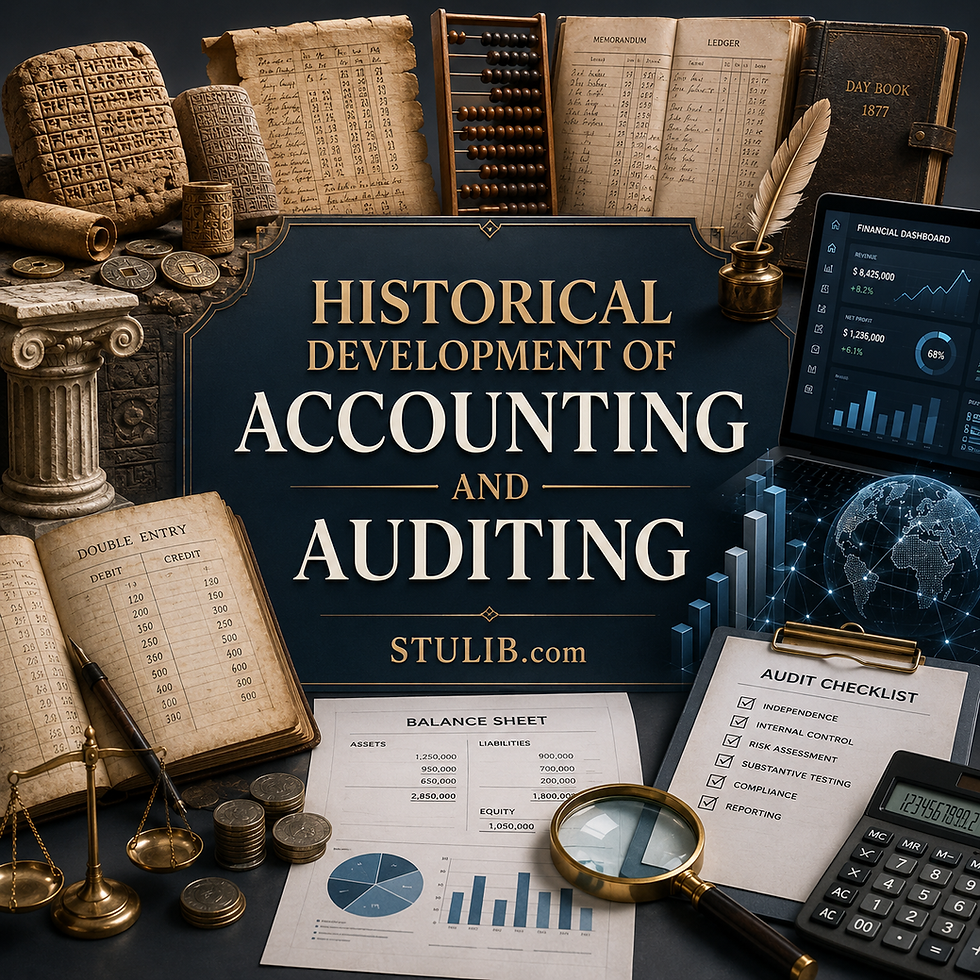
Accounting and auditing are among the oldest tools of organized economic life. Long before modern companies, banks, stock exchanges, and digital platforms existed, people needed ways to record goods, debts, taxes, wages, and promises. These early #financial_records were not only technical documents. They were also instruments of trust, authority, memory, and control. As societies became more complex, accounting developed from simple lists of property into structured systems of #financial_reporting. Auditing also changed. It moved from basic checking of accounts to a professional practice concerned with evidence, independence, governance, risk, and public confidence.
This article studies the #historical_development of accounting and auditing from ancient civilizations to the modern global economy. It explains how accounting became connected with trade, state administration, capitalism, corporate growth, and international regulation. It also examines auditing as a social and institutional response to the problem of trust. The article uses a qualitative historical and conceptual method. It applies selected ideas from Bourdieu, #world_systems_theory, and institutional isomorphism to show that accounting and auditing are not neutral techniques only. They are also shaped by power, professional status, global economic hierarchy, and institutional pressure.
The analysis finds that accounting developed through several major stages: ancient recordkeeping, medieval commercial calculation, double-entry bookkeeping, industrial and corporate accounting, professional auditing, and international standardization. Auditing developed because owners, governments, investors, creditors, and the public needed assurance that financial information was reliable. The article concludes that accounting and auditing are central to #business_governance because they organize economic memory, support accountability, and create confidence in institutions. Their future will depend on how well the profession responds to digital transformation, sustainability reporting, and new forms of economic risk.
Introduction
Accounting is often seen as a technical field based on numbers, documents, and reports. Auditing is often understood as the checking of those reports. These descriptions are correct, but they are incomplete. Accounting and auditing are also part of the social history of trade, government, law, and business organization. They developed because people needed reliable ways to answer simple but powerful questions: What do we own? What do we owe? Who is responsible? Can this report be trusted? Who has the right to control resources?
The history of #accounting is therefore not only the history of calculation. It is the history of accountability. When economic life became more complex, memory alone was not enough. A merchant could not remember every transaction in a long-distance trade network. A king could not personally inspect every tax payment. A monastery could not manage lands, rents, and donations without written records. A modern company cannot satisfy investors, regulators, and creditors without structured financial statements. In all these cases, accounting became a form of organized economic memory.
The history of #auditing is closely connected to the history of trust. When one person manages resources for another person, a problem appears. The owner, ruler, investor, creditor, or public authority may not directly observe what the manager is doing. This creates a need for verification. Auditing emerged to reduce this gap between control and information. Over time, audit work developed from simple checking of receipts and payments into an independent professional function. Modern auditing now includes assessment of evidence, internal controls, risk, material misstatement, fraud risk, compliance, governance, and public interest.
The subject is important for students because it shows that accounting and auditing did not appear suddenly as modern university subjects. They were built slowly through human needs. Every stage of economic development created new recording and assurance problems. Ancient agricultural societies needed grain records. Trading cities needed merchant books. Industrial capitalism needed cost accounts. Joint-stock companies needed financial statements. Global capital markets needed standards and independent audits. Today, digital business and sustainability concerns create new demands for #transparency and #accountability.
This article studies the historical development of accounting and auditing in a structured academic way. It uses simple English, but it follows the style of a scholarly article. The main objective is to explain how financial recording, reporting, accountability, and audit practices became essential to #business_governance. The article also connects the topic to social theory. Bourdieu helps explain accounting and auditing as professional fields with symbolic authority. #World_systems_theory helps explain why accounting standards and audit models often spread from economically powerful centers to other regions. Institutional isomorphism helps explain why organizations adopt similar accounting and audit practices to gain legitimacy.
The article is guided by three research questions. First, how did accounting develop from ancient recordkeeping into modern financial reporting? Second, how did auditing develop from basic verification into an independent professional and institutional practice? Third, how can social theory help explain the rise of accounting and auditing as systems of governance, legitimacy, and control?
Background and Theoretical Framework
The early development of #accounting_records can be understood through the basic problem of economic coordination. Whenever people exchange goods, collect taxes, store property, or manage resources for others, records become necessary. In ancient Mesopotamia, Egypt, Greece, Rome, China, and other civilizations, records were used to manage agricultural production, temple wealth, state taxes, labor obligations, and trade. These records were not modern financial statements, but they served similar purposes. They created evidence. They supported administration. They reduced uncertainty. They helped powerful institutions control resources.
The growth of trade increased the importance of accounting. In local trade, personal trust and memory could sometimes be enough. In long-distance trade, written records became more important. Merchants needed to track shipments, loans, partnerships, currency differences, and profit-sharing. This was especially visible in medieval trading centers, where commercial activity connected ports, markets, banks, and family firms. Accounting became a practical language of commerce. It allowed merchants to compare costs, monitor agents, and protect claims.
A major turning point came with the spread of #double_entry_bookkeeping. This method records each transaction in two connected aspects, normally debit and credit. Its strength is not only mathematical balance. Its deeper importance is that it creates a complete view of economic relationships. It links assets, liabilities, capital, income, and expenses. It makes business activity more visible and more controllable. Luca Pacioli’s 1494 description of double-entry bookkeeping is often treated as a landmark because it helped formalize and circulate a method already used by merchants in Italian commercial cities.
From a theoretical perspective, accounting can be seen as a form of social power. Pierre Bourdieu’s ideas about field, capital, and symbolic power are useful here. Accounting is part of a professional #field in which accountants, auditors, regulators, educators, firms, and standard-setters compete for authority. Accountants do not only prepare reports; they also hold specialized cultural capital. Their knowledge gives them professional status. Auditors hold symbolic capital because their opinion can influence trust in an organization. Financial statements are therefore not only documents; they are recognized forms of legitimate knowledge.
Bourdieu also helps explain why accounting language can appear neutral while still supporting power relations. Terms such as assets, liabilities, profit, impairment, fair value, materiality, and going concern are technical, but they also shape how people see organizations. Accounting categories decide what becomes visible and what remains less visible. For example, a company may record machinery as an asset but may not fully record social harm, environmental damage, or employee stress. This means accounting can define economic reality in ways that reflect institutional priorities.
#World_systems_theory, associated with Immanuel Wallerstein, gives another useful perspective. It sees the modern world economy as structured around core, semi-peripheral, and peripheral zones. Accounting and auditing developed strongly in commercial and industrial centers because these centers had powerful capital markets, colonial trade networks, banks, and corporations. Over time, accounting practices from dominant economic regions spread internationally. This does not mean that other societies had no recordkeeping traditions. Rather, it means that modern financial reporting became strongly shaped by the needs of global capitalism, international investment, and cross-border regulation.
This theory helps explain why modern accounting standards are often presented as universal, even though they are historically connected to particular economic systems. International standards help investors compare companies across countries, but they may also reflect the needs of global capital markets more than the needs of small local businesses, informal economies, or developing states. The spread of accounting and audit models is therefore both technical and political.
Institutional isomorphism, developed by DiMaggio and Powell, explains why organizations become similar over time. It identifies three main pressures: coercive, mimetic, and normative. Coercive pressure comes from law, regulation, governments, and powerful institutions. Mimetic pressure appears when organizations copy others during uncertainty. Normative pressure comes from education, professions, and shared standards. These ideas are highly relevant to #auditing and #financial_reporting. Companies adopt similar reporting systems because regulators require them. Universities teach similar accounting curricula because professional bodies influence them. Audit firms follow common standards because professional legitimacy depends on them.
Together, these theories show that accounting and auditing developed through both practical need and social pressure. They are tools of calculation, but they are also tools of legitimacy. They help organizations present themselves as rational, responsible, and trustworthy.
Method
This article uses a qualitative historical and conceptual method. It does not present new statistical data or field interviews. Instead, it examines the development of accounting and auditing through existing academic literature, historical interpretation, and theoretical analysis. The method is suitable because the purpose is not to measure one narrow variable, but to explain a long process of institutional development.
The analysis follows a chronological and thematic structure. Chronologically, it moves from ancient recordkeeping to medieval commerce, double-entry bookkeeping, industrial capitalism, corporate reporting, professional auditing, international standards, and contemporary challenges. Thematically, it focuses on four connected themes: #recordkeeping, #financial_reporting, #accountability, and #audit_assurance.
The conceptual framework combines three theoretical lenses. Bourdieu is used to interpret accounting and auditing as professional fields with symbolic authority. #World_systems_theory is used to connect accounting development to global economic structures and the spread of capitalist institutions. Institutional isomorphism is used to explain why accounting and auditing practices became standardized across organizations and countries.
This method has one main limitation. Because it is historical and conceptual, it does not test a hypothesis using numerical data. However, this is also its strength. It allows a broad interpretation of accounting and auditing as social, economic, and institutional practices. It helps students understand why the field matters beyond technical rules.
Analysis
1. Ancient Recordkeeping and the Birth of Economic Memory
The earliest forms of accounting appeared when societies needed to manage resources beyond personal memory. In ancient agricultural economies, temples, palaces, and state authorities controlled grain, animals, land, workers, and taxes. Written records helped them organize these resources. Clay tablets, papyrus, tally sticks, and other early recording tools show that #economic_memory was essential to administration.
In these early systems, accounting was closely linked to authority. The person who controlled the record often had power over the resource. A grain record was not only a note; it could decide whether a worker received food, whether a tax was paid, or whether a storehouse was short. This shows that accounting from the beginning was connected with #governance.
Ancient accounting was not designed for investors in the modern sense. It was designed for control. Rulers and administrators needed to know what entered and left their stores. Religious institutions needed to manage offerings and land income. Military authorities needed to supply armies. These needs created the first strong connection between accounting and organized power.
Auditing also has ancient roots. When one official collected goods and another official checked the record, an early audit function existed. The word audit itself is linked to hearing, because accounts were often read aloud before being checked. This reminds us that auditing began as a human process of listening, verifying, and questioning. It was not first a modern office procedure. It was a way to confirm responsibility.
2. Medieval Commerce and the Rise of Merchant Accounting
During the medieval period, accounting developed in trading cities, especially where commerce, banking, and long-distance exchange were active. Merchants needed better systems because business became more complex. A single trader might deal with goods moving across different cities, currencies, partners, agents, and credit arrangements. Simple lists were no longer enough.
Merchant accounting helped answer practical questions: How much capital was invested? What goods were sold? Which customers owed money? Which partners were entitled to profit? Which debts had to be paid? These questions show why accounting became a language of #commercial_trust.
Medieval accounting also supported partnerships. When several people invested in a venture, they needed a fair way to divide profit and loss. Written accounts reduced disputes. They also helped merchants monitor agents who operated in distant places. This created an early version of the agency problem: one person controlled resources on behalf of another. Auditing and account checking developed because trust required evidence.
Bourdieu’s concept of capital helps explain the social role of merchant accounting. Merchants who kept clear records had economic capital, but they also gained symbolic capital. They appeared more reliable, disciplined, and professional. Their books became signs of seriousness. In this way, accounting helped create a culture of commercial respectability.
3. Double-Entry Bookkeeping and the Logic of Balance
The development of #double_entry_bookkeeping was one of the most important events in accounting history. It created a structured method in which each transaction affected at least two accounts. This made it possible to check internal consistency. If the books did not balance, an error might exist. The system therefore combined recording with control.
Double-entry bookkeeping also changed how business owners understood their activity. It separated the business from the owner more clearly. It allowed owners to see capital, profit, assets, liabilities, and expenses in relation to one another. This encouraged a more analytical view of business.
The method matched the needs of expanding commerce. It was especially useful in cities where merchants, bankers, and traders needed to manage credit and investment. It supported the growth of capitalism because it made profit calculation more systematic. Werner Sombart and Max Weber both treated accounting as part of the rational organization of capitalist enterprise, although scholars continue to debate the exact strength of this connection.
From a #business_governance perspective, double-entry bookkeeping was important because it created a disciplined structure. It did not remove fraud or error, but it made accounts easier to inspect. This improved the possibility of audit. A checker could examine whether entries were supported by documents and whether the ledger remained balanced.
The rise of double-entry bookkeeping also shows institutional isomorphism in an early form. Successful merchants used it. Others copied it because it appeared more reliable and modern. Teachers, manuals, and commercial networks spread the method. Over time, it became a professional norm.
4. State Finance, Taxation, and Public Accountability
Accounting did not develop only in private business. It also developed in government. States needed accounts to manage taxes, public spending, debt, military costs, infrastructure, and administration. Public finance required records because rulers needed to know how resources were collected and used.
Government accounting increased the importance of #public_accountability. When taxes are collected from people, questions of responsibility become stronger. Who collected the money? Who spent it? Was it used legally? Did officials abuse their position? These questions created demand for public audit institutions.
Public auditing developed as a way to check officials and protect state resources. In many countries, audit offices or similar institutions were created to examine government accounts. Their role was not only financial but constitutional. They helped limit arbitrary power by requiring evidence and reporting.
This is where accounting becomes deeply political. Financial reports can show whether a government is disciplined or wasteful, transparent or secretive, accountable or corrupt. Auditing can support public trust, but only when auditors have enough independence, authority, and competence.
From the view of #institutional_isomorphism, states also copied each other’s administrative and audit models. As modern states developed, they adopted similar budget systems, public accounts, audit offices, and reporting requirements. International organizations later strengthened this process by promoting public financial management standards.
5. Industrial Capitalism and Cost Accounting
The Industrial Revolution changed accounting again. Factories created new problems. Owners needed to calculate production costs, labor costs, machine costs, inventory, depreciation, and efficiency. Traditional merchant bookkeeping was not enough for complex manufacturing. This led to the development of #cost_accounting and later management accounting.
Cost accounting helped managers understand how resources were used inside the organization. It answered questions such as: What does one unit cost to produce? Which department is inefficient? How should overhead be allocated? Should the company make a product or buy it? These questions show that accounting became a tool of internal management, not only external reporting.
Industrial accounting also changed labor relations. Workers became part of cost calculations. Time, productivity, wages, and output were measured more closely. This supported efficiency, but it also increased managerial control. Bourdieu’s theory helps explain this as a form of symbolic power. When accounting categories define labor mainly as a cost, they shape how managers think about people and production.
The factory also increased the need for auditing. Larger businesses had more transactions, more employees, more inventory, and more risk of error or fraud. Owners could not personally supervise everything. Independent checking became more important. Internal control systems began to matter because auditors could not check every transaction in large organizations.
6. Joint-Stock Companies and the Separation of Ownership and Control
The growth of joint-stock companies was a turning point in the history of #financial_reporting and auditing. In small owner-managed businesses, the owner often knew the business directly. In large companies, ownership became separated from management. Shareholders provided capital, but managers controlled daily operations. This created a serious information gap.
Financial statements became the main way for managers to report to owners and investors. The balance sheet, income statement, and later cash flow statement became central documents of corporate life. They allowed investors to judge performance, risk, and financial position.
Auditing became essential because investors needed assurance that management’s reports were reliable. Without audit, financial statements would depend only on management’s claims. Independent auditors helped reduce this trust problem. They did not guarantee perfection, but they provided a professional opinion based on evidence.
This development is central to modern #corporate_governance. Governance depends on information. Boards, shareholders, lenders, regulators, and the public need credible reporting. Auditing supports governance by strengthening confidence in that reporting.
Agency theory is often used to explain this. Managers are agents who act on behalf of owners. Because agents may have different interests from owners, monitoring is needed. Auditing is one monitoring mechanism. However, Bourdieu adds another layer. Auditors also operate in a professional field where reputation, independence, and symbolic authority matter. Their opinion has value because society recognizes their expertise.
7. Professionalization of Accounting and Auditing
During the nineteenth and twentieth centuries, accounting and auditing became organized professions. Professional bodies were formed. Exams, ethical rules, training systems, and professional titles became important. This created a recognized group of experts with specialized knowledge.
Professionalization gave accountants and auditors social status. It also created barriers to entry. Not everyone could claim to be a qualified accountant. This strengthened quality, but it also protected professional power. Bourdieu would describe this as the formation of a professional field with its own forms of capital. Technical knowledge became cultural capital. Membership in professional bodies became symbolic capital. Audit signatures became institutional authority.
The rise of the profession also reflected normative isomorphism. Universities, training providers, firms, and professional bodies created common knowledge systems. Students learned similar principles. Auditors followed similar procedures. Companies expected similar qualifications. This made accounting and auditing more standardized.
However, professionalization also created tensions. Auditors were expected to serve the public interest, but they were often paid by the companies they audited. This created a possible conflict of interest. The profession responded with ethical codes, independence rules, quality reviews, and regulatory oversight. These reforms show that auditing must constantly defend its legitimacy.
8. Accounting Standards and the Search for Comparability
As capital markets expanded, users needed financial reports that could be compared across companies and countries. If each company used very different accounting methods, investors and creditors would struggle to understand performance. This led to the rise of formal #accounting_standards.
Standards define how transactions should be recognized, measured, presented, and disclosed. They reduce diversity in reporting and improve comparability. They also limit management’s ability to choose methods only for self-interest. However, standards cannot remove judgment. Many accounting areas still require estimates, assumptions, and professional interpretation.
International standardization became more important with globalization. Cross-border investment required comparable information. Multinational companies needed reporting systems that could satisfy different regulators. International accounting standards and later international financial reporting frameworks became powerful instruments of global financial communication.
#World_systems_theory helps explain this process. Standards often spread through global capital markets, international organizations, major audit firms, and powerful economies. Countries may adopt international standards to attract investment, gain legitimacy, or integrate with global markets. This can support transparency, but it can also create pressure on countries whose local business structures differ from the assumptions of global standards.
Institutional isomorphism is also visible here. Coercive pressure appears when regulators require standards. Mimetic pressure appears when countries copy reporting systems used by respected markets. Normative pressure appears through professional education and international audit firms. As a result, accounting systems across the world become more similar.
9. Auditing Standards, Evidence, and Independence
Modern auditing is based on standards, evidence, professional judgment, and independence. Auditors plan the audit, understand the organization, assess risks, test controls, examine evidence, and form an opinion. The audit report communicates whether the financial statements are presented fairly according to the applicable framework.
The central idea of #audit_assurance is reasonable assurance, not absolute certainty. This is important. An audit reduces risk, but it cannot remove all risk. Auditors use sampling, judgment, and materiality. Some frauds may be hidden by collusion or false documents. Therefore, audit quality depends on professional skepticism, strong methods, ethical behavior, and effective oversight.
Independence is the moral center of auditing. If auditors are not independent, their opinion loses value. Independence has two sides: independence in fact and independence in appearance. Auditors must actually be objective, and they must also appear objective to reasonable users. This is why rules exist about financial interests, long relationships, non-audit services, and audit partner rotation.
The history of auditing includes many scandals that led to reform. When major companies collapsed after misleading reporting, public trust declined. Regulators responded with stronger rules, oversight bodies, internal control requirements, and stricter governance expectations. This shows that auditing develops not only through theory but also through crisis.
10. Accounting, Auditing, and Corporate Governance
#Corporate_governance refers to the system by which organizations are directed, controlled, and held accountable. Accounting and auditing are central to this system because governance needs reliable information. Without accounting, governance lacks organized facts. Without auditing, governance lacks independent assurance.
Boards use accounting information to monitor management. Investors use financial statements to make decisions. Creditors use reports to assess repayment risk. Regulators use accounts to enforce rules. Employees, suppliers, and communities may also be affected by financial reporting because company decisions influence jobs, contracts, and social stability.
Auditing strengthens governance by checking whether reported information is credible. It also encourages better internal controls. The presence of an audit can discipline management because managers know that records may be examined. Audit committees, internal auditors, external auditors, and regulators all form part of the wider governance system.
However, accounting and auditing do not automatically create good governance. They can be weak if standards are poor, auditors lack independence, management manipulates estimates, regulators are ineffective, or users do not understand reports. Good governance requires not only rules, but also ethical culture.
Bourdieu’s theory reminds us that governance is also about symbolic legitimacy. A company with audited financial statements appears more credible. A clean audit opinion can create confidence. But symbolic legitimacy can become dangerous if users treat it as a guarantee. Audit reports must be understood carefully.
11. Global Audit Firms and the International Professional Field
The modern audit profession is strongly global. Large audit networks serve multinational companies, advise on complex standards, and influence professional practice. These firms have strong economic capital, cultural capital, and symbolic capital. They employ experts, train professionals, and participate in global debates about reporting, assurance, risk, and governance.
From a #world_systems_theory perspective, global audit firms are part of the infrastructure of international capitalism. They help capital move across borders by making financial reports more credible to investors. They also spread common methods and professional norms. This supports global comparability, but it may also strengthen the dominance of accounting models developed in powerful financial centers.
Institutional isomorphism is clear in the work of global audit firms. Their methodologies create similar audit practices across countries. Their training systems produce professionals with similar technical language. Their clients often adopt reporting systems that match global expectations. In this way, audit practice becomes standardized beyond national borders.
At the same time, local context remains important. Legal systems, tax rules, enforcement strength, business culture, ownership structures, and corruption risks vary across countries. A strong audit system must understand these differences. Global methods must be adapted carefully to local realities.
12. Digital Transformation and New Forms of Accountability
Digital technology is changing accounting and auditing again. Cloud accounting, data analytics, blockchain, artificial intelligence tools, automated controls, and real-time reporting are changing how information is recorded and checked. Transactions can now be processed faster, stored in larger systems, and analyzed with more advanced tools.
This creates opportunities. Digital systems can reduce manual errors, improve access to information, and help auditors analyze larger data sets. Continuous auditing may become more possible. Internal controls can be embedded into systems. Reports can be prepared more quickly.
But digital transformation also creates risks. Cybersecurity, data privacy, algorithmic bias, system access, and digital fraud become major concerns. Auditors must understand information systems, not only traditional documents. Accounting professionals must develop new skills while preserving ethical judgment.
Digital tools also raise a deeper question: if accounting becomes more automated, what remains human in the profession? The answer is judgment, responsibility, interpretation, skepticism, and ethical decision-making. Technology can process data, but professional accountability remains a human and institutional duty.
13. Sustainability Reporting and the Expansion of Audit Logic
In recent years, accounting has expanded beyond traditional financial reporting. Organizations are increasingly asked to report environmental, social, and governance information. This includes climate risk, carbon emissions, labor practices, diversity, human rights, governance structures, and social impact. This development is often called #sustainability_reporting or non-financial reporting.
This expansion shows that society now expects companies to be accountable for more than profit. Investors, governments, communities, and civil society want information about long-term impact. Accounting is therefore moving into areas that were once outside financial statements.
Auditing is also expanding. Assurance over sustainability information is becoming more important because users want to know whether such reports are credible. This creates new challenges. Environmental and social information may be harder to measure than financial transactions. Standards are still developing. Evidence may be more complex. Professional judgment becomes even more important.
Bourdieu’s theory helps explain this shift. New forms of reporting create new symbolic capital. Companies can gain legitimacy by showing responsibility. But there is also a risk of symbolic reporting without real change. Assurance can help reduce this risk, but only if it is rigorous and independent.
Institutional isomorphism is also visible. Companies adopt sustainability reporting because regulators require it, competitors do it, investors expect it, and professional bodies promote it. As with financial reporting, legitimacy is a major driver.
Findings
The historical development of accounting and auditing shows several important findings.
First, accounting began as a practical response to the need for #recordkeeping. Ancient societies needed records to manage resources, taxes, labor, and property. Over time, these records became more structured and more closely connected to governance.
Second, accounting developed with trade and capitalism. Merchant activity required better ways to record credit, debt, profit, and partnership interests. #Double_entry_bookkeeping helped create a disciplined system for organizing business information. It supported calculation, control, and commercial trust.
Third, auditing developed because of the problem of trust. When one person controls resources for another, verification becomes necessary. Auditing grew from simple checking into an independent professional practice. Its purpose is to provide assurance, reduce information risk, and support accountability.
Fourth, the rise of corporations made accounting and auditing essential to #business_governance. The separation of ownership and control created a need for financial statements and independent audits. Investors, creditors, boards, and regulators rely on these systems to monitor organizations.
Fifth, accounting and auditing became professional fields. Professional bodies, education systems, standards, ethics, and qualifications gave accountants and auditors authority. Using Bourdieu, this can be understood as the creation of professional capital and symbolic power.
Sixth, global accounting and audit standards spread through economic and institutional pressure. #World_systems_theory shows that global standards are connected to international capitalism and financial centers. Institutional isomorphism shows why countries and organizations adopt similar practices to gain legitimacy and satisfy external expectations.
Seventh, accounting and auditing are still changing. Digital systems, sustainability reporting, and complex global risks are expanding the meaning of accountability. The profession must adapt without losing its core values: reliability, independence, evidence, transparency, and public responsibility.
Conclusion
The history of accounting and auditing is the history of how societies learned to organize economic trust. Accounting began with simple records, but it became a powerful system for describing financial reality. Auditing began with checking, but it became a professional practice that supports confidence in reports, organizations, and markets.
This development was not automatic. It followed the growth of states, trade, capitalism, industrial production, corporations, capital markets, professional bodies, and international regulation. At every stage, accounting and auditing answered real problems. People needed records because memory was limited. Owners needed reports because managers controlled resources. Investors needed audits because financial statements required trust. Governments needed public accounts because taxation required accountability.
The article has shown that accounting and auditing are not only technical practices. They are also social institutions. Bourdieu helps explain how the profession gains authority and symbolic power. #World_systems_theory shows how accounting and auditing are connected to global economic structures. Institutional isomorphism explains why organizations and countries adopt similar reporting and audit practices.
For students, the main lesson is clear. Accounting is not only about numbers, and auditing is not only about checking documents. Both are central to #governance, trust, and social responsibility. They shape how organizations are seen, how decisions are made, and how power is controlled. In the modern world, where business crosses borders and information moves quickly, the need for reliable accounting and independent auditing is stronger than ever.
The future of the field will depend on its ability to protect public confidence. Digital tools may change methods. Sustainability reporting may expand the scope of accountability. Global standards may continue to evolve. But the central purpose remains the same: to make economic activity visible, understandable, and accountable.
References
Bourdieu, P. (1977). Outline of a Theory of Practice. Cambridge University Press.
Bourdieu, P. (1984). Distinction: A Social Critique of the Judgement of Taste. Harvard University Press.
Brown, R. (1905). A History of Accounting and Accountants. T. C. & E. C. Jack.
Carruthers, B. G., & Espeland, W. N. (1991). Accounting for Rationality: Double-Entry Bookkeeping and the Rhetoric of Economic Rationality. American Journal of Sociology, 97(1), 31–69.
Chandler, A. D. (1977). The Visible Hand: The Managerial Revolution in American Business. Harvard University Press.
Chatfield, M. (1977). A History of Accounting Thought. Robert E. Krieger Publishing.
DiMaggio, P. J., & Powell, W. W. (1983). The Iron Cage Revisited: Institutional Isomorphism and Collective Rationality in Organizational Fields. American Sociological Review, 48(2), 147–160.
Flint, D. (1988). Philosophy and Principles of Auditing: An Introduction. Macmillan Education.
Hopwood, A. G., & Miller, P. (Eds.). (1994). Accounting as Social and Institutional Practice. Cambridge University Press.
Littleton, A. C. (1933). Accounting Evolution to 1900. American Institute Publishing.
Mautz, R. K., & Sharaf, H. A. (1961). The Philosophy of Auditing. American Accounting Association.
Pacioli, L. (1494). Summa de Arithmetica, Geometria, Proportioni et Proportionalita. Paganino de Paganini.
Power, M. (1997). The Audit Society: Rituals of Verification. Oxford University Press.
Sombart, W. (1916). Der moderne Kapitalismus. Duncker & Humblot.
Wallerstein, I. (1974). The Modern World-System. Academic Press.
Weber, M. (1978). Economy and Society. University of California Press.
Watts, R. L., & Zimmerman, J. L. (1986). Positive Accounting Theory. Prentice Hall.
#Accounting_History #Auditing_History #Financial_Reporting #Business_Governance #Corporate_Accountability #Double_Entry_Bookkeeping #Audit_Assurance #Institutional_Isomorphism #World_Systems_Theory #Professional_Ethics #Transparency #Public_Trust #Accounting_Standards #Corporate_Governance #Economic_History


Comments